

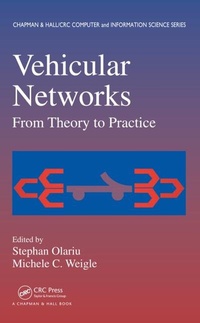
Vehicular Networks
From Theory to Practice
1st Edition
Will be published approx. on 17. March 2009
Book
Hardback
472 pages
978-1-4200-8588-4 (ISBN)
Description
In spite of their importance and potential societal impact, there is currently no comprehensive source of information about vehicular ad hoc networks (VANETs). Cohesively integrating the state of the art in this emerging field, Vehicular Networks: From Theory to Practice elucidates many issues involved in vehicular networking, including traffic engineering, human factors studies, and novel computer science research.
Divided into six broad sections, the book begins with an overview of traffic engineering issues, such as traffic monitoring and traffic flow modeling. It then introduces governmental and industrial efforts in the United States and Europe to set standards and perform field tests on the feasibility of vehicular networks. After highlighting innovative applications enabled by vehicular networks, the book discusses several networking-related issues, including routing and localization. The following section focuses on simulation, which is currently the primary method for evaluating vehicular networking systems. The final part explores the extent and impact of driver distraction with in-vehicle displays.
Encompassing both introductory and advanced concepts, this guide covers the various areas that impact the design of applications for vehicular networks. It details key research challenges, offers guidance on developing future standards, and supplies valuable information on existing experimental studies.
Divided into six broad sections, the book begins with an overview of traffic engineering issues, such as traffic monitoring and traffic flow modeling. It then introduces governmental and industrial efforts in the United States and Europe to set standards and perform field tests on the feasibility of vehicular networks. After highlighting innovative applications enabled by vehicular networks, the book discusses several networking-related issues, including routing and localization. The following section focuses on simulation, which is currently the primary method for evaluating vehicular networking systems. The final part explores the extent and impact of driver distraction with in-vehicle displays.
Encompassing both introductory and advanced concepts, this guide covers the various areas that impact the design of applications for vehicular networks. It details key research challenges, offers guidance on developing future standards, and supplies valuable information on existing experimental studies.
Reviews / Votes
...the easy style of writing ... makes it suitable not only for specialists but also generalists. ...some topics overlap, but instead of being a hindrance, this further expands the vision of the reader on crucial topics in VANETs. Overall, the book is a concise overview of the current state-of-the-art technologies and important research issues in VANETs. ...-Computing Reviews, August 2009
More details
Series
Language
English
Place of publication
Oxford
United Kingdom
Publishing group
Taylor & Francis Ltd
Target group
Professional and scholarly
Professional
Product notice
Paper over boards
Illustrations
23 s/w Tabellen, 143 s/w Abbildungen
23 Tables, black and white; 143 Illustrations, black and white
Dimensions
Height: 234 mm
Width: 156 mm
Weight
810 gr
ISBN-13
978-1-4200-8588-4 (9781420085884)
Copyright in bibliographic data and cover images is held by Nielsen Book Services Limited or by the publishers or by their respective licensors: all rights reserved.
Schweitzer Classification
Other editions
Additional editions
Book
06/2017
1st Edition
CRC Press
€104.40
Shipment within 10-20 days
E-Book
03/2009
1st Edition
Chapman & Hall/CRC
€94.99
Available for download
E-Book
03/2009
Chapman and Hall
€94.99
Available for download
Persons
Stephan Olariu, Michele C. Weigle
Content
Traffic Engineering. U.S. and European Initiatives. Applications. Networking Issues. Simulation. Human Factors. Index.