

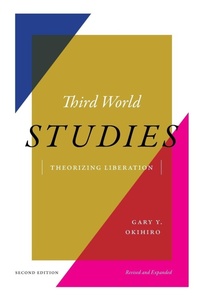
Third World Studies
Theorizing Liberation
2nd Edition
Published on 23. August 2024
Book
Paperback/Softback
328 pages
978-1-4780-3067-6 (ISBN)
Description
In this revised and expanded second edition of Third World Studies, Gary Y. Okihiro considers the methods and theories that might constitute the formation of Third World studies. Proposed in 1968 at San Francisco State College by the Third World Liberation Front but replaced by faculty and administrators with ethnic studies, Third World studies was over before it began. As opposed to ethnic studies, which Okihiro critiques for its liberalism and US-centrism, Third World studies begins with the colonized world and the anti-imperial, anticolonial, and antiracist projects located therein as described by W. E. B. Du Bois in 1900. Third World studies analyzes the locations and articulations of power around the axes of race, gender, sexuality, (dis)ability, class, and nation. In this new edition, Okihiro emphasizes the work of Third World intellectuals such as M. N. Roy, JosE Carlos MariAtegui, and Oliver Cromwell Cox; foregrounds the importance of Bandung and the Tricontinental; and adds discussions of eugenics, feminist epistemologies, and religion. With this work, Okihiro establishes Third World studies as a theoretical formation and a liberatory practice.
Reviews / Votes
Praise for the First Edition"A bracing account of the phantom Third World studies, the field that never was. Gary Y. Okihiro has had his feet planted firmly in the fields of ethnic studies and global studies, two fields that would have been part of Third World studies, making him well positioned to write this book." - Vijay Prashad, author of (The Poorer Nations: A Possible History of the Global South) Praise for the First Edition
"Okihiro makes an exciting and innovative contribution to the scholarship on Third World studies. . . . [This book] will make excellent reading for anyone interested in the interplay between politics and framing of subjectivities and would be particularly useful for undergraduate and graduate courses on postcolonial studies, critical pedagogy, and international politics." - Ananya Sharma, (Postcolonial Studies) "Gary Y. Okihiro's Third World Studies remains an extraordinarily important contribution. It is the single most effective critique of racial capitalism's entanglement with multicultural liberalism, remarkably showing readers how Third World studies offers a distinct challenge and radically different way of viewing human history and society. This book is indispensable." - Penny M. Von Eschen, author of (Paradoxes of Nostalgia: Cold War Triumphalism and Global Disorder since 1989) "This second edition summarizes Okihiro's 'intellectual labors.' It is also a tribute to a first-generation ethnic studies scholar (notwithstanding his misgiving about labeling the field thus) who helped found, define, and redefine the field to break out of parochial identity politics and focus on relationships of power, domination, and liberation. Recommended. Lower-division undergraduates through faculty; professionals." - E. Hu-DeHart (Choice)
More details
Edition
Second Edition, Revised
Language
English
Place of publication
North Carolina
United States
Target group
Professional and scholarly
Edition type
New edition
Product notice
Paperback (trade)
Illustrations
4 illustrations
Dimensions
Height: 229 mm
Width: 152 mm
Thickness: 19 mm
Weight
534 gr
ISBN-13
978-1-4780-3067-6 (9781478030676)
Copyright in bibliographic data and cover images is held by Nielsen Book Services Limited or by the publishers or by their respective licensors: all rights reserved.
Schweitzer Classification
Person
Gary Y. Okihiro (1945-2024) was Visiting Professor of American Studies and Ethnicity, Race, and Migration at Yale University and the author of many books, including The Boundless Sea: Self and History and American History Unbound: Asians and Pacific Islanders.
Content
Acknowledgments ix
Introduction 1
1. Subjects 19
2. Nationalism 45
3. Imperialism 69
4. World-System 91
5. Education 113
6. Subjectification 131
7. Racial Formation 149
8. Social Formation 171
9. A luta continua 203
Notes 241
Bibliography 271
Index 299
Introduction 1
1. Subjects 19
2. Nationalism 45
3. Imperialism 69
4. World-System 91
5. Education 113
6. Subjectification 131
7. Racial Formation 149
8. Social Formation 171
9. A luta continua 203
Notes 241
Bibliography 271
Index 299