

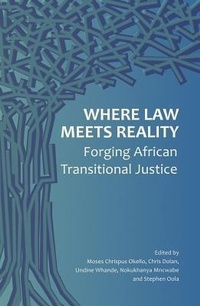
Where Law Meets Reality
Forging African Transitional Justice
Published on 11. July 2012
Book
Paperback/Softback
250 pages
978-0-85749-093-3 (ISBN)
Description
This book is unique in exploring from an African perspective the dilemmas and complexities involved in addressing past human rights violations to enable a society move to a more peaceful future. While challenging current transitional justice narratives, which have inadequately addressed the concerns of post-conflict societies in Africa, it also emphasises the need to avoid representing African issues as 'exotic' and 'exceptional'. The authors consider the core debates about how to develop a transitional justice agenda and assess the potential of localised justice models to contribute to justice systems. They show the importance of pursuing locally forged processes that take account of the dynamic and complex challenges of post-conflict societies in Africa and of involving stakeholders in developing policies and practices that affect them. This important new publication also addresses frankly the tension between justice, peace and reconciliation and deepens comprehension of the ever-changing boundaries of transitional justice.
More details
Edition
New
Language
English
Place of publication
Oxford
United Kingdom
Target group
Adult education
Product notice
Paperback (trade)
Illustrations
black & white illustrations
Dimensions
Height: 198 mm
Width: 129 mm
Thickness: 13 mm
Weight
249 gr
ISBN-13
978-0-85749-093-3 (9780857490933)
Copyright in bibliographic data and cover images is held by Nielsen Book Services Limited or by the publishers or by their respective licensors: all rights reserved.
Schweitzer Classification
Persons
Moses Chrispus Okello is a Ugandan national, a senior research advisor at the Refugee Law Project, and a member of the editorial board of the International Journal of Transitional Justice. Chris Dolan is the director of the Refugee Law Project, a community outreach project of the law faculty at Makerere University, and the author of Social Torture: The Case of Northern Uganda 1986 2006. Undine Whande is a social anthropologist who has worked as a practitioner in conflict transformation and social change for the past 14 years as well as a specialist in organizational learning at the Center for the Study of Violence and Reconciliation. Nokukhanya Mncwabe is the African Transitional Justice Research Network's regional coordinator for southern Africa and a lecturer at the University of Stellenbosch in South Africa. Her publications include an article in the International Journal of Transitional Justice entitled African Transitional Justice Research Network: Critical Reflections on a Peer Learning Process. Stephen Oola is a Ugandan national, an Advocate of the High Court of Uganda, and the head of research and advocacy at the Refugee Law Project. He also coordinates the Advisory Consortium on Conflict Sensitivity."
Content
TABLE OF CONTENTS Acronyms Acknowledgements About the Institute for African Transitional Justice Foreword Introduction Levis Onegi Transitional justice and the politics of agenda setting: The paradox of alien knowledge Brian Kagoro Adjudication traditional justice in transitional justice: Customary law Stephen Law Traditional justice as a form of adjudication in Uganda Lyandro Komakech Culture, customs, traditions and transitional justice in Africa David Kaulemu Comprehensive and transformative reparations for women in Africa Nahla Valjii The politics of truth commissions in Africa: The case of Kenya Davis Malombe Transitional Justice and human rights in Africa Christine Alai The nexus between forced migration and transitional justice Lucy Hovil Peace, recovery and development plan for Northern Uganda Robert Senath Esuruku Deconstruction and demonisation: The role of language in transitional justice Pius Ojara Reflections from practice on learning, monitoring and evaluation in transitional justice Undine Whande Towards African models of transitional justice Tim Murithi About the authors and editors Index