

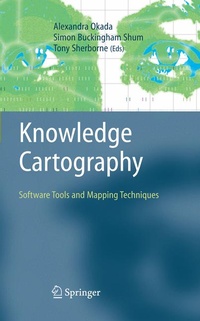
Knowledge Cartography
Software Tools and Mapping Techniques
Published on 4. November 2008
Book
Mixed media product
XXIII, 400 pages
978-1-84800-148-0 (ISBN)
Description
Knowledge Cartography is the discipline of mapping intellectual landscapes.
The focus of this book is on the process by which manually crafting interactive, hypertextual maps clarifies one's own understanding, as well as communicating it.
The authors see mapping software as a set of visual tools for reading and writing in a networked age. In an information ocean, the primary challenge is to find meaningful patterns around which we can weave plausible narratives. Maps of concepts, discussions and arguments make the connections between ideas tangible and disputable.
With 17 chapters from the leading researchers and practitioners, the reader will find the current state-of-the-art in the field. Part 1 focuses on educational applications in schools and universities, before Part 2 turns to applications in professional communities, but with many cross-cutting themes:
conceptual frameworks for understanding knowledge cartography
visual languages, many of which work on both paper and with software
specialist software, much of it freely available and open source
case studies reflecting on successes and failures
ways in which maps can be used both effectively and ineffectively
examples of how to evaluate maps
visit the website for updates on the field, and extra resources for each chapter: www.kmi.open.ac.uk/books/knowledge-cartography
Knowledge Cartography will be of interest to learners, educators, and researchers in all disciplines, as well as policy analysts, scenario planners, knowledge managers and team facilitators. Practitioners will find new perspectives and tools to expand their repertoire, while researchers will find rich enough conceptual grounding for further scholarship.
Reviews / Votes
From the reviews:
"This book attempts to describe the state of the art in the field . . Given the academic and research-oriented focus and style of this book, it will be of most interest to researchers in knowledge cartography and students who desire a research-focused survey of the field. Professional practitioners of knowledge mapping . who wish to use knowledge maps for pedagogical purposes, should also find this book helpful for increasing their repertoires of techniques and deepening their skills." (ACM Computing Reviews, May, 2009)
More details
Series
Edition
2008
Language
English
Place of publication
London
United Kingdom
Target group
College/higher education
Research
Illustrations
133 s/w Abbildungen, 118 farbige Abbildungen, 20 s/w Tabellen, 5 farbige Tabellen
133 black & white illustrations, 118 colour illustrations, 20 black & white tables, 5 colour tables
Dimensions
Height: 23.5 cm
Width: 15.5 cm
ISBN-13
978-1-84800-148-0 (9781848001480)
DOI
10.1007/978-1-84800-149-7
Schweitzer Classification
Other editions
New editions

Alexandra Okada | Simon J. Buckingham Shum | Tony Sherborne
Knowledge Cartography
Software Tools and Mapping Techniques
Book
10/2014
2nd Edition
Springer
€106.99
Shipment within 15-20 days
Additional editions
Alexandra Okada | Simon J. Buckingham Shum | Tony Sherborne
Knowledge Cartography
Software Tools and Mapping Techniques
Book
10/2010
Springer
€149.79
Article exhausted; check different version
Content
Empirical Studies of the Value of Conceptually Explicit Notations in Collaborative Learning.- Concept Mapping Using Cmap Tools to Enhance Meaningful Learning.- Enhancing Collaborative and Meaningful Language Learning through Concept Mapping.- Thinking Maps®: A Visual Language for Learning.- The Constructivist Mapping of Internet Information At Work with Nestor.- Cognitive and Pedagogical Benefits of Argument Mapping: L.A.M.P. Guides the Way to Better Thinking.- Scaffolding School Pupils' Scientific Argumentation with Evidence-Based Dialogue Maps.- Argument Diagramming: The Araucaria Project.- Mapping the curriculum: how concept maps can improve the effectiveness of course development.- Using Compendium as a tool to support the design of learning activities.- Performing Knowledge Art: Understanding Collaborative Cartography.- Knowledge Cartography for Controversies: The Iraq Debate.- Computer Supported Argument Visualisation: Modelling in Consultative Democracy around Wicked Problems.- Human-Agent Knowledge Cartography for e-Science: NASA Field Trials at the Mars Desert Research Station.- Template-based Structured Argumentation.- An Experience of the Use of the Cognitive Mapping Method in Qualitative Research.- Collaborative Knowledge Modelling with a Graphical Knowledge Representation Tool: A Strategy to Support the Transfer of Expertise in Organisations.