

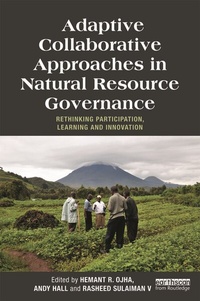
Adaptive Collaborative Approaches in Natural Resource Governance
Rethinking Participation, Learning and Innovation
1st Edition
Published on 10. July 2012
Book
Paperback/Softback
334 pages
978-0-415-69910-5 (ISBN)
Description
The purpose of this book is to showcase a range of approaches that consider learning and collaboration as central processes in agriculture and natural resources governance and management. These include four related and overlapping adaptive collaborative approaches - Adaptive Collaborative Management, Participatory Action Research, Social Learning and Innovation Systems. Despite these being generated in different institutional domains with somewhat diverse epistemological and policy orientations, the authors show that there are common themes among these approaches.
The book presents a review of various adaptive and collaborative approaches to management developed to cope with the social and biophysical complexity of natural resource systems, including case studies from Bangladesh, Ecuador, Nepal and Zimbabwe. The contexts range from farmer field schools, to floodplain management and community forestry. The authors provide rich accounts of how adaptive collaborative approaches were applied to synergise different types of learning, foster collaboration among stakeholders, and nurture innovative development processes. Through its introduction and conclusion chapters, the book establishes a clear theoretical approach and identifies a set of practical methodologies for combining different systems of knowledge in a way that generates and maximizes innovation and the translation of research into practice.
The book presents a review of various adaptive and collaborative approaches to management developed to cope with the social and biophysical complexity of natural resource systems, including case studies from Bangladesh, Ecuador, Nepal and Zimbabwe. The contexts range from farmer field schools, to floodplain management and community forestry. The authors provide rich accounts of how adaptive collaborative approaches were applied to synergise different types of learning, foster collaboration among stakeholders, and nurture innovative development processes. Through its introduction and conclusion chapters, the book establishes a clear theoretical approach and identifies a set of practical methodologies for combining different systems of knowledge in a way that generates and maximizes innovation and the translation of research into practice.
Reviews / Votes
"This impressive collection of articles is about how to enter the intimate improvisational space of everyday practice in ways that can reflexively bring together research with action. Reaffirming the activist potential of grounded field research, it is recommended reading for anyone wishing to be informed and transformative at the same moment." - Dr. Jesse Ribot, Associate Professor of Geography and Affiliate, Beckman Insitute, University of Illinois"...there is much material of real interest here ... Carol Colfer's contribution is a reassuringly frank and personal reflection on the issues underlying conflicts and collaborations between social and natural scientists within an international research institute." - Helen Schneider, Oryx
"This book should serve to provide valuable insights to ACA practitioners...The great strength of these studies is in their sincerity. The authors appear to aim for critical appraisal and improvement rather than with self-promotion or with overtly selling ACA approaches. They demonstrate a commitment to ACA principles of learning from practice and of honest self-reflection." Danielle Spruyt, Lecturer, Institute of Environmental Studies, University of New South Wales, Australia in the African Review of Economics and Finance
More details
Series
Language
English
Place of publication
London
United Kingdom
Publishing group
Taylor & Francis Ltd
Target group
College/higher education
Professional and scholarly
Illustrations
35 s/w Abbildungen, 15 s/w Zeichnungen, 20 s/w Tabellen
20 Tables, black and white; 15 Line drawings, black and white; 35 Illustrations, black and white
Dimensions
Height: 234 mm
Width: 156 mm
Weight
544 gr
ISBN-13
978-0-415-69910-5 (9780415699105)
Copyright in bibliographic data and cover images is held by Nielsen Book Services Limited or by the publishers or by their respective licensors: all rights reserved.
Schweitzer Classification
Other editions
Additional editions
Hemant Ojha | Andy Hall | Rasheed Sulaiman V
Adaptive Collaborative Approaches in Natural Resource Governance
Rethinking Participation, Learning and Innovation
E-Book
12/2012
1st Edition
Routledge
€77.99
Available for download
Hemant Ojha | Andy Hall | Rasheed Sulaiman V
Adaptive Collaborative Approaches in Natural Resource Governance
Rethinking Participation, Learning and Innovation
E-Book
12/2012
1st Edition
Routledge
€77.99
Available for download
Hemant Ojha | Andy Hall | Rasheed Sulaiman V
Adaptive Collaborative Approaches in Natural Resource Governance
Rethinking Participation, Learning and Innovation
Book
07/2012
1st Edition
Routledge
€230.65
Shipment within 15-20 days
Persons
Hemant R. Ojha is a founder of Southasia Institute of Advanced Studies (SIAS) and ForestAction Nepal. He is also a fellow at University of Melbourne and Australian National University.
Andy Hall is Director of LINK Limited and Senior Researcher at UNU-MERIT and Visiting Professor at Open University, UK.
Rasheed Sulaiman V is Director of the Centre for Research on Innovation and Science Policy, Hyderabad, India.
Andy Hall is Director of LINK Limited and Senior Researcher at UNU-MERIT and Visiting Professor at Open University, UK.
Rasheed Sulaiman V is Director of the Centre for Research on Innovation and Science Policy, Hyderabad, India.
Content
1. Adaptive Collaborative Approaches in Natural Resource Governance: An Introduction 2. Adaptive Collaborative Approaches: Traditions, Foundations and Frontiers 3. The Ups and Downs of Institutional Learning: Reflections on the Emergence and Conduct of Adaptive Collaborative Management at the Centre for International Forestry Research 4. Learning in the Social Wild: Farmers Field School and Politics of Agricultural Science and Development in Ecuador 5. Learning through Networking: Enabling Adaptive Learning Network of Local Communities for Integrated Floodplain Management in Bangladesh 6. Learning in Contested Landscapes: Applying Adaptive Collaborative Management in Forested Landscapes of Zimbabwe 7. Learning to Improve Livelihoods: Applying Adaptive Collaborative Approach to Forest Governance in Nepal 8. Learning through Action: Reflections on Action Research in Natural Resource Management 9. Confronting Challenges in Applying Adaptive Collaborative Approaches: Lessons from Practice 10. Moving Forward with Adaptive Collaborative Approaches. Index