

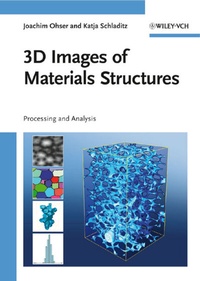
3D Images of Materials Structures
Processing and Analysis
1st Edition
Published on 9. September 2009
Book
Hardback
XVI, 325 pages
978-3-527-31203-0 (ISBN)
Description
Taking and analyzing images of materials' microstructures is essential for quality control, choice and design of all kind of products. Today, the standard method still is to analyze 2D microscopy images. But, insight into the 3D geometry of the microstructure of materials and measuring its characteristics become more and more prerequisites in order to choose and design advanced materials according to desired product properties.
This first book on processing and analysis of 3D images of materials structures describes how to develop and apply efficient and versatile tools for geometric analysis and contains a detailed description of the basics of 3d image analysis.
This first book on processing and analysis of 3D images of materials structures describes how to develop and apply efficient and versatile tools for geometric analysis and contains a detailed description of the basics of 3d image analysis.
More details
Edition
1. Auflage
Language
English
Place of publication
Berlin
Germany
Target group
Professional and scholarly
Illustrations
116
62 s/w Abbildungen, 26 s/w Tabellen, 28 farbige Abbildungen
Dimensions
Height: 24 cm
Width: 17 cm
Thickness: 2.1 cm
Weight
766 gr
ISBN-13
978-3-527-31203-0 (9783527312030)
Schweitzer Classification
Other editions
Additional editions

E-Book
09/2009
1st Edition
Wiley-VCH
€156.99
Available for download
Persons
Dr. Katja Schladitz is with Fraunhofer-Institut für Techno- und Wirtschaftsmathematik in Kaiserslautern, Germany, where she coordinates the group working on analysis of 3D images and modelling of microstructures within the image processing department. She has been involved in a number of industrial and academic projects. Her research focuses on application of methods from stochastic geometry to image analysis and modelling materials microstructures.
Professor Joachim Ohser holds a Chair at University of Applied Sciences, Darmstadt, Germany, where he is teaching in the field of image processing. He has long experience with characterization and geometric modelling of microstructures. Since 1999 he heads the working group on quantitative microstructural analysis of the German Materials Society (DGM). His research focuses on stochastic and discrete geometry, image analysis and simulation of materials properties.
Professor Joachim Ohser holds a Chair at University of Applied Sciences, Darmstadt, Germany, where he is teaching in the field of image processing. He has long experience with characterization and geometric modelling of microstructures. Since 1999 he heads the working group on quantitative microstructural analysis of the German Materials Society (DGM). His research focuses on stochastic and discrete geometry, image analysis and simulation of materials properties.
Content
PERFACE
INTRODUCTION
PRELIMINARIES
General Notation
Characteristics of Sets
Random Sets
Fourier Analysis
LATTICES, ADJACENCY OF LATTICE POINTS, AND IMAGES
Introduction
Point Lattices, Digitizations and Pixel Configurations
Adjacency and Euler Number
The Euler Number of Microstructure Constituents
Image Data
Rendering
IMAGE PROCESSING
Fourier Transform of an Image
Filtering
Segmentation
MEASUREMENT OF INTRINSIC VOLUMES AND RELATED QUANTITIES
Introduction
Intrinsic Volumes
Intrinsic Volume Densities
Directional Analysis
Distances Between Random Sets and Distance Distributions
SPECTRAL ANALYSIS
Introduction
Second-Order Characteristics of a Random Volume Measure
Correlations Between Random Structures
Second-Order Characteristics of Random Surfaces
Second-Order Characteristics of Random Point Fields
MODEL-BASED IMAGE ALANYSIS
Introduction,Motivation
Point Field Models
MacroscopicallyHomogeneous Systems of Non-overlapping Particles
Macroscopically Homogeneous Systems of Overlapping Particles
Macroscopically Homogeneous Fibre Systems
Tessellations
SIMULATION OF MATERIAL PROPERTIES
Introduction
Effective Conductivity of Polycrystals by StochasticHomogenization
Computation of Effective Elastic Moduli of Porous Media by FEM Simulation
REFERENCES
INDEX
INTRODUCTION
PRELIMINARIES
General Notation
Characteristics of Sets
Random Sets
Fourier Analysis
LATTICES, ADJACENCY OF LATTICE POINTS, AND IMAGES
Introduction
Point Lattices, Digitizations and Pixel Configurations
Adjacency and Euler Number
The Euler Number of Microstructure Constituents
Image Data
Rendering
IMAGE PROCESSING
Fourier Transform of an Image
Filtering
Segmentation
MEASUREMENT OF INTRINSIC VOLUMES AND RELATED QUANTITIES
Introduction
Intrinsic Volumes
Intrinsic Volume Densities
Directional Analysis
Distances Between Random Sets and Distance Distributions
SPECTRAL ANALYSIS
Introduction
Second-Order Characteristics of a Random Volume Measure
Correlations Between Random Structures
Second-Order Characteristics of Random Surfaces
Second-Order Characteristics of Random Point Fields
MODEL-BASED IMAGE ALANYSIS
Introduction,Motivation
Point Field Models
MacroscopicallyHomogeneous Systems of Non-overlapping Particles
Macroscopically Homogeneous Systems of Overlapping Particles
Macroscopically Homogeneous Fibre Systems
Tessellations
SIMULATION OF MATERIAL PROPERTIES
Introduction
Effective Conductivity of Polycrystals by StochasticHomogenization
Computation of Effective Elastic Moduli of Porous Media by FEM Simulation
REFERENCES
INDEX