

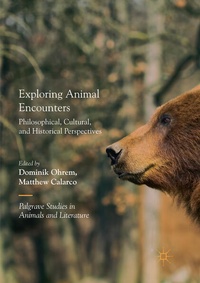
Exploring Animal Encounters
Description
This collection of essays offers multifaceted explorations of animal encounters in a range of philosophical, cultural, literary, and historical contexts. Exploring Animal Encounters encourages us to think about the richness and complexity of animal lives and human-animal relations, foregrounding the intricate roles nonhuman creatures play in the always already more-than-human sphere of ethics and politics. In this way, the essays in this volume can be understood as a contribution to alternative imaginings of interspecies coexistence in a time in which the issue of human relations with earth and earth others has come to the fore with unprecedented force and severity.
Reviews / Votes
"I was fascinated and excited by all the new ideas that populate this book as well as the mule deer, grizzly bears, monkeys, crabs, birds, wolves, baboons, orcas, and wild boars. Through engaging essays, we are offered diverse ways of being with, thinking about, living with, and discussing encounters with animals. One feels one's mind shift with the readings, and experiences a troubling of identity that is most welcome. I also found its influence reverberating, in a profound way, as it changed how a turtle and I encountered each other the other day." (Carol J. Adams, author of The Sexual Politics of Meat (1990) and Protest Kitchen, 2018)More details
Other editions
Additional editions
Persons
Dominik Ohrem is Lecturer and Doctoral Candidate at the University of Cologne, Germany. He is editor of American Beasts: Perspectives on Animals, Animality and U.S. Culture, 1776-1920 (2017) and co-editor of Beyond the Human-Animal Divide: Creaturely Lives in Literature and Culture (Palgrave Macmillan, 2017).
Matthew Calarco is Professor of Philosophy at CSU Fullerton where he teaches courses in Continental philosophy and animal and environmental philosophy. He has published numerous articles and books in critical animal studies, the latest of which is Thinking through Animals: Identity, Difference, Indistinction (2015).