

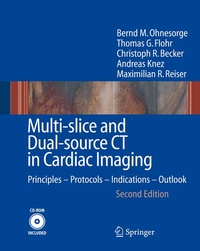
Multi-slice and Dual-source CT in Cardiac Imaging
Principles - Protocols - Indications - Outlook
2nd Edition
Published on 19. October 2006
Book
Mixed media product
XVIII, 370 pages
978-3-540-25523-9 (ISBN)
Description
Preface to the Second Edition Despite worldwide efforts to assess and control cardiovascular risk factors, cardiac diseases and in particular coronary artery disease (CAD) are still the foremost causes of death in the developed countries of Western Europe, North America and Asia and are becoming increasingly common in Eastern Europe and the developing world (Deanfield 2001). Approximately one in five deaths is currently related to cardiac disease in Europe and the US. Nearly 500,000 deaths caused by CAD are reported every year in the US, over 600,000 in Europe, 170,000 of these in Germany alone. Over 12 million US citizens have a history of CAD, while every year 1. 1 million US and 300,000 German citizens suffer a coronary attack and more than 40% will die as a result of these attacks. Every second patient dies without prior symptoms and, in most cases, myocardial infarction occurs without warning. Once a blockage of the coronary arteries has occurred, death may ensue within a few minutes, even before hospitalization is possible. These alarming statistics highlight an acute need for tools to diagnose cardiac and coronary artery disease. Presently, the gold-standard mod- ity for diagnosis of CAD is invasive selective coronary angiography. More than 2.
More details
Edition
2nd ed. 2007
Language
English
Place of publication
Berlin
Germany
Publishing group
Springer Berlin
Target group
Professional and scholarly
Professional/practitioner
Edition type
Revised edition
Illustrations
XVIII, 370 p. 663 illus., 353 illus. in color. With CD-ROM., 310 s/w Abbildungen, 353 farbige Abbildungen, 26 farbige Tabellen
310 black & white illustrations, 353 colour illustrations, 26 colour tables
Dimensions
Height: 24.2 cm
Width: 19.3 cm
ISBN-13
978-3-540-25523-9 (9783540255239)
DOI
10.1007/978-3-540-49546-8
Schweitzer Classification
Other editions
Additional editions
Bernd M. Ohnesorge | Thomas G. Flohr | Christoph R. Becker
Multi-slice and Dual-source CT in Cardiac Imaging
Principles - Protocols - Indications - Outlook
E-Book
12/2006
2nd Edition
Springer
€160.49
Available for download
Previous edition
Bernd M. Ohnesorge | Thomas G. Flohr | Christoph R. Becker
Multi-slice CT in Cardiac Imaging
Technical Principles, Imaging Protocols, Clinical Indications and Future Perspective
Book
04/2002
Springer
€85.59
Article exhausted; check for reprint
Content
Introduction: Basic principles of CT. Established imaging modalities for cardiac imaging. Clinical goals for CT in the diagnosis of cardiac and thoracic diseases. History and evolution of CT in cardiac imaging.- Cardiac and cardio-thoracic anatomy in CT: Topography. Standard views. Coronary arteries and veins. Pericardium. Cardiac chambers. Cardiac valves. Great vessels.- Multi-slice CT technology basics: Evolution of spiral CT from 1 to 64 slices. Principles of multi-slice CT system design. Multi-slice CT acquisition and reconstruction for whole-body imaging.- Technical principles of multi-slice cardiac imaging: Basic performance requirements for CT imaging of the heart. CT imaging with optimized temporal resolution: The principle of half-scan reconstruction. Prospectively ECG-triggered multi-slice CT. Retrospectively ECG-gated multi-slice CT. Synchronization to the ECG and cardiac motion. Radiation exposure considerations.- Clinical examination protocols with 4- to 64-slice CT: Quantification of coronary artery calcification. CT angiography of the cardiac anatomy and the coronary arteries. Cardiac function imaging. Cardio-thoracic examination protocols.- Image visualization and postprocessing techniques: Trans-axial image slices. Multi-planar reformation (MPR). Maximum intensity projection (MIP). Volume rendering technique (VRT). Vessel segmentation and vessel analysis. 4D visualization and functional parameter assessment. Dynamic evaluation of myocardial perfusion. Quantification of coronary calcification.- Clinical Indications: Current and future clinical potentials. Risk assessment with coronary artery calcium screening. Detection and exclusion of coronary artery stenosis. Assessment and interpretation of atherosclerotic coronary plaque. Usefulness in patients with chest pain. Evaluation of coronary artery bypass grafts. Patency control of coronary stents. Evaluation of non-atherosclerotic coronary disease. Diagnosis of congenital heart disease in adults andchildren. Evaluation of ventricular function parameters. Imaging and diagnosis of cardiac valves. Visualization of cardiac tumors and masses. Imaging of the pulmonary veins. Potential of myocardial perfusion and viability studies. Cardio-thoracic multi-slice CT in the emergency department.- Future technical developments in cardiac CT: Limitations and pitfalls with today's multi-slice CT. A future for electron beam CT? Future possibilities with area detector CT. New frontiers with dual-source CT.-