

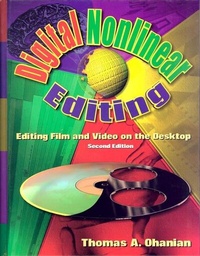
Digital Nonlinear Editing
Editing Film and Video on the Desktop
2nd Edition
Published on 22. April 1998
Book
Hardback
313 pages
978-0-240-80225-1 (ISBN)
Description
Nonlinear editing is the key topic in digital film and video today, and Digital Nonlinear Editing is the professional "bible" of the new era in post-production. The book details the procedural, creative, and technical fundamentals of editing moving images within a computer-based, interactive environment. Readers will understand not only what nonlinear editing is and how it works, but also how such systems can be used to achieve greater creative flexibility as well as cost and time savings.
The completely revised second edition chronicles a decade of digital nonlinear editing from home consumer editing applications to professional film and video editing systems. It provides in-depth explanations of digital video compression, storage, and networking; advances in digital video, computer processing power, the blurring of offline and online, digital storage advances, and desktop painting and compositing applications.
By far the most comprehensive book on the subject, Digital Nonlinear Editing details the growing role of compressed and digitized video in all types of communication. From the basics of traditional editing to the cutting edge of digital media, this is the book for every current and prospective communications professional.
Thomas A. Ohanian is a Chief Editor, Director of Product Design for Avid Technology in Massachusetts and a designer of the Avid Media Composer. During is tenure as a film and video editor he has worked on award-winning commercials, documentaries, industrials, television shows, and features. He is also the author with Michael Phillips of Digital Filmmaking (Focal Press).
The completely revised second edition chronicles a decade of digital nonlinear editing from home consumer editing applications to professional film and video editing systems. It provides in-depth explanations of digital video compression, storage, and networking; advances in digital video, computer processing power, the blurring of offline and online, digital storage advances, and desktop painting and compositing applications.
By far the most comprehensive book on the subject, Digital Nonlinear Editing details the growing role of compressed and digitized video in all types of communication. From the basics of traditional editing to the cutting edge of digital media, this is the book for every current and prospective communications professional.
Thomas A. Ohanian is a Chief Editor, Director of Product Design for Avid Technology in Massachusetts and a designer of the Avid Media Composer. During is tenure as a film and video editor he has worked on award-winning commercials, documentaries, industrials, television shows, and features. He is also the author with Michael Phillips of Digital Filmmaking (Focal Press).
Reviews / Votes
Review of First Edition:"One of the better texts available for understanding the basic advantages of nonlinear editing technology".
Videography, January 1996
More details
Edition
2nd New edition
Language
English
Place of publication
Oxford
United Kingdom
Publishing group
Taylor & Francis Ltd
Target group
Professional and scholarly
Edition type
New edition
Dimensions
Height: 276 mm
Width: 203 mm
ISBN-13
978-0-240-80225-1 (9780240802251)
Copyright in bibliographic data and cover images is held by Nielsen Book Services Limited or by the publishers or by their respective licensors: all rights reserved.
Schweitzer Classification
Person
Content
Preface * Acknowledgements * Word Processing, Linear Editing, and Digital Nonlinear Editing * Film and Videotape Editing, the Offline and Online Process, Digital Video Processing and Defining the Digital Nonlinear Editor * The First and Second Waves of Nonlinear Editing: Tape and Laserdisc-based * The Third Wave: Digital Nonlinear Editing * Editing on a Digital Nonlinear Editing System * The Fourth Wave: Digital Nonlinear Online * The Desktop Applications Explosion * The Fifth Wave: Intraframe Editing * Video and Computer Fundamentals * The Digitization and Compression Process * Digital Storage Devices * Networks, Shared Workgroups, and Transmitting Video Data * The Sixth Wave: Digital Media Management: Open vs. Closed Systems, File Compatibility, and the World Wide Web * Editing Film on the Desktop * Digital Nonlinear Editing Systems * Index