

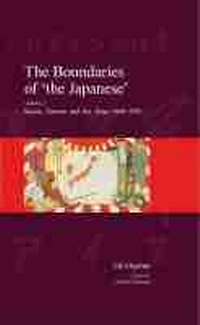
The Boundaries of 'the Japanese'
Volume 2: Korea, Taiwan and the Ainu 1868-1945
Published on 30. May 2017
Book
Paperback/Softback
590 pages
978-1-925608-94-6 (ISBN)
Description
This the parallel volume to The Boundaries of 'the Japanese': Volume 1: Okinawa 1818-1972, publisher in 2014, renowned historical sociologist Eiji Oguma further explores the fluctuating political, geographical, ethnic, and sociocultural borders of Japan and the Japanese from the latter years of the Tokugawa shogunate to the mid-20th century. Focus is placed first upon the northern island of Hokkaido with its indigenous Ainu inhabitants, and then upon the mainstays of Japan's colonial empire - Taiwan and Korea.
In continuing to elaborate on the theme of inclusion and exclusion, the author comprehensively recounts and analyzes the events, actions, campaigns, and attitudes of both the rulers and the ruled as Japan endeavoured both to be seen as a strong, civilized nation by the wider world, and to 'civilize' its disparate subjects on its own terms.
In continuing to elaborate on the theme of inclusion and exclusion, the author comprehensively recounts and analyzes the events, actions, campaigns, and attitudes of both the rulers and the ruled as Japan endeavoured both to be seen as a strong, civilized nation by the wider world, and to 'civilize' its disparate subjects on its own terms.
More details
Series
Language
English
Place of publication
Victoria
Australia
Target group
Professional and scholarly
Dimensions
Height: 223 mm
Width: 141 mm
ISBN-13
978-1-925608-94-6 (9781925608946)
Copyright in bibliographic data and cover images is held by Nielsen Book Services Limited or by the publishers or by their respective licensors: all rights reserved.
Schweitzer Classification
Person
Eiji Oguma is a Japanese sociologist and Professor in the Faculty of Policy Management at Keio University specializing in historical sociology and correlated social sciences. Although aspiring to study physics at the Department of Physics, Faculty of Science, Nagoya University, he dropped out and instead went on to graduate from the Department of Agriculture, University of Tokyo, in 1987. He joined Iwanami Shoten, a major academic publisher in Japan, and worked as book editor until 1996. He then joined the Department of International Social Sciences, Graduate School of Arts and Sciences, University of Tokyo, where he completed his PhD. He served as Lecturer at Keio University, and later as Associate Professor, before assuming his current position. He is actively involved in research and discussions on political thought largely focused on nationalism and democracy and based on history. His books have won prestigious academic awards such as the Suntory Prize for Social Sciences and Humanities and the Mainichi Publishing Culture Award. He is also known as a guitarist.
Content
- Figures
- Preface to the English Edition: Coloured Imperialism
- and Beyond
- Introduction
- 1 The People of the 'Empire's Northern Gateway'
- 2 The Possession of Taiwan
- 3 The Birth of a Government-General's Kingdom
- 4 Japanese-who-were-Koreans
- 5 Separate but Equal
- 6 'People's Rights' and 'Impartial Benevolence'
- 7 Green is the Willow, Scarlet the Blossom
- 8 Mainland Extensionism
- 9 The Failure of Governance Reform
- 10 The Dream of 'Different Flesh, Same Mind'
- 11 'Korean-born Japanese'
- 12 Japanisation and 'the Japanese'
- 13 The Final Reforms
- Conclusion
- Appendix
- Notes
- Bibliography
- Name Index
- Subject Index
- Preface to the English Edition: Coloured Imperialism
- and Beyond
- Introduction
- 1 The People of the 'Empire's Northern Gateway'
- 2 The Possession of Taiwan
- 3 The Birth of a Government-General's Kingdom
- 4 Japanese-who-were-Koreans
- 5 Separate but Equal
- 6 'People's Rights' and 'Impartial Benevolence'
- 7 Green is the Willow, Scarlet the Blossom
- 8 Mainland Extensionism
- 9 The Failure of Governance Reform
- 10 The Dream of 'Different Flesh, Same Mind'
- 11 'Korean-born Japanese'
- 12 Japanisation and 'the Japanese'
- 13 The Final Reforms
- Conclusion
- Appendix
- Notes
- Bibliography
- Name Index
- Subject Index