

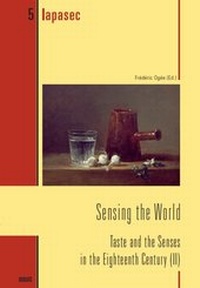
Sensing the World
Taste and the Senses in the Eighteenth Century (II)
Published on 19. May 2017
Book
Paperback/Softback
234 pages
978-3-86821-703-2 (ISBN)
Description
Throughout the eighteenth century, under the combined influence of the empiricist philosophers and of the 'moral sense' school, the idea emerged that there was perhaps little difference, if any, between feeling and thinking. In the 1760s, it was a common belief that the heart's private feelings were the prime inspirers of man's moral behaviour, that through the pleasurable sensations we derive from our benevolent actions (we feel 'loved'), we get to understand the (private) advantages to be drawn from an actively virtuous (public) life. The true standard of taste can only be reached by those who remain constantly aware of the perceptive operations of their senses, and reach that 'fine tuning' which alone can endow it with any authority.
The idea that human existence is very much about the recording and understanding of one's body's operations became a central Enlightenment concern. Modern identity (life in the modern world) is therefore very much a matter of Taste, taste of oneself and taste of the world, which requires a heightened awareness of the operations of the senses. This, very much, is what the contributors to the present volume have been working on together for some years, and which their essays in this collection try to address from their different perspectives. They propose a remarkable variety of case studies which examine the way taste and the senses 'vibrated' and how they came into resonance during the Enlightenment period.
The idea that human existence is very much about the recording and understanding of one's body's operations became a central Enlightenment concern. Modern identity (life in the modern world) is therefore very much a matter of Taste, taste of oneself and taste of the world, which requires a heightened awareness of the operations of the senses. This, very much, is what the contributors to the present volume have been working on together for some years, and which their essays in this collection try to address from their different perspectives. They propose a remarkable variety of case studies which examine the way taste and the senses 'vibrated' and how they came into resonance during the Enlightenment period.
More details
Person
Editor
Professor of British Literature and Art History
Frédéric Ogée is Professor of British Literature and Art History at Université Paris Diderot. His main areas of research are 18th-century aesthetics, literature and art, on which he has published several volumes and articles, including two collections of essays on William Hogarth. In 2006-07, he curated the first-ever exhibition on William Hogarth for the Louvre Museum. Some of his recent publications include: "Better in France? The circulation of ideas across the Channel in the 18th century" (Bucknell University Press, 2005), "Diderot and European Culture, a collection of essays" (Oxford: The Voltaire Foundation, 2006, re-issued 2009), and J.M.W. Turner, Les Paysages absolus (Paris, Hazan, 2010). He is currently preparing a monograph and an exhibition on British portraitist Thomas Lawrence for 2018. With Peter Wagner, he has edited four volumes in the LAPASEC series published by WVT.
ISNI: GND:
Frédéric Ogée is Professor of British Literature and Art History at Université Paris Diderot. His main areas of research are 18th-century aesthetics, literature and art, on which he has published several volumes and articles, including two collections of essays on William Hogarth. In 2006-07, he curated the first-ever exhibition on William Hogarth for the Louvre Museum. Some of his recent publications include: "Better in France? The circulation of ideas across the Channel in the 18th century" (Bucknell University Press, 2005), "Diderot and European Culture, a collection of essays" (Oxford: The Voltaire Foundation, 2006, re-issued 2009), and J.M.W. Turner, Les Paysages absolus (Paris, Hazan, 2010). He is currently preparing a monograph and an exhibition on British portraitist Thomas Lawrence for 2018. With Peter Wagner, he has edited four volumes in the LAPASEC series published by WVT.
ISNI: GND:
Content
Table of Contents
Foreword ix
Overture: The Great Sensorium 1
Frédéric Ogée
Sensate Knowledge
Mediating between the Senses and Reason:
Aesthetics and Vitalism in the High and Late Enlightenment 15
Peter Hanns Reill
Tactility
"Do not touch me": The Politics of Touch in the Eighteenth Century 33
Christoph Houswitschka
Palpation and Knowledge: Touch in 18th-century English
Literary and Medical Discourse 43
Marcel Hartwig
Hearsay
Handel's Oratorios and the Taste of Eighteenth-Century London Audiences:
Solomon as a Box Office Disaster 59
Christoph Heyl
Emotion, Affectation and Theatricality:
the Ethics of Hearing as a Matter of Taste 73
Pierre Degott
'For Whose Ear?' The Reception of Mozart's Music 93
Laurel E. Zeiss
Seeing Things Through
The Continuous Deception of Colours 107
Amélie Junqua
"A Work to wonder at": Seeing the English Landscape Garden 121
Frédéric Ogée
The Sense of Otherness
The Aesthetics of Chinoiserie and the Economy of Taste
in Eighteenth-century England 141
Vanessa Alayrac-Fielding
A man of sense surveys Europe: Edward Gibbon abroad, 1764 157
Robert Mankin
The Politics of Taste
'From head [.] to eyes': John Wilkes in the flight of taste 177
Madeleine Descargues-Grant
From Deadly Dullness to Murderous Anarchy: Good Taste and Morality 195
Robert Maniquis
Notes on Contributors 215
Index 219
Foreword ix
Overture: The Great Sensorium 1
Frédéric Ogée
Sensate Knowledge
Mediating between the Senses and Reason:
Aesthetics and Vitalism in the High and Late Enlightenment 15
Peter Hanns Reill
Tactility
"Do not touch me": The Politics of Touch in the Eighteenth Century 33
Christoph Houswitschka
Palpation and Knowledge: Touch in 18th-century English
Literary and Medical Discourse 43
Marcel Hartwig
Hearsay
Handel's Oratorios and the Taste of Eighteenth-Century London Audiences:
Solomon as a Box Office Disaster 59
Christoph Heyl
Emotion, Affectation and Theatricality:
the Ethics of Hearing as a Matter of Taste 73
Pierre Degott
'For Whose Ear?' The Reception of Mozart's Music 93
Laurel E. Zeiss
Seeing Things Through
The Continuous Deception of Colours 107
Amélie Junqua
"A Work to wonder at": Seeing the English Landscape Garden 121
Frédéric Ogée
The Sense of Otherness
The Aesthetics of Chinoiserie and the Economy of Taste
in Eighteenth-century England 141
Vanessa Alayrac-Fielding
A man of sense surveys Europe: Edward Gibbon abroad, 1764 157
Robert Mankin
The Politics of Taste
'From head [.] to eyes': John Wilkes in the flight of taste 177
Madeleine Descargues-Grant
From Deadly Dullness to Murderous Anarchy: Good Taste and Morality 195
Robert Maniquis
Notes on Contributors 215
Index 219