

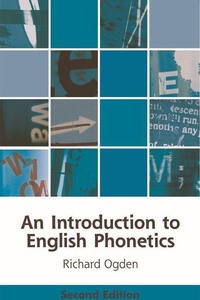
An Introduction to English Phonetics
2nd Edition
Published on 28. February 2017
Book
Paperback/Softback
236 pages
978-1-4744-1176-9 (ISBN)
Description
The second edition of this best selling textbook introduces undergraduates to the concepts, terminology and representations needed for an understanding of how English is pronounced around the world. Assuming no prior knowledge, it guides the reader through the vocal tract and explains how the sounds of speech are made, offering an accessible and expanded introduction to areas including transcription, vowels and acoustic analysis. As far as possible, it uses naturally-occurring conversational speech so that readers are familiar with the details of everyday talk (and not just the careful pronunciations presented in dictionaries). The book also includes a new concluding chapter that works through a piece of spoken data to show the reader how a more complete phonetic analysis can be conducted.
More details
Edition
2nd edition
Language
English
Place of publication
Edinburgh
United Kingdom
Target group
College/higher education
Edition type
New edition
Product notice
Paperback (trade)
Unsewn / adhesive bound
Dimensions
Height: 216 mm
Width: 139 mm
Thickness: 17 mm
Weight
302 gr
ISBN-13
978-1-4744-1176-9 (9781474411769)
Copyright in bibliographic data and cover images is held by Nielsen Book Services Limited or by the publishers or by their respective licensors: all rights reserved.
Schweitzer Classification
Other editions
Additional editions
Richard Ogden
Introduction to English Phonetics
E-Book
02/2017
Edinburgh University Press
€24.49
Available for download
Richard Ogden
Introduction to English Phonetics
E-Book
02/2017
2nd Edition
Edinburgh University Press
€24.49
Available for download
Person
Richard Ogden is Senior Lecturer at the University of York, where he has taught phonetics since 1995.
Content
List of figures and tables; To readers; Acknowledgements; 1. Introduction to phonetics; 2. Overview of the human speech mechanism; 3. Representing the sounds of speech; 4. The larynx, voicing and voice quality; 5. Vowels; 6. Approximants; 7. Plosives; 8. Fricatives; 9. Nasals; 10. Glottalic and velaric airstreams; 11. Sounds and structures; 12. Conclusion Glossary; Discussion of the exercises; Further reading; Index.