

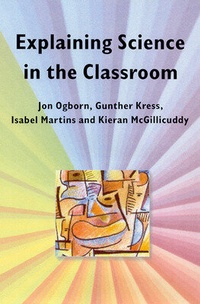
EXPLAINING SCIENCE IN THE CLASSROOM
Published on 16. November 1996
Book
Paperback/Softback
160 pages
978-0-335-19719-4 (ISBN)
Description
"This is an impressive book. It is an example of that rare item - a book about complex scientific ideas, expressed in clear, simple language - built on real teacher - learner conversations. Starting in the classroom, or the laboratory, with the most common occurence - a teacher offering an explanation, it proceeds by analysing the nature of specific explanations so that teachers can gain fuller insights into what is happening. Having teased out the processes of explanation, the authors then reconstruct them showing how elaboration, transformation and demonstration can enhance the understanding of the learner."
Professor Peter Mortimore
* How do science teachers explain science to students?
* What makes explanations work?
Is explaining science just an art, or can it be described, taught and learned? That is the question posed by this book. From extensive classroom observations, the authors give vivid descriptions of how teachers explain science to students, and provide their account with a sound theoretical basis.
Attention is given to the ways in which needs for explanation are generated, how the strange new entities of science - from genes to electrons - are created through talk and action, how knowledge is transformed to become explainable, and how demonstrations link explanation and reality. Different styles of explanation are illustrated, from the 'teller of tales' to those who ask students to 'say it my way'.
Explaining Science in the Classroom is a new and exciting departure in science education. It brings together science educators and specialists in discourse and communication, to reach a new synthesis of ideas. The book offers science teachers very practical help and insight.
Professor Peter Mortimore
* How do science teachers explain science to students?
* What makes explanations work?
Is explaining science just an art, or can it be described, taught and learned? That is the question posed by this book. From extensive classroom observations, the authors give vivid descriptions of how teachers explain science to students, and provide their account with a sound theoretical basis.
Attention is given to the ways in which needs for explanation are generated, how the strange new entities of science - from genes to electrons - are created through talk and action, how knowledge is transformed to become explainable, and how demonstrations link explanation and reality. Different styles of explanation are illustrated, from the 'teller of tales' to those who ask students to 'say it my way'.
Explaining Science in the Classroom is a new and exciting departure in science education. It brings together science educators and specialists in discourse and communication, to reach a new synthesis of ideas. The book offers science teachers very practical help and insight.
Reviews / Votes
"This is a book that expresses complex ideas clearly, and provides examples that science teachers will recognise as faithfully representing the complexities of classroom interactions. It wears its learning lightly, and should not be missed." - Studies in Education "...a seminal contribution to our understanding of a neglected topic...This is an important book...Explaining Science in the Classroom is essential reading for anyone with an interest in science education." - Times Educational Supplement"This is one of the most exciting science education books I have read in a long time, and is destined to be essential reading ona variety of teacher education courses." - Journal of Biological Education "The book will help teachers to gain greater insight into explanation strategies and help to improve students' learning." - School Science Review "...compelling and convincing." - Physics Education "This book is worthy of getting, reading, and most importantly, acting upon." - The Science Teacher "...a very readable guide, full of transcripts of classroom discussions that really show you how to do it. If you want to become a better teacher, you'll like this book." - Journal of Chemical Education "This is an impressive book. It is an example of that rare item - a book about complex scientific ideas, expressed in clear, simple language - built on real teacher - learner conversations. Starting in the classroom, or the laboratory, with the most common occurrence - a teacher offering an explanation, it proceeds by analysing the nature of specific explanations so that teachers can gain fuller insights into what is happening. Having teased out the processes of explanation, the authors then reconstruct them showing how elaboration, transformation and demonstration can enhance the understanding of the learner." - Professor Peter MortimoreMore details
Other editions
Additional editions
Jon Ogborn
Explaining Science In The Classroom
E-Book
11/1996
1st Edition
McGraw-Hill Education
€69.39
Available for download
Persons
Jon Ogborn is Professor of Science Education. Responsible (with Paul Black) for Nuffield Advanced Physics, he has also done research on basic categories of thinking, on computer tools to develop reasoning, and on the learning and communicating of science.
Gunther Kress is Professor of Education/English. He has written many books on language, visual and other non-verbal kinds of communication, and on the social nature of communication. His current interests are in literacies, curriculum and social futures.
Isabel Martins taught physics at high school level and studied science education in Brazil and the U.K. She is now a researcher in science education and is interested in models of cognition and in the communication of science to lay audiences.
Kieran McGillicuddy is a linguist and former high school teacher who studied at the University of Sydney, and is currently interested in the inter-relationships of language, action and the meaning of things. He has also taught communication and media studies.
All four authors work at the Institute of Education, University of London.
Gunther Kress is Professor of Education/English. He has written many books on language, visual and other non-verbal kinds of communication, and on the social nature of communication. His current interests are in literacies, curriculum and social futures.
Isabel Martins taught physics at high school level and studied science education in Brazil and the U.K. She is now a researcher in science education and is interested in models of cognition and in the communication of science to lay audiences.
Kieran McGillicuddy is a linguist and former high school teacher who studied at the University of Sydney, and is currently interested in the inter-relationships of language, action and the meaning of things. He has also taught communication and media studies.
All four authors work at the Institute of Education, University of London.
Content
Preface
Classrooms, explaining and science
Opening up differences
The construction of entities
Re-working knowledge
Demonstration
putting meaning into matter
Dynamics of explanation
'Styles' of explaining
What now, and what next?
Appendix
context and sources
Bibliography
Index.
Classrooms, explaining and science
Opening up differences
The construction of entities
Re-working knowledge
Demonstration
putting meaning into matter
Dynamics of explanation
'Styles' of explaining
What now, and what next?
Appendix
context and sources
Bibliography
Index.