

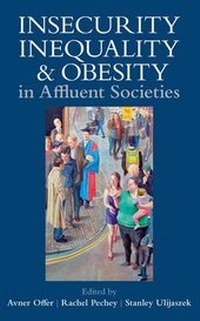
Insecurity, Inequality, and Obesity in Affluent Societies
1st Edition
Published on 5. April 2012
Book
Hardback
220 pages
978-0-19-726498-0 (ISBN)
Description
During the last three decades, obesity has emerged as a big public health issue in affluent societies. A number of academic and policy approaches have been taken, none of which has been very effective. Most of the academic research, whether biological, epidemiological, social-scientific, or in the humanities, has focused on the individual, and on his or her response to external incentives.
The point of departure taken here is that institutions matter a great deal too, and especially the normative environment of the nation state. In brief, the argument is that obesity is a response to stress, and that some types of welfare regimes are more stressful than others. English-speaking market-liberal societies have higher levels of obesity, and also higher levels of labour and product market competition, which induce uncertainty and anxiety. The studies presented here investigate this hypothesis, utilising a variety of disciplines, and the concluding contribution by the editors presents strong statistical evidence for its validity at the aggregate level. The hypothesis has an important bearing on public health policy and, indirectly, on economic policy more generally. It indicates that important drivers of obesity arise from the interaction between the external 'shock' of falling food prices and the enduring normative assumptions that govern society as a whole.
If obesity is determined in part by inflexible norms and institutions, it may not be easy to counter it by focused interventions. Distinctive societal policy norms like an attachment to individualism (which national communities embrace with some conviction) may have harmful social spillovers which are rarely taken into account.
The point of departure taken here is that institutions matter a great deal too, and especially the normative environment of the nation state. In brief, the argument is that obesity is a response to stress, and that some types of welfare regimes are more stressful than others. English-speaking market-liberal societies have higher levels of obesity, and also higher levels of labour and product market competition, which induce uncertainty and anxiety. The studies presented here investigate this hypothesis, utilising a variety of disciplines, and the concluding contribution by the editors presents strong statistical evidence for its validity at the aggregate level. The hypothesis has an important bearing on public health policy and, indirectly, on economic policy more generally. It indicates that important drivers of obesity arise from the interaction between the external 'shock' of falling food prices and the enduring normative assumptions that govern society as a whole.
If obesity is determined in part by inflexible norms and institutions, it may not be easy to counter it by focused interventions. Distinctive societal policy norms like an attachment to individualism (which national communities embrace with some conviction) may have harmful social spillovers which are rarely taken into account.
More details
Series
Language
English
Place of publication
Oxford
United Kingdom
Target group
Professional and scholarly
Public health scholars and policy makers; social scientists and population biologists; general reader
Dimensions
Height: 241 mm
Width: 161 mm
Thickness: 23 mm
Weight
580 gr
ISBN-13
978-0-19-726498-0 (9780197264980)
Copyright in bibliographic data and cover images is held by Nielsen Book Services Limited or by the publishers or by their respective licensors: all rights reserved.
Schweitzer Classification
Persons
Avner Offer is Chichele Professor of Economic History at the University of Oxford, a Fellow of All Souls College and of the British Academy. He was born and educated in Israel, graduated from the Hebrew University, and took his D.Phil. at Oxford. He initially studied land tenure, international political economy and the economics of war, and published Property and Politics 1870-1914 (CUP, 1981), and The First World War: An Agrarian Interpretation (OUP, 1989) as well as many articles. Subsequently he has focused on consumption and the quality of life (e.g. ed. In Pursuit of the Quality of Life (OUP, 1996)), and more recently, The Challenge of Affluence: Self-control and Well-Being in the United States and Britain since 1950 (OUP, 2006)).
Rachel Pechey is Research Officer at the Unit for Biocultural Variation and Obesity, University of Oxford. She graduated from the University of Durham, taking Psychology with Mathematics, and completed her MSc and PhD at Cardiff University. Her initial work focused on investigating subclinical symptoms of psychosis (in particular, delusions) in the general population. Subsequently she became involved in obesity research, in particular, looking at political and economic factors that have been implicated in the development of obesity at the population level.
Stanley Ulijaszek is Professor of Human Ecology and Director, Unit for Biocultural Variation and Obesity, at the University of Oxford, and Vice-Master of St Cross College Oxford. He is associate editor of Homo. Journal of Comparative Human Biology, and book review editor of the Journal of Biosocial Science. He graduated from the University of Manchester in Biochemistry, and took his PhD at the University of London (King's College). His work on nutritional ecology and anthropology has involved fieldwork and research in Papua New Guinea, the Cook Islands, Sarawak and South Asia.
Rachel Pechey is Research Officer at the Unit for Biocultural Variation and Obesity, University of Oxford. She graduated from the University of Durham, taking Psychology with Mathematics, and completed her MSc and PhD at Cardiff University. Her initial work focused on investigating subclinical symptoms of psychosis (in particular, delusions) in the general population. Subsequently she became involved in obesity research, in particular, looking at political and economic factors that have been implicated in the development of obesity at the population level.
Stanley Ulijaszek is Professor of Human Ecology and Director, Unit for Biocultural Variation and Obesity, at the University of Oxford, and Vice-Master of St Cross College Oxford. He is associate editor of Homo. Journal of Comparative Human Biology, and book review editor of the Journal of Biosocial Science. He graduated from the University of Manchester in Biochemistry, and took his PhD at the University of London (King's College). His work on nutritional ecology and anthropology has involved fieldwork and research in Papua New Guinea, the Cook Islands, Sarawak and South Asia.
Content
1: Introduction
2: Jon Wisman and Kevin Capehart: Creative Destruction, Economic Insecurity, Stress, and Epidemic Obesity
Part 1: Biological Fundamentals
3: Robin Dunbar: Obesity: An Evolutionary Perspective
4.: Trent Smith: Behavioural Biology and Obesity
Part 2: Social Stress
5.: Adam Drewnowski: Spatial Analyses of Obesity and Poverty
6: Ruth Bell: Spatial Analyses of Obesity and Poverty
7: Peter Whybrow: Time Urgency, Sleep Loss and Obesity
Part 3: Sicuak Diffusion of Obesity and its Causes
8: John Komlos: The Transition to Post-Industrial BMI Values in the United States
9: Thorkild Sorensen: The History of the Obesity Epidemic in Denmark
10: Kate Pickett: Income Inequality and Psychosocial Pathways to Obesity
11: Avner Offer: 1. Obesity Under Affluence Varies by Welfare Regimes
2: Jon Wisman and Kevin Capehart: Creative Destruction, Economic Insecurity, Stress, and Epidemic Obesity
Part 1: Biological Fundamentals
3: Robin Dunbar: Obesity: An Evolutionary Perspective
4.: Trent Smith: Behavioural Biology and Obesity
Part 2: Social Stress
5.: Adam Drewnowski: Spatial Analyses of Obesity and Poverty
6: Ruth Bell: Spatial Analyses of Obesity and Poverty
7: Peter Whybrow: Time Urgency, Sleep Loss and Obesity
Part 3: Sicuak Diffusion of Obesity and its Causes
8: John Komlos: The Transition to Post-Industrial BMI Values in the United States
9: Thorkild Sorensen: The History of the Obesity Epidemic in Denmark
10: Kate Pickett: Income Inequality and Psychosocial Pathways to Obesity
11: Avner Offer: 1. Obesity Under Affluence Varies by Welfare Regimes