

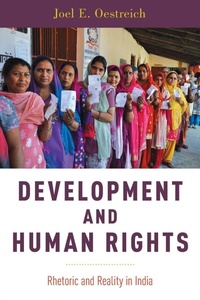
Development and Human Rights
Rhetoric and Reality in India
Published on 7. January 2020
Book
Paperback/Softback
226 pages
978-0-19-008685-5 (ISBN)
Description
In 2003, the United Nations adopted a common rights-based approach to development in their efforts to promote an international standard of human rights throughout the world. The approach emphasizes economic, social, and cultural rights, but plays down the role of civil and political rights in development. Intergovernmental and non-governmental agencies operate only at the invitation and sufferance of their hosts, and states retain full sovereignty and control over their territory; and the direct promotion of civil and political rights by foreign organizations has seemed beyond the ability of multilateral development agencies. But as Development and Human Rights shows, UN agencies have begun to take on a remarkable set of development priorities that, while carefully circumscribed and defined, constitute greater involvement in a state's internal affairs than anyone would have considered in the past.
In this book, Joel E. Oestreich presents the first full-length study of how international agencies evaluate the rights situation in a single country, and the first study to look at both the good and the bad in a rights-based approach. It looks particularly at the human rights challenges faced in India, considering the work of five UN agencies: UNICEF, the UN Development Programme, the World Bank, the UN Fund for Population Activities, and UN Women. Over the course of the book, Oestreich summarizes how the UN navigates this difficult political terrain, and how effectively these policies are being implemented. Development and Human Rights ultimately considers how rights-based approaches fit in the traditional discourse on human rights, and the ability of these agencies to initiate meaningful change on state behavior in the rights arena.
In this book, Joel E. Oestreich presents the first full-length study of how international agencies evaluate the rights situation in a single country, and the first study to look at both the good and the bad in a rights-based approach. It looks particularly at the human rights challenges faced in India, considering the work of five UN agencies: UNICEF, the UN Development Programme, the World Bank, the UN Fund for Population Activities, and UN Women. Over the course of the book, Oestreich summarizes how the UN navigates this difficult political terrain, and how effectively these policies are being implemented. Development and Human Rights ultimately considers how rights-based approaches fit in the traditional discourse on human rights, and the ability of these agencies to initiate meaningful change on state behavior in the rights arena.
Reviews / Votes
A must-read book for human rights proponents, governments or civil society, especially for its positive but frequently misunderstood message. In countries where advocacy for human rights is politically sensitive, real progress can still be made not by public confrontation but indirectly by promoting rights-based development programs. In this original and carefully documented study, Joel Oestreich shows where and how this indirect approach has avoided government opposition, delivered on the specifics, and yet, in doing so, has mobilized community awareness of their rights and stimulated further community action." * Sir Richard Jolly, Honorary Professor Institute of Development Studies Sussex, and former deputy executive director of UNICEF, 1982-1995 * Oestreich's analysis of UN advocacy and implementation of first and second generation rights in the world's biggest democracy breaks new ground in demonstrating why multilateralism matters. As the book's subtitle makes clear, UN officials can make a difference to the quality of human life in reality, not merely in rhetoric." * Thomas G. Weiss, The Graduate Center, The City University of New York * Development and Human Rights solidifies Oestreich's reputation as a leader in the deep study of international organizations. This important contribution to the analysis of international organizations beyond the global level carefully illustrates how international organizations act intrusively in, and independently of, states, while simultaneously navigating resistance within states. It demonstrates the necessity - and difficulty - of maintaining a connection between economic, social and cultural rights and civil and political rights to further transformative development." * Kurt Mills, Senior Lecturer in International Human Rights, University of Glasgow *More details
Language
English
Place of publication
New York
United States
Target group
College/higher education
Professional and scholarly
Dimensions
Height: 234 mm
Width: 156 mm
Thickness: 12 mm
Weight
351 gr
ISBN-13
978-0-19-008685-5 (9780190086855)
Copyright in bibliographic data and cover images is held by Nielsen Book Services Limited or by the publishers or by their respective licensors: all rights reserved.
Schweitzer Classification
Person
Joel E. Oestreich is Associate Professor of Political Science and Director of the International Area Studies Program at Drexel University. He is the author of Power and Principle: Human Rights Programming in International Organizations.
Content
Chapter 1: Human Rights, Politics, and Development
Chapter 2: Development and Human Rights in India
Chapter 3: The United Nations Development Programme
Chapter 4: The United Nations Children's Fund
Chapter 5: Other UN Agencies Involved in RBA
Chapter 6: Strategies and Outcomes of Rights-Based Approaches
Chapter 7: Conclusion: New Ways of Pursuing Human Rights Promotion
Notes
Index
Chapter 2: Development and Human Rights in India
Chapter 3: The United Nations Development Programme
Chapter 4: The United Nations Children's Fund
Chapter 5: Other UN Agencies Involved in RBA
Chapter 6: Strategies and Outcomes of Rights-Based Approaches
Chapter 7: Conclusion: New Ways of Pursuing Human Rights Promotion
Notes
Index