

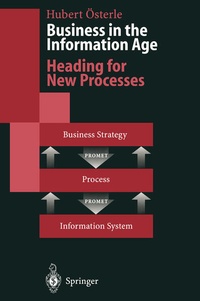
Business in the Information Age
Heading for New Processes
Published on 28. August 1995
Book
Hardback
XVI, 388 pages
978-3-540-60023-7 (ISBN)
Description
The industrial society is fast becoming an information society. As a result, many companies are experiencing serious difficulties in developing the new internal structures required. The increasing use of information technology has a profound effect on markets, products, and processes, as well as the management of and co-operation between companies. Recognising the possibilities and grasping the emerging potential is an important challenge for todays management, if the organisations and systems are to develop over the next twenty years. Business in the Information Age offers models and techniques for transforming company structures to help face this challenge. Viewing the business process as a new model to describe the organisation forms the link between company strategy and information systems. The book points out advantages accessible through IT, together with ways of integrating this knowledge in effective and efficient processes.
More details
Edition
1995 ed.
Language
English
Place of publication
Berlin
Germany
Publishing group
Springer Berlin
Target group
Professional and scholarly
Professional/practitioner
Illustrations
309 s/w Abbildungen
XVI, 388 p. 309 illus.
Dimensions
Height: 23.5 cm
Width: 15.5 cm
Weight
769 gr
ISBN-13
978-3-540-60023-7 (9783540600237)
DOI
10.1007/978-3-662-03086-8
Schweitzer Classification
Other editions
Additional editions
E-Book
11/2013
Springer
€96.29
Available for download
Book
12/2010
Springer
€106.99
Shipment within 7-9 days
Content
Contents: Introduction: The Transformation of the Economy.- Business Transformation and its Roots.- Business Engineering.- The PROMET Method.- Reader's Guide.- Organization Design: The Goals of Organization Design.- Process Model.- Process Vision.- Output Analysis.- Flow Planning.- Workflow Planning.- Process Management.- Architecture Planning.- IT Assessment.- Customer Relationship Analysis.- Activity-Specific Analyses.- Benchmarking.- Organizational Monitoring.- Further Reading.- Data Design: Data Design Objectives.- Data Model.- Normalization.- 'Semantic and Object-Oriented Data Modelling'.- Keys.- Integrity Conditions.- Code Tables.- Providing Data History.- Data Integration.- Implementing the Data Modell.- Further Reading.- Function Design: Objectives of Function Design.- Function Model.- Derivation of Transactions.- Checking for Completeness.- Derivation of Applications and Databases.- Transaction Network.- Lists and Messages.- Designing the User Interface.- Control Structure.- Authorization.- Workflow Design.- Further Reading.- Foundations of a Business Engineering Method: Business Engineering Levels.- Business Engineering Meta-Modell.- Business Engineering Method.