

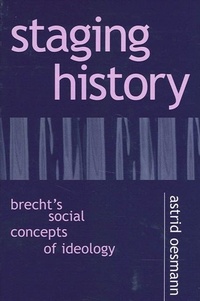
Staging History
Brecht's Social Concepts of Ideology
Published on 1. June 2006
Book
Paperback/Softback
241 pages
978-0-7914-6386-4 (ISBN)
Description
Examines Brecht's use of the theatre as a public arena for political change.
Staging History analyzes the commitment to social change present in the theatrical and theoretical writings of Bertolt Brecht. Challenging previous notions, Astrid Oesmann argues that Brecht's work was less dependent on Marxist ideology than is often assumed and that his work should be seen as a coherent whole. Brecht used the stage to release political ideas into experimental spaces in which actors and spectators could explore the relationships between abstract thought and concrete social life. Oesmann places Brecht within the context of the major leftist theorists of the twentieth century, particularly Adorno, Benjamin, and Lukacs, focusing on their discussions of realism, aesthetics, natural history, and mimesis. Oesmann elaborates upon the vision of a "counter-public sphere" in a number of Brecht's theoretical texts and plays-especially The Three Penny Trial and Fear and Misery of the Third Reich-that present the emergence of such a sphere in the face of fascism. By exploring Brecht's theoretical writings, selected plays, and recently published theatrical fragments, Oesmann reveals unpredictable constructions of history and surprising distinctions among various political ideologies, while also proving that Brecht remains vitally relevant to a "post-communist" world.
Staging History analyzes the commitment to social change present in the theatrical and theoretical writings of Bertolt Brecht. Challenging previous notions, Astrid Oesmann argues that Brecht's work was less dependent on Marxist ideology than is often assumed and that his work should be seen as a coherent whole. Brecht used the stage to release political ideas into experimental spaces in which actors and spectators could explore the relationships between abstract thought and concrete social life. Oesmann places Brecht within the context of the major leftist theorists of the twentieth century, particularly Adorno, Benjamin, and Lukacs, focusing on their discussions of realism, aesthetics, natural history, and mimesis. Oesmann elaborates upon the vision of a "counter-public sphere" in a number of Brecht's theoretical texts and plays-especially The Three Penny Trial and Fear and Misery of the Third Reich-that present the emergence of such a sphere in the face of fascism. By exploring Brecht's theoretical writings, selected plays, and recently published theatrical fragments, Oesmann reveals unpredictable constructions of history and surprising distinctions among various political ideologies, while also proving that Brecht remains vitally relevant to a "post-communist" world.
More details
Language
English
Place of publication
Albany, NY
United States
Target group
US School Grade: College Graduate Student and over
Product notice
Paperback (trade)
Dimensions
Height: 228 mm
Width: 154 mm
Thickness: 15 mm
Weight
340 gr
ISBN-13
978-0-7914-6386-4 (9780791463864)
Copyright in bibliographic data and cover images is held by Nielsen Book Services Limited or by the publishers or by their respective licensors: all rights reserved.
Schweitzer Classification
Other editions
Additional editions
E-Book
02/2012
1st Edition
De Gruyter
€35.99
Available for download
Person
Astrid Oesmann is Associate Professor of German and Comparative Literature at The University of Iowa
Content
Foreword
Acknowledgments
Introduction
1 Brecht and Theory
Realism and Reversed Perception
Art as the Speaker of History
Natural History
Mimetic Activities
2 Prehistories
The Theatrical Destruction of Subjectivity
The Unorganized Material
Instincts and Transformations
3 Man Between Material and Social Order
Material Against Identity: Mann ist Mann
Brecht's Concept of the Public Sphere
The Captured Material (Exploitation/Imploitation)
Political Distinctions
4 Revolution: Change and Persistence
The Teaching Plays: Brecht's Theatre of Poverty
Social Space and Human Standing
Einverstaendnis: Consent in Crisis
Subject Bound/Thought Unbound
Defacement and Death
5 Brecht's Archaeology of Knowledge
The Genealogy of Terror
Memory and Morality
Body in Time: Haltung
Thought in Time: Lehre
Notes
Index
Acknowledgments
Introduction
1 Brecht and Theory
Realism and Reversed Perception
Art as the Speaker of History
Natural History
Mimetic Activities
2 Prehistories
The Theatrical Destruction of Subjectivity
The Unorganized Material
Instincts and Transformations
3 Man Between Material and Social Order
Material Against Identity: Mann ist Mann
Brecht's Concept of the Public Sphere
The Captured Material (Exploitation/Imploitation)
Political Distinctions
4 Revolution: Change and Persistence
The Teaching Plays: Brecht's Theatre of Poverty
Social Space and Human Standing
Einverstaendnis: Consent in Crisis
Subject Bound/Thought Unbound
Defacement and Death
5 Brecht's Archaeology of Knowledge
The Genealogy of Terror
Memory and Morality
Body in Time: Haltung
Thought in Time: Lehre
Notes
Index