

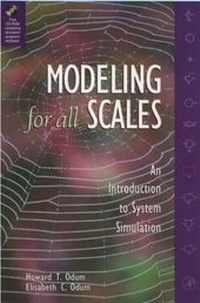
Modeling for All Scales
An Introduction to System Simulation
Published on 3. February 2000
Book
Hardback
458 pages
978-0-12-524170-0 (ISBN)
Description
All manner of models are used to describe, simulate, extrapolate, and ultimately understand the function of dynamic systems. These sorts of models are usually based upon a mathematical foundation that can be difficult to manipulate especially for students. Modeling for All Scales uses object-oriented programming to erect and evaluate the efficacy of models of small, intermediate and large scale systems. Such models allow users to employ intuitively based symbols and a systems ecology approach. The authors have been leaders in the systems ecology community and have originated much of the scientific vocabulary of the field. After introducing modeling and its benefits, there is a series of chapters detailing the more particular elements of successful simulation. There follows another series of chapters, each devoted to models of different sorts of systems. Small scale models of growth, competition, and evolution give way, successively, to larger and larger scale models such as international trade and the global geobiosphere. Anyone interested in an easy to use approach to modeling complex systems authored by perhaps the most original systems ecologists of the century will want this book. To further enhance the users ability to apply the lessons of this book, there is included a CD-ROM disc which provides the fundamental tools for modeling at all scales.
More details
Language
English
Place of publication
San Diego
United States
Publishing group
Elsevier Science Publishing Co Inc
Target group
Professional and scholarly
Ecologists - especially systems ecologists, theoretical biologists, environmental scientists, faculty, graduate students and advanced undergraduates in the ecological and environmental sciences. Resource economists, land management professionals and related audiences.
Dimensions
Height: 254 mm
Width: 171 mm
Weight
830 gr
ISBN-13
978-0-12-524170-0 (9780125241700)
Copyright in bibliographic data and cover images is held by Nielsen Book Services Limited or by the publishers or by their respective licensors: all rights reserved.
Schweitzer Classification
Other editions
Additional editions
E-Book
02/2000
Academic Press
€99.95
Available for download
Persons
Howard T. Odum is the recognized originator of the systems approach to environmental and ecological modeling The recipient of many awards, his students and close colleagues now represent the leading proponents of systems science.
Content
Preface.
Part I: Modeling:
Modeling and Simulation. Energy Systems Diagramming.
Numbers on Networks.
Part II: Simulation:
Simulation with Picture Blocks.
Simulation with General Systems Blocks.
Equations with Diagrams.
Calibrating Models.
Simulating with Spreadsheets.
Programming in BASIC.
Simulating with STELLA.
Simulating Energy and Transformity.
Part III: Fundamental Minimodels:
Suggestions for Simulation.
Models of Production and Recycle.
Models of Growth.
Models of Competition and Cooperation.
Models of Series and Oscillation.
Minimodels of Succession and Evolution.
Models of Microeconomics.
Models of Macroeconomic Overview.
Models of International Relations and Trade.
Models of the Global Geobiosphere.
Part IV: Application:
Modeling Projects and Complexity.
Simulation Approaches.
Appendices:
Programming Blocks for GENSYS using EXTEND.
Notes on Computer Use and BASIC Programming.
Answers to Questions.
Use of Energy Systems Symbols.
Contents of the CD with this Book.
References and Suggested Readings.
Tables.
Legends.
Figures.
Part I: Modeling:
Modeling and Simulation. Energy Systems Diagramming.
Numbers on Networks.
Part II: Simulation:
Simulation with Picture Blocks.
Simulation with General Systems Blocks.
Equations with Diagrams.
Calibrating Models.
Simulating with Spreadsheets.
Programming in BASIC.
Simulating with STELLA.
Simulating Energy and Transformity.
Part III: Fundamental Minimodels:
Suggestions for Simulation.
Models of Production and Recycle.
Models of Growth.
Models of Competition and Cooperation.
Models of Series and Oscillation.
Minimodels of Succession and Evolution.
Models of Microeconomics.
Models of Macroeconomic Overview.
Models of International Relations and Trade.
Models of the Global Geobiosphere.
Part IV: Application:
Modeling Projects and Complexity.
Simulation Approaches.
Appendices:
Programming Blocks for GENSYS using EXTEND.
Notes on Computer Use and BASIC Programming.
Answers to Questions.
Use of Energy Systems Symbols.
Contents of the CD with this Book.
References and Suggested Readings.
Tables.
Legends.
Figures.