

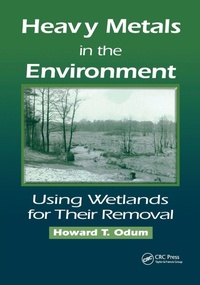
Heavy Metals in the Environment
Using Wetlands for Their Removal
1st Edition
Published on 19. June 2019
Book
Paperback/Softback
344 pages
978-0-367-39862-0 (ISBN)
Description
Much of the convenience of modern life resides in sheet metal, the cowling shield of most machines and appliances. However, the load that this takes off human shoulders has to be carried elsewhere, and the Earth has borne the burden. Many of us woke up to the environmental cost when over a century of industrialization finally surpassed the capacity of nature to assimilate it.
International in scope, Heavy Metals in the Environment: Using Wetlands for Their Removal discusses wetland functions and heavy metal contamination. It addresses such questions as: Can systems powered by sunlight handle toxins more effectively than systems running on fossil fuel? At what scale and by what means do we define efficiency? These questions resonate increasingly with a number of global challenges.
As inescapable as climate change, you can no longer avoid airborne toxins, acid rain, and polluted water by moving away from them. When the time comes to rely less on fossil fuel-based technology, how will we clean up the aftermath of toxic misadventures?
Written by a leader in the growing field of ecological engineering, Heavy Metals in the Environment: Using Wetlands for Their Removal presents scientific studies that illustrate how natural systems use wetlands to adapt to changes in the ecosystem. It focuses primarily on lead, one of the first materials used by developing civilizations and a metal used heavily in the industrial era. The goal: to achieve a better understanding of how natural systems use wetlands to adapt to wastes.
International in scope, Heavy Metals in the Environment: Using Wetlands for Their Removal discusses wetland functions and heavy metal contamination. It addresses such questions as: Can systems powered by sunlight handle toxins more effectively than systems running on fossil fuel? At what scale and by what means do we define efficiency? These questions resonate increasingly with a number of global challenges.
As inescapable as climate change, you can no longer avoid airborne toxins, acid rain, and polluted water by moving away from them. When the time comes to rely less on fossil fuel-based technology, how will we clean up the aftermath of toxic misadventures?
Written by a leader in the growing field of ecological engineering, Heavy Metals in the Environment: Using Wetlands for Their Removal presents scientific studies that illustrate how natural systems use wetlands to adapt to changes in the ecosystem. It focuses primarily on lead, one of the first materials used by developing civilizations and a metal used heavily in the industrial era. The goal: to achieve a better understanding of how natural systems use wetlands to adapt to wastes.
More details
Language
English
Place of publication
London
United Kingdom
Publishing group
Taylor & Francis Ltd
Target group
College/higher education
Professional and scholarly
Academic and Professional Practice & Development
Dimensions
Height: 254 mm
Width: 178 mm
Thickness: 19 mm
Weight
652 gr
ISBN-13
978-0-367-39862-0 (9780367398620)
Copyright in bibliographic data and cover images is held by Nielsen Book Services Limited or by the publishers or by their respective licensors: all rights reserved.
Schweitzer Classification
Other editions
Additional editions
E-Book
04/2016
CRC Press
€92.49
Available for download
E-Book
04/2016
CRC Press
€92.49
Available for download
Book
05/2000
1st Edition
CRC Press
€260.80
Shipment within 3-4 weeks
Person
Howard T. Odum, Wlodzimierz Wojcik, Lowell Pritchard, Shanshin Ton, Joseph J. Delfino, Malgorzata Wojcik, Slawomir Leszczynski, Jay D. Patel , Steven J. Doherty, Jacek Stasik
Content
Contents
Introduction and Background. Lead in a Cypress-Gum Swamp, Jackson County, Florida. Lead and Wetlands in Poland. Value and Policy. Appendices. References.
Introduction and Background. Lead in a Cypress-Gum Swamp, Jackson County, Florida. Lead and Wetlands in Poland. Value and Policy. Appendices. References.