

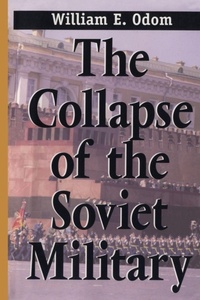
The Collapse of the Soviet Military
Will be published approx. on 12. May 2000
Book
Paperback/Softback
544 pages
978-0-300-08271-5 (ISBN)
Description
One of the great surprises in modern military history is the collapse of the Soviet Armed Forces in 1991-along with the party-state with which it was inextricably intertwined. In this important book, a distinguished United States Army officer and scholar traces the rise and fall of the Soviet military, arguing that it had a far greater impact on Soviet politics and economic development than was perceived in the West.
General William E. Odom asserts that Gorbachev saw that dramatically shrinking the military and the military-industrial sector of the economy was essential for fully implementing perestroika and that his efforts to do this led to the dissolution of the Soviet Union. Odom enhances his account with interviews with key actors in the Soviet Union before, during, and after the collapse. He describes the condition of the Soviet military during the mid-1980s and explains how it became what it was-its organizational structures, manpower policies, and military-industrial arrangements. He then moves to the dramatic events that led to its destruction, taking us to the most secret circles of Soviet policy making, as well as describing the public debates, factional struggles in the new parliament, and street combat as army units tried to repress the political forces unleashed by glasnost. Odom shows that just as the military was the ultimate source of stability for the multinational Soviet state, the communist ideology justified the military's priority claim on the economy. When Gorbachev tried to shift resources from the military to the civilian sector to overcome economic stagnation, he had to revise the official ideology in order to justify removing the military from its central place. Paralyzed by corruption, mistrust, and public disillusionment, the military was unable and unwilling to intervene against either Gorbachev's perestroika or Yeltsin's dissolution of the Soviet Union.
General William E. Odom asserts that Gorbachev saw that dramatically shrinking the military and the military-industrial sector of the economy was essential for fully implementing perestroika and that his efforts to do this led to the dissolution of the Soviet Union. Odom enhances his account with interviews with key actors in the Soviet Union before, during, and after the collapse. He describes the condition of the Soviet military during the mid-1980s and explains how it became what it was-its organizational structures, manpower policies, and military-industrial arrangements. He then moves to the dramatic events that led to its destruction, taking us to the most secret circles of Soviet policy making, as well as describing the public debates, factional struggles in the new parliament, and street combat as army units tried to repress the political forces unleashed by glasnost. Odom shows that just as the military was the ultimate source of stability for the multinational Soviet state, the communist ideology justified the military's priority claim on the economy. When Gorbachev tried to shift resources from the military to the civilian sector to overcome economic stagnation, he had to revise the official ideology in order to justify removing the military from its central place. Paralyzed by corruption, mistrust, and public disillusionment, the military was unable and unwilling to intervene against either Gorbachev's perestroika or Yeltsin's dissolution of the Soviet Union.
Reviews / Votes
"America's premier expert on Soviet military affairs has produced a seminal work of far-reaching political and strategic importance. Indispensable to an understanding not only of the current stage of the Russian military but also of the wider geostrategic implications of Russia's current condition." Zbigniew Brzezinski "A superb and comprehensive study that will stand as a major pillar in support of a thorough understanding of the Gorbachev period and the collapse of the Soviet Union. It also provides needed perspective for the evaluation of the problems confronting the Russian military today." Walter C. Uhler, Philadelphia Inquirer "Essential reading for everyone who wants to understand why America's Cold War rival acted the way it did and what caused that opponent to become a colossus with feet of clay." W. Bruce Lincoln, Washington Post Book World "Odom's book...opinionated and...exciting sees the dissolution of the Union as intimately linked to military collapse." John Lloyd, Financial TimesMore details
Language
English
Place of publication
United States
Target group
College/higher education
Professional and scholarly
Product notice
Paperback (trade)
Dimensions
Height: 234 mm
Width: 157 mm
Thickness: 33 mm
Weight
739 gr
ISBN-13
978-0-300-08271-5 (9780300082715)
Copyright in bibliographic data and cover images is held by Nielsen Book Services Limited or by the publishers or by their respective licensors: all rights reserved.
Schweitzer Classification
Person
William E. Odom retired in 1988 as a lieutenant general in the United States Army and as director of the National Security Agency. He is currently director of national security studies at the Hudson Institute and an adjunct professor of political science at Yale University.