

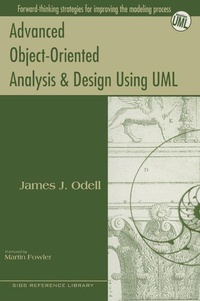
Advanced Object-Oriented Analysis and Design Using UML
Published on 13. February 1998
Book
Paperback/Softback
262 pages
978-0-521-64819-6 (ISBN)
Description
This 1998 book conveys the essence of object-oriented programming and software building through the Unified Modeling Language (UML). Composed of updated versions of James Odell's articles from The Journal of Object-Oriented Programming, ROAD, and Object Magazine, it provides concise but in-depth pieces on structural issues, dynamic issues, business rules, object complexity, object aggregation, design templates, and the process of objects.
Reviews / Votes
"These pages contain the essence of what it is to understand the world as objects and build software based on that understanding. You will be able to come back to these articles time and again, gaining new layers of understanding as you gain layers of experience." Kent Beck "There is certainly good information in this book, and it is presented well. This book should be useful to those seriously interested in object-oriented analysis and design (OOAD)...." Computing ReviewsMore details
Series
Language
English
Place of publication
Cambridge
United Kingdom
Target group
Professional and scholarly
Product notice
Paperback (trade)
Illustrations
Worked examples or Exercises
Dimensions
Height: 229 mm
Width: 152 mm
Thickness: 16 mm
Weight
430 gr
ISBN-13
978-0-521-64819-6 (9780521648196)
Copyright in bibliographic data and cover images is held by Nielsen Book Services Limited or by the publishers or by their respective licensors: all rights reserved.
Schweitzer Classification
Other editions
Additional editions
James J. Odell
Advanced Object-Oriented Analysis and Design Using UML
Book
01/1998
Cambridge University Press
Unfortunately, price unknown
Article exhausted; check for reprint
Previous edition
James J. Odell
Advanced Object-Oriented Analysis and Design Using UML
Book
01/1998
Cambridge University Press
Unfortunately, price unknown
Article exhausted; check for reprint
Persons
Content
Part I. Structural Issues: 1. Modeling objects: using Binary- and Entity-relationship approaches; 2. Object types as objects and vice versa; 3. Power types; 4. Specifying structural constraints; 5. Toward a formalization of OO analysis; Part II. Dynamic Issues: 6. What is object state?; 7. Dynamic and multiple classification; 8. Events and their specification; 9. Approaches to finite-state machine modeling; Part III. Business Rules: 10. Business rules; 11. Using rules with diagrams; Part IV. Object Complexity: 12. Managing object complexity, Part I: classification and generalization; 13. Managing object complexity, Part II: aggregation; Part V. Object Aggregation: 14. Six different kinds of aggregation; 15. A foundation for aggregation; 16. A user-level model of aggregation; Part VI. Design Templates: 17. From analysis to design using templates, Part I; 18. From analysis to design using templates, Part II; 19. From analysis to design using templates, Part III; Part VII. The Process of Objects: 20. Method engineering; 21. User workshop techniques; 22. Object-oriented methodologies.