

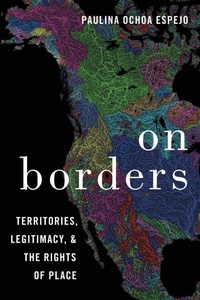
On Borders
Territories, Legitimacy, and the Rights of Place
Published on 8. September 2020
Book
Paperback/Softback
344 pages
978-0-19-007420-3 (ISBN)
Description
When are borders justified? Who has a right to control them? Where should they be drawn?
Today people think of borders as an island's shores. Just as beaches delimit a castaway's realm, so borders define the edges of a territory, occupied by a unified people, to whom the land legitimately belongs. Hence a territory is legitimate only if it belongs to a people unified by a civic identity. Sadly, this Desert Island Model of territorial politics forces us to choose. If we want territories, then we can either have democratic legitimacy, or inclusion of different civic identities--but not both. The resulting politics creates mass xenophobia, migrant-bashing, hoarding of natural resources, and border walls.
To escape all this, On Borders presents an alternative model. Drawing on an intellectual tradition concerned with how land and climate shape institutions, it argues that we should not see territories as pieces of property owned by identity groups. Instead, we should see them as watersheds: as interconnected systems where institutions, people, the biota, and the land together create overlapping civic duties and relations, what the book calls place-specific duties.
This Watershed Model argues that borders are justified when they allow us to fulfill those duties; that border-control rights spring from internationally-agreed conventions--not from internal legitimacy; that borders should be governed cooperatively by the neighboring states and the states system; and that border redrawing should be done with environmental conservation in mind. The book explores how this model undoes the exclusionary politics of desert islands.
Today people think of borders as an island's shores. Just as beaches delimit a castaway's realm, so borders define the edges of a territory, occupied by a unified people, to whom the land legitimately belongs. Hence a territory is legitimate only if it belongs to a people unified by a civic identity. Sadly, this Desert Island Model of territorial politics forces us to choose. If we want territories, then we can either have democratic legitimacy, or inclusion of different civic identities--but not both. The resulting politics creates mass xenophobia, migrant-bashing, hoarding of natural resources, and border walls.
To escape all this, On Borders presents an alternative model. Drawing on an intellectual tradition concerned with how land and climate shape institutions, it argues that we should not see territories as pieces of property owned by identity groups. Instead, we should see them as watersheds: as interconnected systems where institutions, people, the biota, and the land together create overlapping civic duties and relations, what the book calls place-specific duties.
This Watershed Model argues that borders are justified when they allow us to fulfill those duties; that border-control rights spring from internationally-agreed conventions--not from internal legitimacy; that borders should be governed cooperatively by the neighboring states and the states system; and that border redrawing should be done with environmental conservation in mind. The book explores how this model undoes the exclusionary politics of desert islands.
Reviews / Votes
Paulina Ochoa Espejo's On Borders: Territories, Legitimacy, & the Rights of Place offers an indirect response and critique of the limitations of cosmopolitan frameworks as they relate to place-based politics via an analysis of borders and bordered thinking. * Arturo Chang, Theory & Event * Even for those who still believe that traditional territorial borders are very real because they matter in multiple ways, the book certainly comes recommended. * Dorte Jagetic Andersen, Journal of Borderlands Studies * Richly textured and deeply insightful ... Ochoa Espejo's book is a splendid read, and in my view should be required reading for scholars of borders from all disciplines. * Patti Tamara Lenard, The Review of Politics * Explores borders, territories, and inclusion in terms of place, examining the practices and physical structures that constitute the localized, concrete character of people's experiences. * Journal of Economic Literature (Volume 59, no. 1) * Banging on about 'broken borders' is the major leitmotif of contemporary populism in Europe and the United States. This subtle and engaging exploration of borders as a theme in political philosophy shows how much about them is obscured when questions of immigration policy and territorial sovereignty are bundled together with the 'border question.' In placing borders at the center of analysis, this book effectively demolishes and replaces the very basis to the current debate about their meaning * John Agnew, University of California, Los Angeles * Ochoa Espejo urges us to think place apart from presumed national identities in border politics. Foregrounding the politics of peoples and the earth, and backgrounding nation states, she expands the intellectual space for conceiving, drawing, and governing the proximate territories of borders. * Wendy Brown, University of California, Berkeley * Ochoa Espejo argues that we should recognize borders as sites of important place-specific rights and duties. Looking at borders from this perspective, rather than through the lens of questions about collective identities or individual rights, disrupts conventional normative discussions. Her focus on place has a challenging and transformative effect on debates about territory and immigration and enables us to see ethical issues, especially environmental issues, that otherwise largely escape our view. A rich and rewarding read * Joseph H. Carens, University of Toronto * On Borders is itself a watershed in the political theory of territory, of migration, and of the interactions between human institutions and the natural world. Paulina Ochoa Espejo reframes our picture of the state and its relationship to its members and the places they live and work. Her originality is grounded in both deep insight as well as extensive and careful research across several disciplines. It is political theory for the 21st century. * Avery Kolers, University of Louisville *More details
Language
English
Place of publication
New York
United States
Target group
Professional and scholarly
Dimensions
Height: 234 mm
Width: 156 mm
Thickness: 18 mm
Weight
521 gr
ISBN-13
978-0-19-007420-3 (9780190074203)
Copyright in bibliographic data and cover images is held by Nielsen Book Services Limited or by the publishers or by their respective licensors: all rights reserved.
Schweitzer Classification
Other editions
Additional editions
Book
09/2020
Oxford University Press Inc
€150.50
Shipment within 15-20 days
E-Book
06/2020
OUP eBook
€15.49
Available for download
E-Book
06/2020
OUP eBook
€18.99
Available for download
Person
Paulina Ochoa Espejo is Associate Professor of Political Science at Haverford College. She is the author of The Time of Popular Sovereignty: Process and the Democratic State and co-editor of The Oxford Handbook of Populism.
Content
Preface
Acknowledgments
1. Introduction
Part I: Taking Identity Too Seriously: Against the Desert Island Model of Territorial Politics
2. The Desert Island Model of Territorial Politics
3. What Do Borders Divide? Peoples, Places, Jurisdictions
4. Democratic Legitimacy and the Vicious Circle of People and Territory
5. Natural Borders: From the Natural Boundaries of States to Ecological Accounts of Territory
Part II: Taking Place Seriously: For the Watershed Model of Territorial Politics
6. The Topian Tradition: A Forgotten Alternative to Utopianism
7. How Place-Specific Duties Make Borders Morally Relevant
8. The Watershed: A (Not So) New Model for Territories and Border Placement
Part III: The Morality of Border Politics in the Real World: Applying the Watershed Model
9. Grounds of Border Control and Shared Border Governance
10. Immigration: Rights Based on Presence Rather Than Identity
11. Sharing Ecosystems: Rivers as an Example of Transborder Resource Use and Cooperation
12. What is Wrong with Border Walls?
Envoi
Bibliography
Index
Acknowledgments
1. Introduction
Part I: Taking Identity Too Seriously: Against the Desert Island Model of Territorial Politics
2. The Desert Island Model of Territorial Politics
3. What Do Borders Divide? Peoples, Places, Jurisdictions
4. Democratic Legitimacy and the Vicious Circle of People and Territory
5. Natural Borders: From the Natural Boundaries of States to Ecological Accounts of Territory
Part II: Taking Place Seriously: For the Watershed Model of Territorial Politics
6. The Topian Tradition: A Forgotten Alternative to Utopianism
7. How Place-Specific Duties Make Borders Morally Relevant
8. The Watershed: A (Not So) New Model for Territories and Border Placement
Part III: The Morality of Border Politics in the Real World: Applying the Watershed Model
9. Grounds of Border Control and Shared Border Governance
10. Immigration: Rights Based on Presence Rather Than Identity
11. Sharing Ecosystems: Rivers as an Example of Transborder Resource Use and Cooperation
12. What is Wrong with Border Walls?
Envoi
Bibliography
Index