

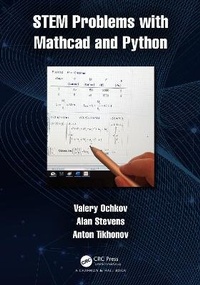
STEM Problems with Mathcad and Python
1st Edition
Published on 9. December 2022
Book
Hardback
416 pages
978-1-032-13165-8 (ISBN)
Description
STEM Problems with Mathcad and Python seeks to remove the fear of tackling difficult scientific and technical calculations for future mathematicians, engineers, scientists, and other STEM researchers. The authors hope to show that such calculations can be not only useful, but that the process of learning how to do them can be enjoyable, especially with the help of Mathcad and Python programming skills. The book will also illustrate how the use of modern computer software allows one to significantly expand the range of problems considered beyond those conventionally taught. This includes computational experiments, multivariate calculations, inverse problems and optimization problems, with both static and animated visual feedback.
Features
Suitable for undergraduates and early postgraduates who need simple and accessible guidance for solving practical interdisciplinary technical problems
Can be used as an additional textbook in a variety of topics, including Calculus, Linear Algebra, Analytical Geometry, Discrete Mathematics, Computer Science, Computational Mathematics, Scientific Visualization, Computer Graphics
Gives computer users access to an exciting new hobby - solving complex problems described in fiction
Features
Suitable for undergraduates and early postgraduates who need simple and accessible guidance for solving practical interdisciplinary technical problems
Can be used as an additional textbook in a variety of topics, including Calculus, Linear Algebra, Analytical Geometry, Discrete Mathematics, Computer Science, Computational Mathematics, Scientific Visualization, Computer Graphics
Gives computer users access to an exciting new hobby - solving complex problems described in fiction
More details
Language
English
Place of publication
Oxford
United Kingdom
Publishing group
Taylor & Francis Ltd
Target group
Professional and scholarly
Illustrations
1 s/w Tabelle, 193 s/w Abbildungen, 180 farbige Abbildungen, 2 s/w Photographien bzw. Rasterbilder, 8 Farbfotos bzw. farbige Rasterbilder, 191 s/w Zeichnungen, 172 farbige Zeichnungen
1 Tables, black and white; 172 Line drawings, color; 191 Line drawings, black and white; 8 Halftones, color; 2 Halftones, black and white; 180 Illustrations, color; 193 Illustrations, black and white
Dimensions
Height: 254 mm
Width: 178 mm
Weight
1000 gr
ISBN-13
978-1-032-13165-8 (9781032131658)
Copyright in bibliographic data and cover images is held by Nielsen Book Services Limited or by the publishers or by their respective licensors: all rights reserved.
Schweitzer Classification
Other editions
Additional editions
Valery Ochkov | Alan Stevens | Anton Tikhonov
STEM Problems with Mathcad and Python
E-Book
12/2022
1st Edition
Chapman & Hall/CRC
€73.99
Available for download
Valery Ochkov | Alan Stevens | Anton Tikhonov
STEM Problems with Mathcad and Python
E-Book
12/2022
1st Edition
Chapman & Hall/CRC
€73.99
Available for download
Persons
Dr Valery Ochkov is Professor at Moscow Power Engineering Institute (Technical University - MPEI - www.mpei.ru) in the Department of Theoretical Basics of Heat Engineering. He earned his Ph.D. in 1979 on "Research of processes and development of technology for magnetic water treatment in the energy sector." In 2006 he defended his doctoral dissertation on the topic "Improving the design and operation of power plant equipment using modern information technologies."
In 2005, he founded his own private company, which is engaged in the creation of computer programs and simulators for the training of personnel in thermal, hydraulic and nuclear power plants.?
Dr Alan Stevens received a Bachelor's degree in Physics from the University of Warwick, then a PhD for research in Theoretical Physics from the University of Essex. He then spent most of his working life at Rolls-Royce as a mathematical modeller, dealing mainly with engineering heat transfer and fluid flow; also spending a certain amount of time teaching engineering mathematics to engineers at various Rolls-Royce sites. In retirement he has sat on several committees of the Institute of Mathematics and Its Applications (IMA) in the UK, including its Executive Board and governing Council.
Dr Anton Tikhonov received his bachelor's degree in semiconductor physics and his master's degree in applied mathematics from the Moscow Power Engineering Institute (MPEI). He has spent his entire working life at the Moscow Power Engineering Institute, where he received his PhD for research on semiconductor devices. He is currently a professor at MPEI. His research interests are information technology in education, scientific visualization.
In 2005, he founded his own private company, which is engaged in the creation of computer programs and simulators for the training of personnel in thermal, hydraulic and nuclear power plants.?
Dr Alan Stevens received a Bachelor's degree in Physics from the University of Warwick, then a PhD for research in Theoretical Physics from the University of Essex. He then spent most of his working life at Rolls-Royce as a mathematical modeller, dealing mainly with engineering heat transfer and fluid flow; also spending a certain amount of time teaching engineering mathematics to engineers at various Rolls-Royce sites. In retirement he has sat on several committees of the Institute of Mathematics and Its Applications (IMA) in the UK, including its Executive Board and governing Council.
Dr Anton Tikhonov received his bachelor's degree in semiconductor physics and his master's degree in applied mathematics from the Moscow Power Engineering Institute (MPEI). He has spent his entire working life at the Moscow Power Engineering Institute, where he received his PhD for research on semiconductor devices. He is currently a professor at MPEI. His research interests are information technology in education, scientific visualization.
Content
1. Portrait of the Roots of the System of Equations. 2. Oval and Ellipse. 3. Reading Fiction and Solving Linear Equations. 4. Trust but Verify. 5. Comet of 1811: Check Harmony with Algebra. 6. Running along the Route given by Pierre de Fermat, or Geometric Optics. 7. Patterns on a Complex Plane. 8. Rectangle Mappings on the Complex Plane. 9. Monte-Carlo: Shapes and Ships. 10. Pseudo-Parallelism. 11. A Catenary: to Step or Ride Over? 12. Round and Round. 13. Iterations and Fractal Sets of Mandelbrot and Julia. 14. Water Digital Twin: Cloud Functions, Correct Temperature Units. 15. Hydropower Thoughts and Calculations when Looking at a Banknote or Spline Interpolation. 16. Cellular Automatons. 17. Arrays and Images. 18. Three Circles tied with an Elastic Band Or New Pendulum.