

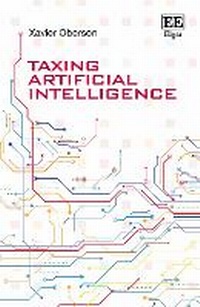
Taxing Artificial Intelligence
2nd Edition
Published on 8. March 2024
Book
Hardback
250 pages
978-1-0353-0754-8 (ISBN)
Description
In this insightful book, a fully updated edition of the author's Taxing Robots, Xavier Oberson explores taxing Artificial Intelligence (AI) as a potential response to rising workplace disruption and inequality as the use of AI across the economy continues to grow.
Drawing on key legal and economic principles, Xavier Oberson, who may be regarded as one of the pioneers of the idea of taxing robots, examines diverse tax models that could be applied to either the use of AI, such as a usage or automation tax, or to AI systems directly, and presents a novel argument in favour of taxing AI. Oberson highlights critical issues including definitions of AI and robots, the complexity of granting a tax capacity to AI, and the compatibility of AI taxes with international tax rules. In particular, this cutting-edge new edition analyses how VAT can be applied to enterprises using AI and autonomous AI systems, and reflects on the legal and technological limits facing lawmakers.
Taxing Artificial Intelligence will be essential reading for scholars, policy makers and students across law and economics. It will also be invaluable for law and tax professionals seeking to understand the latest developments in AI, automation, and the future of work.
Drawing on key legal and economic principles, Xavier Oberson, who may be regarded as one of the pioneers of the idea of taxing robots, examines diverse tax models that could be applied to either the use of AI, such as a usage or automation tax, or to AI systems directly, and presents a novel argument in favour of taxing AI. Oberson highlights critical issues including definitions of AI and robots, the complexity of granting a tax capacity to AI, and the compatibility of AI taxes with international tax rules. In particular, this cutting-edge new edition analyses how VAT can be applied to enterprises using AI and autonomous AI systems, and reflects on the legal and technological limits facing lawmakers.
Taxing Artificial Intelligence will be essential reading for scholars, policy makers and students across law and economics. It will also be invaluable for law and tax professionals seeking to understand the latest developments in AI, automation, and the future of work.
Reviews / Votes
'Oberson's book is an incredible tour de force. He ventures boldly into the new field of AI and develops a truly revolutionary tax proposal. This book is a must read for anyone interested in a technology that promises to revolutionize our world in the next decade.' -- Reuven S. Avi-Yonah, University of Michigan, USMore details
Edition
2nd edition
Language
English
Place of publication
Cheltenham
United Kingdom
Target group
Professional and scholarly
Dimensions
Height: 234 mm
Width: 156 mm
ISBN-13
978-1-0353-0754-8 (9781035307548)
Copyright in bibliographic data and cover images is held by Nielsen Book Services Limited or by the publishers or by their respective licensors: all rights reserved.
Schweitzer Classification
Other editions
Previous edition
Book
05/2019
Edward Elgar Publishing
€127.76
Article exhausted; check for reprint
Person
Xavier Oberson, Professor of Law, University of Geneva, Switzerland
Content
Contents:
Preface
1 General introduction to Taxing Artificial Intelligence
2 The development of artificial intelligence and robots
3 Definition of artificial intelligence and robots
4 Artificial intelligence as a new legal or taxable person
5 The case for a tax on artificial intelligence
6 Current income (profit) taxation of artificial intelligence
7 Development of the taxation of the digital economy and its
impact on the taxation of artificial intelligence
8 VAT on the activities of artificial intelligence
9 The design of a tax on artificial intelligence
10 Taxing artificial intelligence from an international perspective
11 Financing the disruption and automation costs (notably
universal basic income)
12 Main findings and final recommendation
Bibliography
Index
Preface
1 General introduction to Taxing Artificial Intelligence
2 The development of artificial intelligence and robots
3 Definition of artificial intelligence and robots
4 Artificial intelligence as a new legal or taxable person
5 The case for a tax on artificial intelligence
6 Current income (profit) taxation of artificial intelligence
7 Development of the taxation of the digital economy and its
impact on the taxation of artificial intelligence
8 VAT on the activities of artificial intelligence
9 The design of a tax on artificial intelligence
10 Taxing artificial intelligence from an international perspective
11 Financing the disruption and automation costs (notably
universal basic income)
12 Main findings and final recommendation
Bibliography
Index