

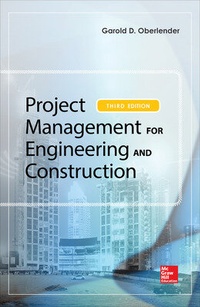
Project Management for Engineering and Construction, Third Edition
3rd Edition
Published on 16. August 2014
Book
Hardback
432 pages
978-0-07-182231-2 (ISBN)
Description
Publisher's Note: Products purchased from Third Party sellers are not guaranteed by the publisher for quality, authenticity, or access to any online entitlements included with the product.
The Latest, Most Effective Engineering and Construction project Management StrategiesFully revised throughout, this up-to-date guide presents the principles and techniques of managing engineering and construction projects from the initial conceptual phase, through design and construction, to completion. The book emphasizes project management duringthe beginning stages of project development to influence the quality, cost, and schedule of a project as early in the process as possible. Featuring an all-new chapter on risk management, the third edition also includes new sections on:
Ensuring project quality
The owner's team
Parametric estimating
Importance of the estimator
Formats for work breakdown structures
Design work packages
Benefits of planning
Calculations to verify schedules and cost distributions
Common problems in managing design
Build-operate-transfer delivery methods
Based on the author's decades of experience in working with hundreds of project managers, this essential resource includes many new real-world examples and updated sample problems.
Project Management for Engineering and Construction, Third Edition, covers:
Working with project teams
Project initiation
Early estimates
Project budgeting
Development of work plan
Design proposals
Project scheduling
Tracking work
Design coordination
Construction phase
Project close out
Personal management skills
Risk management
The Latest, Most Effective Engineering and Construction project Management StrategiesFully revised throughout, this up-to-date guide presents the principles and techniques of managing engineering and construction projects from the initial conceptual phase, through design and construction, to completion. The book emphasizes project management duringthe beginning stages of project development to influence the quality, cost, and schedule of a project as early in the process as possible. Featuring an all-new chapter on risk management, the third edition also includes new sections on:
Ensuring project quality
The owner's team
Parametric estimating
Importance of the estimator
Formats for work breakdown structures
Design work packages
Benefits of planning
Calculations to verify schedules and cost distributions
Common problems in managing design
Build-operate-transfer delivery methods
Based on the author's decades of experience in working with hundreds of project managers, this essential resource includes many new real-world examples and updated sample problems.
Project Management for Engineering and Construction, Third Edition, covers:
Working with project teams
Project initiation
Early estimates
Project budgeting
Development of work plan
Design proposals
Project scheduling
Tracking work
Design coordination
Construction phase
Project close out
Personal management skills
Risk management
More details
Edition
3rd edition
Language
English
Place of publication
United States
Publishing group
McGraw-Hill Education - Europe
Target group
Professional and scholarly
Illustrations
125 Illustrations
Dimensions
Height: 236 mm
Width: 155 mm
Thickness: 31 mm
Weight
724 gr
ISBN-13
978-0-07-182231-2 (9780071822312)
Schweitzer Classification
Person
McGraw-Hill authors represent the leading experts in their fields and are dedicated to improving the lives, careers, and interests of readers worldwide
Content
Ch. 1: IntroductionCh. 2: Working with Project TeamsCh. 3: Project InitiationCh. 4: Early EstimateCh. 5: Project BudgetingCh. 6: Development of the Work PlanCh. 7: Design ProposalsCh. 8: Project SchedulingCh. 9: Tracking WorkCh. 10: Design CoordinationCh. 11: Construction PhaseCh. 12: Project Close OutCh. 13: Personal Management SkillsCh. 14: Risk Assessment and Risk Analysis