

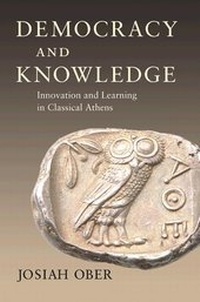
Democracy and Knowledge
Innovation and Learning in Classical Athens
Published on 5. October 2008
Book
Hardback
368 pages
978-0-691-13347-8 (ISBN)
Description
When does democracy work well, and why? Is democracy the best form of government? These questions are of supreme importance today as the United States seeks to promote its democratic values abroad. "Democracy and Knowledge" is the first book to look to ancient Athens to explain how and why directly democratic government by the people produces wealth, power, and security. Combining a history of Athens with contemporary theories of collective action and rational choice developed by economists and political scientists, Josiah Ober examines Athenian democracy's unique contribution to the ancient Greek city-state's remarkable success, and demonstrates the valuable lessons Athenian political practices hold for us today. He argues that the key to Athens' success lay in how the city-state managed and organized the aggregation and distribution of knowledge among its citizens.Ober explores the institutional contexts of democratic knowledge management, including the use of social networks for collecting information, publicity for building common knowledge, and open access for lowering transaction costs.
He explains why a government's attempt to dam the flow of information makes democracy stumble. Democratic participation and deliberation consume state resources and social energy. Yet as Ober shows, the benefits of a well designed democracy far outweigh its costs. Understanding how democracy can lead to prosperity and security is among the most pressing political challenges of modern times. "Democracy and Knowledge" reveals how ancient Greek politics can help us transcend the democratic dilemmas that confront the world today.
He explains why a government's attempt to dam the flow of information makes democracy stumble. Democratic participation and deliberation consume state resources and social energy. Yet as Ober shows, the benefits of a well designed democracy far outweigh its costs. Understanding how democracy can lead to prosperity and security is among the most pressing political challenges of modern times. "Democracy and Knowledge" reveals how ancient Greek politics can help us transcend the democratic dilemmas that confront the world today.
Reviews / Votes
Josiah Ober is a practically minded, get up and go, people's kind of democrat... There is certainly nothing like [Democracy and Knowledge] in the literature on ancient politics. -- Geoffrey Hawthorn Times Literary Supplement Democracy and Knowledge is the final book in an extraordinary trilogy. It follows Mass and Elite in Democratic Athens, which appeared in 1989, and Political Dissent in Democratic Athens, in 1998. This third book incorporates the central conclusions of the first two, and with this volume Ober, by means of a highly original historical argument about Athens, does in fact refute Michel's famous law... Ober's careful historical work and his theoretical framework generate a convincing portrait of a flourishing participatory democracy that overcame real crises, and achieved a stable balancing of the interests of masses and wealthy elites, and responded to collective action problems by developing institutional and cultural solutions that focused on the social distribution and the social valuation of knowledge... Is it too much to ask that members of the Obama administration turn to a dense work of ancient history to help them make good on Obama's vision of an American state that combines the resources of representative and participatory democracy? They would take away from Democracy and Knowledge at least a few important general ideas. -- Danielle Allen The New Republic This book ... richly rewards any reader with interests in democratic theory or Athens. For many it could renew an interest in the sociology of deliberative action. And it does an excellent job rethinking tired political hyperdivision of 'public vs. private,' 'weak vs. strong publics,' and 'civic vs. market orientations.' -- Christopher Moore Bryn Mawr Classical ReviewMore details
Language
English
Place of publication
New Jersey
United States
Target group
College/higher education
Professional and scholarly
Product notice
Trade binding
Illustrations
15 halftones. 9 line illus. 19 tables.
Dimensions
Height: 229 mm
Width: 152 mm
Weight
680 gr
ISBN-13
978-0-691-13347-8 (9780691133478)
Copyright in bibliographic data and cover images is held by Nielsen Book Services Limited or by the publishers or by their respective licensors: all rights reserved.
Schweitzer Classification
Other editions
Additional editions
E-Book
09/2008
1st Edition
Princeton University Press
€30.49
Available for download
Person
Josiah Ober is the Constantine Mitsotakis Professor of Political Science and Classics at Stanford University. His books include "Athenian Legacies, Political Dissent in Democratic Athens," and "Mass and Elite in Democratic Athens" (all Princeton).
Content
List of Illustrations xi List of Tables xii Preface xiii List of Abbreviations xvii Athenian Money, Taxes, Revenues xviii CHAPTER ONE: Introduction: Dispersed Knowledge and Public Action 1 Theory and Practice 3 Rational Choice and Joint Action 6 Premises and Problem 12 Caveats and Method 22 The Argument and Its Contexts 28 Experts and Interests 34 Hypothesis 37 CHAPTER TWO: Assessing Athenian Performance 39 Historical Evaluation 40 Aggregate Flourishing 43 Distribution of Coinage 48 Athens versus Syracuse and Sparta 52 Citations in Greek Literature and Other Measures 53 Athens ??12: A Multiperiod Case Study 55 Democracy as an Explanatory Variable 70 Republics, Democracies, and Athenian Exceptionalism 75 CHAPTER THREE: Competition, Scale, and Varieties of Knowledge 80 Competition and Its Consequences 80 Participation and Scale 84 Social, Technical, and Latent Knowledge 90 Preferences, Parties, and Costly Information 97 Hierarchy, Democracy, and Productivity 102 Knowledge Processes as Public-Action Strategies 106 CHAPTER FOUR: Aggregation: Networks, Teams, and Experts 118 Institutional Design: Incentives, Low Cost, Sorting 118 Establishing a Naval Station, 325/4 B.C. 124 Demes and Tribes as Social Networks 134 The Council of 500: Structural Holes and Bridging Ties 142 Organizational and Individual Learning 151 Boards of Magistrates as Real Teams 156 Ostracism, Assembly, and People's Courts 160 CHAPTER FIVE: Alignment: Common Knowledge, Commitment, and Coordination 168 Alignment and Hierarchy 169 Following Leaders, Rules, and Commitments 172 Cascading and Social Equilibrium 179 A Trial for Treason, 330 B.C. 183 Common Knowledge and Publicity 190 Rational Rituals and Public Monuments 194 Architecture and Intervisibility 199 Scaling Common Knowledge 205 CHAPTER SIX: Codification: Access, Impartiality, and Transaction Costs 211 Intention and Interpretation 211 Open Entry, Fair Procedure, and Transaction Costs 214 A Law on Silver Coinage, 375/4 B.C. 220 Silver Owls, Athenian and Imitation 226 Approval, Certification, Confiscation 231 Legal Standing and Social Status 241 Rules and Rents: Historical Survey 245 Expanding Access 249 Democracy and Social Security 254 Horizons of Fairness 258 CHAPTER SEVEN: Conclusions: Government by the People 264 Knowledge in Action 264 The Democracy/Knowledge Hypothesis Revisited 268 Formality and Experimentation 270 Institutions and Ideology 272 Exceptionalism and Exemplarity 276 APPENDIX A. Aggregate Material Flourishing 281 APPENDIX B. Distribution of Coins in Hoards 285 APPENDIX C. Prominence in Classical Greek Literature 287 APPENDIX D. Impact of Constitution and Historical Experience 289 APPENDIX E. Athenian State Capacity and Democracy, 600-250 B.C. 292 Bibliography 295 Index 333