

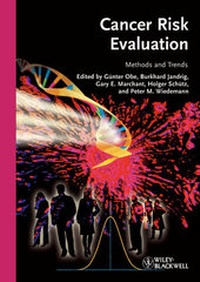
Cancer Risk Evaluation
Methods and Trends
1st Edition
Published on 20. April 2011
Book
Hardback
XVIII, 348 pages
978-3-527-32753-9 (ISBN)
Description
An overview of the different approaches to cancer risk assessment of environmental factors - including "-omics" technologies, discussing the strengths and weaknesses of the methods in different fields. The main focus is on the carcinogenic effects of ionizing and non-ionizing radiation, demonstrating the difficulties in accurately assessing those factors that may or may not pose a significant cancer risk. The book extends the view to a broader context of risk assessment, highlighting various aspects of risk management. Written by leading experts in the field, this is a resource for policy makers and professionals in health risk assessment, and public health workers, as well as oncologists and researchers in academia.
Reviews / Votes
"Overall, the book provides an excellent account of various aspects of cancer and radiation risk assessment for a broad understanding of principles and effects for the betterment of human health." (Indian J Med Res, 1 March 2013)More details
Edition
1. Auflage
Language
English
Place of publication
Berlin
Germany
Publishing group
Wiley-VCH
Target group
Professional and scholarly
Illustrations
22
7 farbige Abbildungen, 27 s/w Abbildungen, 22 s/w Tabellen
Dimensions
Height: 24 cm
Width: 17 cm
Thickness: 2.1 cm
Weight
832 gr
ISBN-13
978-3-527-32753-9 (9783527327539)
Schweitzer Classification
Other editions
Additional editions
E-Book
05/2011
1st Edition
Wiley-Blackwell
€99.99
Available for download
E-Book
03/2011
1st Edition
Wiley-Blackwell
€99.99
Available for download
Persons
Günter Obe was a full professor at the University of Duisburg-Essen from 1988 until his retirement in 2004. He obtained his degree from the Free University Berlin in 1967, where he was a professor from 1974 onwards. His field of research focused on cytogenetics, such as in vitro induction of chromosomal aberrations, cytogenetic population monitoring of persons exposed to suspected mutagens, and mechanisms of the origin of chromosomal aberrations.
Burkhard Jandrig gained his degree in biochemistry from the University of Leipzig. From 1982 until 1991 he was a research associate and group leader at the Institute of Cancer Research Berlin, working in the areas of chemical carcinogenesis and multidrug resistance. From 1992 through 2010 he held the same positions at the Max-Delbrück Center for Molecular Medicine in Berlin. His research activities are in the fields of molecular carcinogenesis, tumor genetics, tumor virology and bioethics.
Gary Marchant is the Lincoln Professor of Emerging Technologies, Law and Ethics at the Sandra Day O´Connor College of Law at Arizona State University, where he is also a professor of life sciences and executive director of the Center for Law, Science & Innovation. Professor Marchant teaches and researches in the subject areas of environmental law, risk assessment and risk management, genetics and the law, biotechnology law, food and drug law, legal aspects of nanotechnology, and law, sciences and technology.
Holger Schütz studied educational sciences at the Technical University of Braunschweig. From 1986 to 1990 he worked at the Institute of Psychology, Technical University of Berlin, and has been at the Research Center Jülich since 1990. His research focuses on risk perception and risk communication, comparative assessment of environmental health risks, and evidence assessment.
Peter Wiedemann is a psychologist and professor at the Karlsruhe Institute of Technology, teaches at the University of Innsbruck, Austria, and a former president of the Society of Risk Analysis, Europe. His research and teaching activities focus on risk perception, risk communication, and precautionary risk management, as well as on risk and sustainability issues.
Burkhard Jandrig gained his degree in biochemistry from the University of Leipzig. From 1982 until 1991 he was a research associate and group leader at the Institute of Cancer Research Berlin, working in the areas of chemical carcinogenesis and multidrug resistance. From 1992 through 2010 he held the same positions at the Max-Delbrück Center for Molecular Medicine in Berlin. His research activities are in the fields of molecular carcinogenesis, tumor genetics, tumor virology and bioethics.
Gary Marchant is the Lincoln Professor of Emerging Technologies, Law and Ethics at the Sandra Day O´Connor College of Law at Arizona State University, where he is also a professor of life sciences and executive director of the Center for Law, Science & Innovation. Professor Marchant teaches and researches in the subject areas of environmental law, risk assessment and risk management, genetics and the law, biotechnology law, food and drug law, legal aspects of nanotechnology, and law, sciences and technology.
Holger Schütz studied educational sciences at the Technical University of Braunschweig. From 1986 to 1990 he worked at the Institute of Psychology, Technical University of Berlin, and has been at the Research Center Jülich since 1990. His research focuses on risk perception and risk communication, comparative assessment of environmental health risks, and evidence assessment.
Peter Wiedemann is a psychologist and professor at the Karlsruhe Institute of Technology, teaches at the University of Innsbruck, Austria, and a former president of the Society of Risk Analysis, Europe. His research and teaching activities focus on risk perception, risk communication, and precautionary risk management, as well as on risk and sustainability issues.
Content
Preface
Introduction
MODELS AND APPROACHES
Models of cancer development: genetic and environmental influences (Jandrig)
Endogenous DNA damage and its relevance for the initiation of carcinogenesis (Epe, Fusser)
The IARC Monographs Programme: cancer-hazard identification as a first step in cancer-risk assessment and cancer prevention (Baan, Cogliano)
EPIDEMIOLOGICAL RESEARCH
The role of epidemiology in cancer risk assessment of non-ionising radiation (Schüz, Berg-Beckhoff, Schlehofer, Blettner)
The role of epidemiology in cancer risk assessment of ionizing radiation (Wakeford)
ANIMAL STUDIES
Animal studies on RF-EMF cancer effects (Dasenbrock, Buschmann)
Animal studies in carcinogen identification: The example of power-frequency (50/60 Hz) magnetic fields (McCormick)
GENOTOXICITY STUDIES
Chromosomal aberrations in human populations and cancer (Obe, Lloyd, Durante)
Cytogenetic studies in mammalian somatic cells exposed to radiofrequency radiation: A meta-analysis (Vijayalaxmi , Prihoda)
OMICS - A NEW TOOL FOR CANCER RISK ASSESSMENT?
Genomics and cancer risk assessment (Schweiger, Timmermann)
Transcriptomics and cancer risk assessment (Kemmner)
Proteomics and cancer risk assessment (Schramm)
CURRENT USE OF OMICS STUDIES FOR CANCER RISK ASSESSMENT
Omics in cancer risk assessment: Pathways to disease (Portier, Thomas)
What have omics taught us about the health risks associated with exposure to low doses of ionizing radiation? (Morgan, Sowa)
Current use of omics studies for cancer risk assessment: Transcriptomics approach in RF-EMF research (Mevissen)
Proteomics approach In mobile phone radiation research (Leszczynski)
CHALLENGES FOR RISK MANAGEMENT
Evaluating the reliability of controversial scientific results (Lerchl)
Comparative risk assessment with ionising and non-ionising radiations (Kiefer)
Communicating about uncertainties in cancer risk assessment (Wiedemann, Schütz)
The Precautionary Principle and radiofrequency exposure from mobile phones (Marchant)
Introduction
MODELS AND APPROACHES
Models of cancer development: genetic and environmental influences (Jandrig)
Endogenous DNA damage and its relevance for the initiation of carcinogenesis (Epe, Fusser)
The IARC Monographs Programme: cancer-hazard identification as a first step in cancer-risk assessment and cancer prevention (Baan, Cogliano)
EPIDEMIOLOGICAL RESEARCH
The role of epidemiology in cancer risk assessment of non-ionising radiation (Schüz, Berg-Beckhoff, Schlehofer, Blettner)
The role of epidemiology in cancer risk assessment of ionizing radiation (Wakeford)
ANIMAL STUDIES
Animal studies on RF-EMF cancer effects (Dasenbrock, Buschmann)
Animal studies in carcinogen identification: The example of power-frequency (50/60 Hz) magnetic fields (McCormick)
GENOTOXICITY STUDIES
Chromosomal aberrations in human populations and cancer (Obe, Lloyd, Durante)
Cytogenetic studies in mammalian somatic cells exposed to radiofrequency radiation: A meta-analysis (Vijayalaxmi , Prihoda)
OMICS - A NEW TOOL FOR CANCER RISK ASSESSMENT?
Genomics and cancer risk assessment (Schweiger, Timmermann)
Transcriptomics and cancer risk assessment (Kemmner)
Proteomics and cancer risk assessment (Schramm)
CURRENT USE OF OMICS STUDIES FOR CANCER RISK ASSESSMENT
Omics in cancer risk assessment: Pathways to disease (Portier, Thomas)
What have omics taught us about the health risks associated with exposure to low doses of ionizing radiation? (Morgan, Sowa)
Current use of omics studies for cancer risk assessment: Transcriptomics approach in RF-EMF research (Mevissen)
Proteomics approach In mobile phone radiation research (Leszczynski)
CHALLENGES FOR RISK MANAGEMENT
Evaluating the reliability of controversial scientific results (Lerchl)
Comparative risk assessment with ionising and non-ionising radiations (Kiefer)
Communicating about uncertainties in cancer risk assessment (Wiedemann, Schütz)
The Precautionary Principle and radiofrequency exposure from mobile phones (Marchant)