

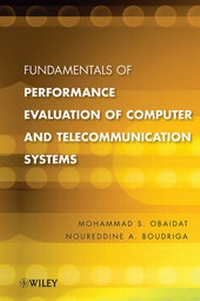
Fundamentals of Performance Evaluation of Computer and Telecommunications Systems
1st Edition
Published on 9. February 2010
Book
Hardback
460 pages
978-0-471-26983-0 (ISBN)
Description
This book presents all techniques of performance evaluation of computers, networks, and telecommunications in a balanced manner. It is unique in that no other book covers all of the techniques, nor do they treat computer and telecommunications systems as inseparable issues, which the author does here. This book fills a gap by providing the only singular, all-encompassing textbook on the subject.
More details
Product info
GB
Edition
1., Auflage
Language
English
Place of publication
United States
Publishing group
John Wiley & Sons Inc
Target group
College/higher education
Professional and scholarly
Product notice
sewn/stitched
Cloth over boards
Dimensions
Height: 240 mm
Width: 161 mm
Thickness: 30 mm
Weight
883 gr
ISBN-13
978-0-471-26983-0 (9780471269830)
Schweitzer Classification
Other editions
Additional editions
Mohammed S. Obaidat | Noureddine A. Boudriga
Fundamentals of Performance Evaluation of Computer and Telecommunications Systems
E-Book
01/2010
Wiley
€123.99
Available for download
Persons
Professor Mohammad S. Obaidat is an internationally well-known academic/researcher/scientist. He received his Ph.D. and M. S. degrees in Computer Engineering with a minor in Computer Science from the Ohio State University, Columbus, Ohio, USA. Dr. Obaidat is currently a tenured full Professor of Computer Science at Monmouth University, NJ, USA. Among his previous positions are Chair of the Department of Computer Science and Director of the Graduate Program at Monmouth University and a faculty member at the City University of New York. He has received extensive research funding and has published over two hundred and ten (210) refereed technical articles in refereed scholarly journals and proceedings of refereed international conferences. He is the co-author of the book entitled, "Wireless Networks" to be published by Wiley in August 2002.?Noureddine Boudriga is a professor at the School of Telecommunications at Catharge University in Tunis, Tunisia.
Content
1. Introduction and Basic Concepts.
1.1. Background.
1.2. Performance Evaluation Viewpoints and Concepts.
1.3. Goals of Performance Evaluation.
1.4. Applications of Performance Evaluation.
1.5. Techniques.
1.6. Metrics of Performance.
1.7. Workload characterization.
1.8. Benchmarking.
1.9. Summary.
Exercises.
2. Probability Theory Review.
2.1 Basic Concepts on Probability Theory.
2.2 Sample Space and Events.
2.3 Conditional Probability and Independence.
2.2 Mean and Median use.
2.3 Geometric, and Harmonic Mean.
2.4 Variance, and Standard Deviation.
2.5 Random Variables.
2.6 Expectation and Variance.
2.7 Density and Distribution Functions.
2.8 Comparing Systems Using Sample Data.
2.9 Regression Models.
2.10 Summary.
Exercises.
3. Measurement/Testing Technique.
3.1. Event and Measurement Strategies.
3.2. Event Tracing.
3.3. Hardware Monitor.
3.4. Software Monitors.
3.5. Hybrid Monitors.
3.6. Traffic Issues and Solutions.
3.7. Accounting Logs.
3.8. Summary.
Exercises.
4. Benchmarking and Capacity Planning.
4.1 Types of Benchmark Programs.
4.2 Common Mistakes in Benchmarking.
4.3 Example Benchmark Programs.
4.4 Procedures of Capacity planning.
4.5 Problems in Capacity Planning.
4.6 Summary.
Exercises.
5. Data Representation and Game Ratio.
5.1 Guidelines for Preparing Plots.
5.2 Charts Used for Data Presentation.
5.3 Program Profiling.
5.4 Common Mistakes in Charts Construction.
5.5 Errors in Experimental Measurements.
5.6 Summary.
Exercises.
6. Basics of Queueing Theory.
6.1 Introduction.
6.2 Queueing Modeling Notations.
6.3 Rules for all Queues.
6.4 Single-Queue, Single (M/M/ 1) System.
6.5. Single-Queue, Multiple Server (M/M/c) System.
6.6 Other Queues.
6.7. Little's Law.
6.8. Summary.
Exercises.
7. Queueing Networks.
7.1 Definitions.
7.2 Open Queueing Networks.
7.3 Closed Queueing Networks.
7.4 Product-Form Queueing Networks.
7.5 Case Studies.
Exercises.
8. Operational and Mean Value Analysis.
8.1 Utilization Law.
8.2 Little's Formula.
8.3 Forced Flow Law.
8.4 Interactive Response Time Law.
8.5 Bottleneck Analysis.
8.6 Standard Mean Value Analysis (MVA).
8.7 Scheweitzer's Approximation of MVA.
8.8 Balanced Job Bounds.
9. Introduction to the Simulation Technique.
9.1 Simulation Types.
9.2 Terminology.
9.3 Random Number Generation Techniques.
9.3.1 Linear Congruential Generators.
9.3.2 Mixed Generators.
9.3.3 Tausworthe Generators.
9.3.5 Extended Fibonici Generators.
9.4 Survey of Commonly Used Random Number Generators.
9.5 Seed Selections.
9.6 Testing Random Number Generators.
9.7 Random Variate Generation Techniques.
9.7.1 Inverse Transformation.
9.7.2 Rejection.
9.7.3 Characterization.
9.7.4 Convolution.
9.7.5 Composition.
9.8 Examples.
Exercises.
10. Commonly Used Distributions in Simulation and Their Applications.
10.1 Exponential.
10.2 Posisson.
10.3 Uniform.
10.5 Normal.
10.6 Weibull.
10.7 Pareto.
10.8 Geometric.
10.9 Gamma.
10.10 Erlang.
10.11 Beta.
10.12 Binomial.
10.13 Bernoulli.
10.14 Chi-Square.
10.15 F Distribution.
10.16 Log Normal.
10.17 Pascal.
10.18 Student's t Distribution.
10.19 Examples.
Exercises.
11. Analysis of Simulation Outputs.
11.1 Introduction.
11.2 Vérification Techniques.
11.3 Validation techniques.
11.4 Techniques for Transient Removal.
11.5 Techniques for Termination of Simulation and Stopping Criteria.
Exercises.
12. Simulation Software.
12.1 General Purpose Languages.
12.2 Simulation languages.
12.3 Object-Oriented languages.
12.3.1 Standard Object-Oriented Languages.
12.3.2 Objected-oriented Simulation Languages.
12.4 Simulation Packages Used for Simulation of Computer and Telecommunications Systems.
12.4 Case Studies.
Exercises.