

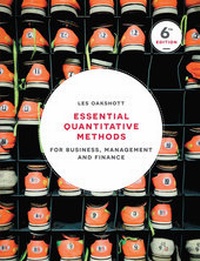
Essential Quantitative Methods
Description
An ideal textbook for undergraduate students of business, management and finance, it is also widely used by MBA students and postgraduates.
Reviews / Votes
"Students will love the succinct presentation and easy-to-follow formulae deductions, all made rleveant through current economic examples. The historical fun facts are engaging; they add to the ease of remembering concepts and stimulate curiosity." - Liliana Danila, American University of Sharjah, UAE 'This is the ideal book for both starters and refreshers who want to get a good grip on the essentials of quantitative methods. It is thoughtful, well-written, and inclusive.' - Bilal Moosa, Hogeschool van Amsterdam, Netherlands 'This new edition of Oakshott builds on the strength of the last. It continues to provide undergraduates with a well-structured scaffolding approach to learning quantitative methods (...) With a range of new examples and well-labelled diagrams of equations, the book is approachable for students who haven't studied maths and stats since GCSE. It takes them right up to the required level.' - Peter Hill, University of Roehampton, UKMore details
Other editions
New editions
Person
Les Oakshott is a former Associate Fellow of Warwick Business School, UK. He has worked in industry and education and has wide experience of applying teaching quantitative methods in a business context.
Content
PART I: MATHEMATICAL APPLICATIONS Revision Mathematics.- 2. Keeping up with Change: Index Numbers.- PART II: COLLECTING AND INTERPRETING DATA 3. Collecting Data: Surveys and Samples.- 4. Finding Patterns in Data: Charts and Tables.- 5. Making Sense of Data: Averages and Measures of Spread.- PART III: PROBABILITY& STATISTICS 6. Taking a Chance: Probability.- 7. The Shape of Data: Probability Distributions.- 8. Interpreting with Confidence: Analysis of Sample Data.- 9. Checking Ideas: Testing a Hypothesis.- 10. Cause and Effect: Correlation and Regression.- PART IV: DECISION MAKING TECHNIQUES 11. How to make Good Decisions.- 12. Choosing wisely: Investment Appraisal.- 13. Forecasting: Time Series Analysis.- 14. Making the Most of Things: Linear Programming.- 15. Planning Large Projects: Network Analysis.- 16. Managing Stock Levels: Materials Management and Inventory Control.