

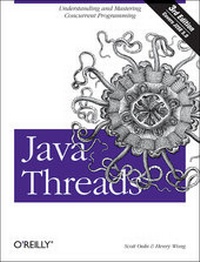
Java Threads
3rd Edition
Published on 19. October 2004
Book
358 pages
978-0-596-00782-9 (ISBN)
Description
Threads are essential to Java programming, but learning to use them effectively is a nontrivial task. This new edition of the classic Java Threads shows you how to take full advantage of Java's threading facilities and brings you up-to-date with the watershed changes in Java 2 Standard Edition version 5.0 (J2SE 5.0). It provides a thorough, step-by-step approach to threads programming.Java's threading system is simple relative to other threading systems. In earlier versions of Java, this simplicity came with tradeoffs: some of the advanced features in other threading systems were not available in Java. J2SE 5.0 changes all that: it provides a large number of new thread-related classes that make the task of writing multithreaded programs that much easier.You'll learn where to use threads to increase efficiency, how to use them effectively, and how to avoid common mistakes. This book discusses problems like deadlock, race conditions, and starvation in detail, helping you to write code without hidden bugs.Java Threads, Third Edition, has been thoroughly expanded and revised. It incorporates the concurrency utilities from java.util.concurrent throughout. New chapters cover thread performance, using threads with Swing, threads and Collection classes, thread pools, and threads and I/O (traditional, new, and interrupted). Developers who cannot yet deploy J2SE 5.0 can use thread utilities provided in the Appendix to achieve similar functionality with earlier versions of Java.Topics include:
* Lock starvation and deadlock detection
* Atomic classes and minimal synchronization (J2SE 5.0)
* Interaction of Java threads with Swing, I/O, and Collection classes
* Programmatically controlled locks and condition variables (J2SE 5.0)
* Thread performance and security
* Thread pools (J2SE 5.0)
* Thread groups
* Platform-specific thread scheduling
* Task schedulers (J2SE 5.0)
* Parallelizing loops for multiprocessor machines
In short, this new edition of Java Threads covers everything you need to know about threads, from the simplest animation program to the most complex applications. If you plan to do any serious work in Java, you will find this book invaluable.Scott Oaks is a senior software engineer for the Java Performance Engineering group at Sun Microsystems and the author of four books in the O'Reilly Java series.Formerly a senior systems engineer at Sun Microsystems, Henry Wong is an independent consultant working on various Java related projects.
Reviews / Votes
If you are a Java programmer and you are thinking of using threads to make your work more responsive or even faster given todays symmetric multiprocessing hardware, then this is an excellent book. It probably isnt academic enough for use in formal education but as a practical guide to how not to do things, and hopefully how to do things better, it is excellent. - Harry Fairhead, VSJ, May 2005More details
Language
English
Place of publication
Sebastopol
United States
Target group
Professional and scholarly
Java developers
Product notice
Paperback (trade)
Unsewn / adhesive bound
Dimensions
Height: 231 mm
Width: 179 mm
Thickness: 22 mm
Weight
606 gr
ISBN-13
978-0-596-00782-9 (9780596007829)
Schweitzer Classification
Other editions
Additional editions
E-Book
09/2004
1st Edition
O'Reilly
€33.99
Available for download
E-Book
09/2004
O'Reilly
€26.49
Available for download
Previous edition
Scott Oaks | Henry Wong
Java Threads
Book
02/1999
2nd Edition
O'Reilly
€29.00
Article exhausted; check for reprint
Persons
Scott Oaks is a Java Technologist at Sun Microsystems, where he has worked since 1987. While at Sun, he has specialized in many disparate technologies, from the SunOS kernel to network programming and RPCs. Since 1995, he's focused primarily on Java and bringing Java technology to end-users. Scott also authored O'Reilly's Java Security, Java Threads and Jini in a Nutshell titles. Henry Wong is a tactical engineer at Sun Microsystems, where he has worked since 1989. Originally hired as a consultant to help customers with special device drivers, kernel modifications, and DOS interoperability products, Henry has also worked on Solaris ports, performance tuning projects, and multithreaded design and implementations for benchmarks and demos. Since early 1995, Henry has been involved in developing Java prototypes and supporting customers who are using Java. Prior to joining Sun, Henry earned a bachelor of science degree in chemical engineering from The Cooper Union in 1987. He joined a small software company in 1986 working on SCSI device drivers, image and audio data compression, and graphics tools used for a medical information system. When not in front of a computer, Henry is an instrument rated private pilot, who also likes to dabble in archery, cooking, and traveling to different places with his wife, Nini.
Content
Preface 1. Introduction to Threads Java Terms About the Examples Why Threads? 2. Thread Creation and Management What Is a Thread? Creating a Thread The Lifecycle of a Thread Two Approaches to Stopping a Thread The Runnable Interface Threads and Objects 3. Data Synchronization The Synchronized Keyword The Volatile Keyword More on Race Conditions Explicit Locking Lock Scope Choosing a Locking Mechanism Nested Locks Deadlock Lock Fairness 4. Thread Notification Wait and Notify Condition Variables 5. Minimal Synchronization Techniques Can You Avoid Synchronization? Atomic Variables Thread Local Variables 6. Advanced Synchronization Topics Synchronization Terms Synchronization Classes Added in J2SE 5.0 Preventing Deadlock Deadlock Detection Lock Starvation 7. Threads and Swing Swing Threading Restrictions Processing on the Event-Dispatching Thread Using invokeLater( ) and invokeAndWait( ) Long-Running Event Callbacks 8. Threads and Collection Classes Overview of Collection Classes Synchronization and Collection Classes The Producer/Consumer Pattern Using the Collection Classes 9. Thread Scheduling An Overview of Thread Scheduling Scheduling with Thread Priorities Popular Threading Implementations 10. Thread Pools Why Thread Pools? Executors Using a Thread Pool Queues and Sizes Thread Creation Callable Tasks and Future Results Single-Threaded Access 11. Task Scheduling Overview of Task Scheduling The java.util.Timer Class The javax.swing.Timer Class The ScheduledThreadPoolExecutor Class 12. Threads and I/O A Traditional I/O Server A New I/O Server Interrupted I/O 13. Miscellaneous Thread Topics Thread Groups Threads and Java Security Daemon Threads Threads and Class Loading Threads and Exception Handling Threads, Stacks, and Memory Usage 14. Thread Performance Overview of Performance Synchronized Collections Atomic Variables and Contended Synchronization Thread Creation and Thread Pools 15. Parallelizing Loops for Multiprocessor Machines Parallelizing a Single-Threaded Program Multiprocessor Scaling Appendix: Superseded Threading Utilities Index