

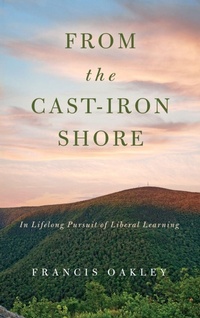
From the Cast-Iron Shore
In Lifelong Pursuit of Liberal Learning
Published on 15. November 2018
Book
Hardback
550 pages
978-0-268-10401-6 (ISBN)
Description
From the Cast-Iron Shore is part personal memoir and part participant-observer's educational history. As president emeritus at Williams College in Massachusetts, Francis Oakley details its progression from a fraternity-dominated institution in the 1950s to the leading liberal arts college it is today, as ranked by U.S. News and World Report.
Oakley's own life frames this transformation. He talks of growing up in England, Ireland, and Canada, and his time as a soldier in the British Army, followed by his years as a student at Yale University. As an adult, Oakley's provocative writings on church authority stimulated controversy among Catholic scholars in the years after Vatican II. A Fellow of the American Academy of Arts and Sciences and the Medieval Academy of America, and an Honorary Fellow of Corpus Christi College, Oxford, he has written extensively on medieval intellectual and religious life and on American higher education.
Oakley combines this account of his life with reflections on social class, the relationship between teaching and research, the shape of American higher education, and the challenge of educational leadership in the late twentieth and early twenty-first century. The book is an account of the life of a scholar who has made a deep impact on his historical field, his institution, his nation, and his church, and will be of significant appeal to administrators of liberal arts colleges and universities, historians, medievalists, classicists, and British and American academics.
Oakley's own life frames this transformation. He talks of growing up in England, Ireland, and Canada, and his time as a soldier in the British Army, followed by his years as a student at Yale University. As an adult, Oakley's provocative writings on church authority stimulated controversy among Catholic scholars in the years after Vatican II. A Fellow of the American Academy of Arts and Sciences and the Medieval Academy of America, and an Honorary Fellow of Corpus Christi College, Oxford, he has written extensively on medieval intellectual and religious life and on American higher education.
Oakley combines this account of his life with reflections on social class, the relationship between teaching and research, the shape of American higher education, and the challenge of educational leadership in the late twentieth and early twenty-first century. The book is an account of the life of a scholar who has made a deep impact on his historical field, his institution, his nation, and his church, and will be of significant appeal to administrators of liberal arts colleges and universities, historians, medievalists, classicists, and British and American academics.
Reviews / Votes
"From the Cast-Iron Shore testifies to... the spectrum of accomplishments and challenges arising from the nature of small collegiate life and the rapidly changing political, social, and cultural forces of the latter twentieth century... Oakley's testimony to the reality, immediacy, and power of campus life can and does directly shape the intellectual imagination about the state of modern liberal arts colleges and their needs-and the demand to understand and properly contextualize, near and far." -- University Bookman"In his beautifully written memoir, Francis Oakley . . . former president of Williams College . . . tells the tale of [his] journey from being an Irish immigrant in England through his education as a first-generation college student at Oxford and then his crossing to North America. . . . The book is . . . illuminating, amusing, wise, and moving." -America
". . .this is less a book about higher education and its ways than about 'the lifelong pursuit of liberal learning'-learning not just from teaching and scholarship, but also from patient listening to those who disagree with you, whether irate students with their 'non-negotiable demands,' skeptical trustees, or faculty who find some curricular suggestions to be 'just not the Williams way.'" -Commonweal
"This is an extraordinary book. One of Francis Oakley's rare qualities is his ability to stand back and look at himself and the situation objectively, even at the time. This characteristic is especially clear in his responses to the many challenges to education posed by students (and agitators) in the 1960s and 1970s. His self-awareness and objectivity, his success in remaining calm and open-minded yet firm in principle, was extraordinary. And as he hints, faculties today face some of the same challenges. They can well learn from him." -Jeffrey B. Russell, emeritus, University of California, Santa Barbara
"Written in prose as captivating as a novel, Francis Oakley recounts his journey from working class childhood in Liverpool to influential president of a leading liberal arts college in the United States. It is a remarkable story about family life, abiding faith and friendships, and dedicated teaching and scholarship. It is also a story of inspired leadership that anyone interested in higher education will find compelling and admirable." -Kenda Mutongi, Williams College
"We are indebted to Francis Oakley-medieval historian, political philosopher, college president, and scholar of the liberal arts college in the United States-for this literary, even lyrical, account of his youth and education as an Irish Catholic in Liverpool; his studies at Oxford, Toronto, and Yale; and his distinguished career at Williams College. This extremely interesting autobiographical commentary on schooling, politics, and higher education in the twentieth century will inform and fascinate scholars and general readers." -Bruce A. Kimball, Ohio State University
"In a thoroughly beguiling way, Francis Oakley shares with the reader his own repeated surprise at the sinuous path along which his life has proceeded. Intelligence and determination played key roles, as did some good teachers, a strong family, and a deep faith. The memoir is beautifully written and is marked by humor, a storyteller's gift for moving the story along, and a generosity of spirit that repeatedly impressed me. This book was my warm companion for several days. When I finished it, I missed it. I think others will feel that way too." -Thomas F. X. Noble, Andrew V. Tackes Professor of History Emeritus, University of Notre Dame
More details
Language
English
Place of publication
Notre Dame IN
United States
Target group
Professional and scholarly
Illustrations
24 halftones - 24 Halftones, unspecified
Dimensions
Height: 235 mm
Width: 157 mm
Thickness: 34 mm
Weight
941 gr
ISBN-13
978-0-268-10401-6 (9780268104016)
Copyright in bibliographic data and cover images is held by Nielsen Book Services Limited or by the publishers or by their respective licensors: all rights reserved.
Schweitzer Classification
Other editions
Additional editions
E-Book
11/2018
University of Notre Dame Press
€27.49
Available for download
Person
Francis Oakley is the Edward Dorr Griffin Professor of the History of Ideas Emeritus, and president emeritus of Williams College. He is also president emeritus of the American Council of Learned Societies, New York. He is the author and editor of numerous books, including The Watershed of Modern Politics: Law, Virtue, Kingship and Consent (1300 to 1650) and The Mortgage of the Past: Reshaping the Ancient Political Inheritance (1050 to 1300).
Content
Prelude
Part 1. LIVERPOOL
1. The secure realm of BEFORE
2. The shadowed world of AFTER
3. Trajectories of Fear
4. Ad Majorem Dei Gloriam
Part 2. LISSANANNY, OXFORD, TORONTO, CAMBRIDGE, MA., PRESTON, ALDERSHOT, CATTERICK, GLOUCESTER, NEW HAVEN
5. Poblacht na hEireann
6. Collegium Corporis Christi
7. Oh, Canada!
8. On Her Majesty's Service
9. Lux et veritas
Part 3. WILLIAMSTOWN
10. Williamstown and its College
11. Encountering the Old Williams
12. The Transformative Sixties (i): The New Williams
13. The Transformative Sixties (ii): The Second Vatican Council
14. Vita contemplativa: Teaching and Research
15. Vita activa (i): Matters of governance
16. Vita activa (ii): The administrative turn
17. Presidential Years (i): The job: nature, range and variety
18. Presidential Years (ii): Organization, appointments, initiatives
19. Presidential Years (iii): Principal challenges confronted
20. Aftermath
Postlude
Acknowledgements
Citations
Part 1. LIVERPOOL
1. The secure realm of BEFORE
2. The shadowed world of AFTER
3. Trajectories of Fear
4. Ad Majorem Dei Gloriam
Part 2. LISSANANNY, OXFORD, TORONTO, CAMBRIDGE, MA., PRESTON, ALDERSHOT, CATTERICK, GLOUCESTER, NEW HAVEN
5. Poblacht na hEireann
6. Collegium Corporis Christi
7. Oh, Canada!
8. On Her Majesty's Service
9. Lux et veritas
Part 3. WILLIAMSTOWN
10. Williamstown and its College
11. Encountering the Old Williams
12. The Transformative Sixties (i): The New Williams
13. The Transformative Sixties (ii): The Second Vatican Council
14. Vita contemplativa: Teaching and Research
15. Vita activa (i): Matters of governance
16. Vita activa (ii): The administrative turn
17. Presidential Years (i): The job: nature, range and variety
18. Presidential Years (ii): Organization, appointments, initiatives
19. Presidential Years (iii): Principal challenges confronted
20. Aftermath
Postlude
Acknowledgements
Citations