

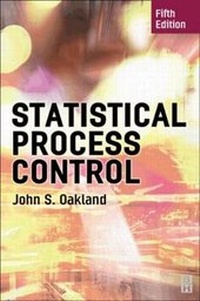
Statistical Process Control
5th Edition
Published on 10. December 2002
Book
Paperback/Softback
464 pages
978-0-7506-5766-2 (ISBN)
Description
It is a highly successful title from one of the UK's leading exponents of TQM. The book features user-friendly presentation and reflects the latest thinking in the field. It will serve as a textbook for self or group instruction for both student and practicing engineers, scientists, technologists and managers and will prove invaluable to all. Statistical process control is a tool, which enables both manufacturers and suppliers to achieve control of product quality by means of the application of statistical methods in the controlling process. This book gives the foundations of good quality management and process control, including an explanation of what quality is, and control of conformance and consistency during production. The text offers clear guidance and help to those unfamiliar with either quality control or statistical applications and covers all the necessary theory and techniques in a practical and non-mathematical manner. This book will be essential reading for anyone wishing to understand or implement modern statistical process control techniques. This new edition is fully updated and includes a new chapter on Six Sigma.
It is written by a well-known, authoritative author who introduced statistical process control to thousands of organizations throughout the world. It is written in a practical way that minimizes the use of formulas and assumes no prior knowledge of statistics.
It is written by a well-known, authoritative author who introduced statistical process control to thousands of organizations throughout the world. It is written in a practical way that minimizes the use of formulas and assumes no prior knowledge of statistics.
Reviews / Votes
"Whether your sector is manufacturing, sales, marketing, finance, service or public, this instructional guide to the tools of SPC is an essential practical guide." QUALITY WORLD (Feb 2003) "Written for managers, technologists, engineers, scientists and students alike, the book uses the minimum of formulas and assumes no prior knowledge of statistics. It covers all the necessary theory and techniques in a practical and non-mathematical manner. The book gives the foundations of good quality management and process control, including an explanation of what quality is, and discusses control of conformance and consistency during production." WORKS MANAGEMENT (Jan 2003) People in management and leadership positions often do not understand variation. As a result, instead of having a stabilising effect, they frequently over-react to events leading to wasted efforts, disorganisation and chaos. The authors advice is: Dont just do something, sit there (and think)! Statistical process control (SPC) is a tool for understanding processes, and thus helping managers in decision-making, so that organisations can improve quality and reduce wasted resources. It is a method to stop producing chaos by reducing management interference. This soft-cover book is a practical guide for SPC and does not presuppose prior statistical or process management knowledge. It also sets out the philosophyessential to the practiceof process management and improvement. There are 15 chapters divided into five sections, with 11 appendices. Each chapter has figures and tables that enhance elucidation, and examples of real-world applications are scattered throughout. The first section, Process understanding, looks at design, conformance and costs of quality. Next, Process variability is split into two chapters. Process control has four chapters that discuss control charts for variables and attributes, and cumulative sum charts. The shortest section, Process capability, has only 14 pages, but adequately presents several capability indices (however, not the well-known CPM index). The last section, Process Improvement, has five chapters, including a new chapter on six sigma. There is a good five-page index and each chapter ends with a list of references. This book would be an excellent tool for managers, engineers and others actively involved in understanding, analysing and improving processes. It is also suitable for business and engineering students, with each chapter providing learning objectives and discussion questions. I was particularly impressed by the ease with which a reader could use it for implementing SPC. It should be in the library of all organisations and on the bookcase of all individuals involved in process design, evaluation, control and continuous improvement of performance, products or services. Mark A. Best, Eastview, June 2005 edition of "Significance - statistics making sense", a publication of the Royal Statistical SocietyMore details
Edition
5th Revised edition
Language
English
Place of publication
Oxford
United Kingdom
Publishing group
Taylor & Francis Ltd
Target group
Professional and scholarly
Edition type
Revised edition
Illustrations
Approx. 150 illustrations
Dimensions
Height: 234 mm
Width: 156 mm
Weight
695 gr
ISBN-13
978-0-7506-5766-2 (9780750657662)
Copyright in bibliographic data and cover images is held by Nielsen Book Services Limited or by the publishers or by their respective licensors: all rights reserved.
Schweitzer Classification
Other editions
New editions
John Oakland | John S. Oakland
Statistical Process Control
Book
09/2007
6th Edition
Butterworth-Heinemann
€49.51
Article exhausted; check for reprint
Previous edition

John Oakland
Statistical Process Control
Book
04/1999
4th Edition
Butterworth-Heinemann
€33.41
Article exhausted; check for reprint
Person
By Other John S Oakland
Content
Part 1: Process Understanding. Part 2: Process Variability. Part 3: Process Control. Part 4: Process Capability. Part 5: Process Improvement. Appendices.