

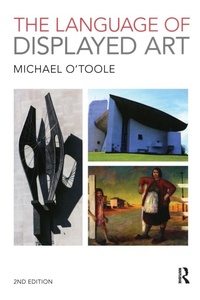
The Language of Displayed Art
1st Edition
Published on 26. November 2010
Book
Paperback/Softback
296 pages
978-0-415-59527-8 (ISBN)
Description
The Language of Displayed Art, first published in 1994, is a seminal work in the field of Multimodality and one of the few to be entirely dedicated to the analysis and interpretation of works of art.
This book explores the "grammar" of the visual arts of painting, sculpture and architecture, proposing that as viewers we simultaneously read three different kinds of meaning in them:
what is represented (Representational meaning)
how it engages us (Modal meaning)
how it is composed (Compositional meaning).
The second edition features: two new chapters; an extended discussion of Chapter 5 "Why Semiotics"; and an extended version of Chapter 7 with more illustrations of language forms, discourse norms and genres, as well as non-art visual modes. The book is now accompanied by a CD, created by the author and features a virtual gallery of twenty-eight additional paintings with questions to encourage analysis and interpretation, and model answers to these questions in the book's appendix. The downloadable resources also include a notebook for readers to record their own observations and ideas.
The Language of Displayed Art is an indispensable text for those studying Multimodality, Applied Linguistics, Language and Art.
This book explores the "grammar" of the visual arts of painting, sculpture and architecture, proposing that as viewers we simultaneously read three different kinds of meaning in them:
what is represented (Representational meaning)
how it engages us (Modal meaning)
how it is composed (Compositional meaning).
The second edition features: two new chapters; an extended discussion of Chapter 5 "Why Semiotics"; and an extended version of Chapter 7 with more illustrations of language forms, discourse norms and genres, as well as non-art visual modes. The book is now accompanied by a CD, created by the author and features a virtual gallery of twenty-eight additional paintings with questions to encourage analysis and interpretation, and model answers to these questions in the book's appendix. The downloadable resources also include a notebook for readers to record their own observations and ideas.
The Language of Displayed Art is an indispensable text for those studying Multimodality, Applied Linguistics, Language and Art.
Reviews / Votes
'Occasionally a book comes along which takes over your whole field of attention and resets the way you look at some aspect of experience. For me "The Language of Displayed Art" was one such book. It opened up the world of painting, architecture and sculpture, bringing out its dimensions and depth of meaning and adding significantly to my understanding- and therefore to my enjoyment- of familiar and not so familiar works of art.' M.A.K. Halliday, Emeritus Professor of Linguistics, University of Sydney, Australia'My favourite bedtime reading beautifully restored and given a new lease of life... this new colour edition with supporting CD-ROM has at last given this timeless masterpiece of art criticism the limelight it has long deserved. A cultural treasure trove for new acquaintances, for old fans the return of a sorely-missed truly multimodal companion.' Anthony Baldry, University of Messina, Italy
More details
Language
English
Place of publication
London
United Kingdom
Publishing group
Taylor & Francis Ltd
Target group
College/higher education
Illustrations
50 Farbfotos bzw. farbige Rasterbilder
50 Halftones, color
Dimensions
Height: 234 mm
Width: 156 mm
Thickness: 16 mm
Weight
456 gr
ISBN-13
978-0-415-59527-8 (9780415595278)
Copyright in bibliographic data and cover images is held by Nielsen Book Services Limited or by the publishers or by their respective licensors: all rights reserved.
Schweitzer Classification
Other editions
Additional editions
Michael O'Toole
The Language of Displayed Art
Book
12/2010
1st Edition
Routledge
€223.21
Article not available at the moment
Person
Michael O'Toole is an emeritus professor of communication at Murdoch University, Perth. He was an early pioneer of audio-visual language teaching methodology and was commissioned by the BBC to write and broadcast two Russian courses for radio. He worked with the Australian 'discourse analysis' school led by Michael Halliday and helped to develop their work in the areas of literary stylistics, general semiotics, and art and aesthetics.
Content
1. Semiotics At Work 2. Bodily Perceptions: A Semiotics of Sculpture 3. A Semiotics of Architecture 4. Semiotics Across the Arts