

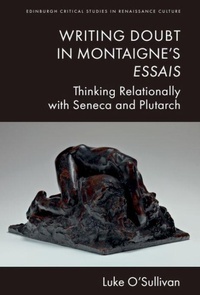
Writing Doubt in Montaigne's Essais
Thinking Relationally with Seneca and Plutarch
Published on 31. August 2024
Book
Hardback
256 pages
978-1-3995-2296-0 (ISBN)
Description
Doubtful Writing offers a major reassessment of philosophical uncertainty in one of the early modern period's foremost doubters. It argues that Montaigne's engagement, his endless 'commerce' with two dogmatists, Seneca and Plutarch, produced a radical new mode of doubtful writing; one with which Montaigne could conduct and communicate a double, unresolved, and contradictory mode of thinking.
Seneca and Plutarch have long been recognised as Montaigne's preferred authors: he himself, on numerous occasions, holds them up as authors of the books he could not be without and their influence on his informal, fragmentary style is widely acknowledged. But these authors have, until now, escaped significant attention from the perspective of philosophical uncertainty. Doubtful Writing argues that it was with these authors - dogmatists who nevertheless practised a 'doubtful and unresolved way of writing' - that Montaigne developed his own maniere de dire ('way of saying'). Reading Montaigne through this lens offers a valuable new perspective on doubt in the Essais and in the early modern period more broadly, understanding doubt not only as a philosophical system or set of arguments but as a practice of thinking in and with writing.
Seneca and Plutarch have long been recognised as Montaigne's preferred authors: he himself, on numerous occasions, holds them up as authors of the books he could not be without and their influence on his informal, fragmentary style is widely acknowledged. But these authors have, until now, escaped significant attention from the perspective of philosophical uncertainty. Doubtful Writing argues that it was with these authors - dogmatists who nevertheless practised a 'doubtful and unresolved way of writing' - that Montaigne developed his own maniere de dire ('way of saying'). Reading Montaigne through this lens offers a valuable new perspective on doubt in the Essais and in the early modern period more broadly, understanding doubt not only as a philosophical system or set of arguments but as a practice of thinking in and with writing.
Reviews / Votes
Luke O'Sullivan is one of the best close-readers of Montaigne around. In this book, he provides a compelling new account of the French essayist's doubtful mode of writing, and of his relationship to Seneca and Plutarch. -- Warren Boutcher, Queen Mary University of LondonMore details
Series
Language
English
Place of publication
Edinburgh
United Kingdom
Target group
College/higher education
Product notice
sewn/stitched
Cloth over boards
Dimensions
Height: 234 mm
Width: 156 mm
Thickness: 16 mm
Weight
540 gr
ISBN-13
978-1-3995-2296-0 (9781399522960)
Copyright in bibliographic data and cover images is held by Nielsen Book Services Limited or by the publishers or by their respective licensors: all rights reserved.
Schweitzer Classification
Other editions
Additional editions
E-Book
08/2024
Edinburgh University Press
€92.49
Available for download
Person
Dr Luke O'Sullivan is a Career Development Fellow in Early Modern French at St Hilda's College, University of Oxford. Between 2013 and 2016, he held a Durham Doctoral Scholarship in the French department at the University of Durham and in 2018 he was awarded a Leverhulme Early Career Fellowship, held in the French department at King's College London for a project titled 'Doubtful Truth-Telling in Early Modern France'.
Content
Acknowledgements
Note on texts, translations, and style
Introduction: Leaky Business
1. A Doubtful Combination
2. Writing Between Authors
3. Forming Thoughts I: Thinking about Form
4. Forming Thoughts II: Writing Doubly
5. Simple Truths
6. Paradoxical Truth-Telling
Communicating Doubt
Bibliography
Note on texts, translations, and style
Introduction: Leaky Business
1. A Doubtful Combination
2. Writing Between Authors
3. Forming Thoughts I: Thinking about Form
4. Forming Thoughts II: Writing Doubly
5. Simple Truths
6. Paradoxical Truth-Telling
Communicating Doubt
Bibliography