

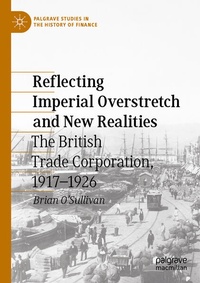
Reflecting Imperial Overstretch and New Realities
Description
This book is the first comprehensive history of the British Trade Corporation, which was constituted under a Royal Charter on 21st April 1917. Its charter was meant to last for sixty years, but in 1926, after a turbulent existence of only nine years, it was amalgamated with the Anglo-Austrian Bank, and absorbed into the Anglo-International Bank.
The corporation together with its two main subsidiaries, the Levant Company and the National Bank of Turkey, conducted business not only in Britain but in Russia, Turkey, the Middle East and in Continental Europe. Although the corporation was not an agent of empire, it reflected Britain's imperialistic ambitions after the First World War. As a result, it invested in some of the most unstable regions of the world. It was also severely affected by British foreign policy, which was often misjudged and, at times, duplicitous, resulting in serious damage to British trade. Within five years of its launch, the British Trade Corporation needed to be refinanced. The economic downturn in the early 1920s and ongoing hostilities in Eastern Europe and the Near East meant that it struggled to survive. Its difficulties reflected many of those faced by Britain in general after the war and the need to come to terms with the new realities of the post-war world.
Despite its innovative attempt to address the perceived deficiencies in Britain's financial system, especially in respect of industrial finance, the British Trade Corporation has been largely ignored by financial historians. Based on substantial archival research, this book rectifies this neglect and makes an important contribution to the financial history of interwar Britain.
Reviews / Votes
"O'Sullivan has written the first in-depth study of the short, challenging but utterly fascinating life of the British Trade Corporation. This wonderfully detailed and comprehensive history is based on extensive archival research. It beautifully illuminates the interplay between imperial ambition, financial innovation, and geopolitical instability in the interwar period, making a notable contribution to both business and imperial history." (Professor Anne L. Murphy, Deputy Vice-Chancellor (Education), University of Portsmouth)
"Brian O'Sullivan sheds crucial new light on an episode, the launch and operations of the British Trade Corporation, which has hitherto surprisingly received scant attention despite being one of the most important financial (and industrial) initiatives taking place in Britain during and soon after the First World War. This is, for that reason, a much-awaited work which fills a major lacuna in the post-war history of the country. Based on an uncommonly wide range of archival sources, he shows that the British Trade Corporation became an important instrument in the changing role of Britain in world affairs after 1918. This work confirms in addition the growing influence of industrial interests on the establishment and management of the war economy. This book is a valid addition to the long-standing debate about the alleged inability of British financial institutions to provide long-term finance to industry in the inter-war era." (Dr Valerio Cerretano, Department of Economics and Business Sciences, University of Florence (UniFI))
"By following the British Trade Corporation and the reversal of its fortunes in markets stretching from Danzig and Belgrade to the Middle East in the years after the First World War, this deeply researched book makes an important contribution to the debate about Britain's decline." (Prof. Frank Trentmann, Frank Trentmann is a professor of history at Birkbeck, University of London)
More details
Other editions
Additional editions
Person
Brian O'Sullivan is a Visiting Research Fellow at King's College, London. His book From Crisis to Crisis: The Transformation of Merchant Banking, 1914-1939 (Palgrave, 2018) was jointly awarded the BAC Wadsworth Prize in 2019. Brian has held senior roles in a number of financial institutions and is a Fellow of the Institute of Chartered Accountants and of the Royal Historical Society.
Content
Introduction.- Part I. Emerging Champion.- Chapter 1. Winning the Peace.- Chapter 2. British Trade Bank.- Chapter 3. Finance and Industry.- Chapter 4. Dash for Growth.- Part II. Merchant Adventurer.- Chapter 5. Russia.- Chapter 6. Turkey.- Chapter 7. Middle East.- Chapter 8. Continental Europe.- Part III. Road to Obscurity.- Chapter 9. Reconstruction.- Chapter 10. Home Front.- Chapter 11. Struggle for Survival.- Chapter 12. Reverberations.- Conclusion and Appendices.