

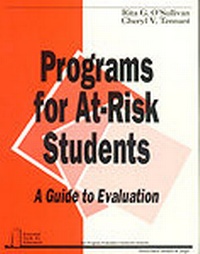
Programs for At-Risk Students
1st Edition
Published on 23. April 1993
Book
Hardback
96 pages
978-0-8039-6043-5 (ISBN)
Description
This straightforward guide includes an overview and rationale for evaluating programmes for students at risk of academic failure. Detailed, intriguing vignettes illustrate how evaluation of programmes are planned, structured, staffed, conducted, interpreted and used. Standards and indicators of programme quality, guides for using these standards and an annotated bibliography are also included.
More details
Series
Language
English
Place of publication
Thousand Oaks
United States
Publishing group
SAGE Publications Inc
Target group
Professional and scholarly
Dimensions
Height: 279 mm
Width: 216 mm
Weight
240 gr
ISBN-13
978-0-8039-6043-5 (9780803960435)
Copyright in bibliographic data and cover images is held by Nielsen Book Services Limited or by the publishers or by their respective licensors: all rights reserved.
Schweitzer Classification
Persons
Rita G. OSullivan, who obtained her Ed.D. in 1984 from Auburn University, was the treasurer of the American Evaluation Association for ten years. She was a member of the education faculty at the University of North Carolina, Greensboro until she joined the faculty at the University of North Carolina, Chapel Hill after being recruited her to teach evaluation techniques to students in management, public and educational administration, and nursing.
Content
Introduction
Vignette One
Assessing Students' Needs Using Focus Groups
Vignette Two
Identifying Students for Program Participation and Comparison Groups Using Existing Documentation
Vignette Three
Determining Whether or Not the Program Improves Students' Attitudes Toward School Using Existing Attitude Scales
Vignette Four
Strengthening Individualized Instruction Using an Observation Checklist
Vignette Five
Verifying that School Staff Support the Program Using a Written Questionnaire
Vignette Six
Establishing the Level of Parents' Involvement in the Program Using Interviews
Summary
Vignette One
Assessing Students' Needs Using Focus Groups
Vignette Two
Identifying Students for Program Participation and Comparison Groups Using Existing Documentation
Vignette Three
Determining Whether or Not the Program Improves Students' Attitudes Toward School Using Existing Attitude Scales
Vignette Four
Strengthening Individualized Instruction Using an Observation Checklist
Vignette Five
Verifying that School Staff Support the Program Using a Written Questionnaire
Vignette Six
Establishing the Level of Parents' Involvement in the Program Using Interviews
Summary