

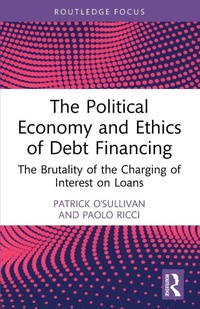
The Political Economy and Ethics of Debt Financing
The Brutality of the Charging of Interest on Loans
1st Edition
Will be published approx. on 20. July 2026
Book
Paperback/Softback
114 pages
978-1-032-90070-4 (ISBN)
Description
This book takes a fresh look at an age-old controversy in ethics and political economy that stretches right back to Aristotle: the morality and the economics of debt financing, or the charging of interest on loans. It endeavours to show the immense relevance of those ancient debates in the contemporary economy.
Outside of countries which practise Islam and Islamic finance, the charging of interest is taken completely for granted today and little or no thought is devoted to its morality or economic and social impacts. This book argues that in fact the question of the morality of charging interest is still debatable and deserves to be considered anew in the 21st century for the light it can shine on certain salient contemporary sources of economic malaise. This book will first of all review the ancient debates on these questions stretching back to Aristotle seeking to restate the concerns in terms of contemporary economic theories and realities. It will also then delve into the current practices in respect of lending of all kinds that can be found in those Islamic countries and financial institutions which endeavour to follow the prohibition of riba (charging of any kind of interest). This will be contrasted with the impact of interest and debt financing in the contemporary non-Islamic economies arguing that debt financing of businesses promotes greater rates of bankruptcy over the business cycle and that the charging of interest on loans for current consumption purposes will over time increase inequality and inequitable concentration of wealth in societies where it is practised. It will also be shown how in a system without predetermined interest charges problems of exponentially exploding government debt could largely and neatly be avoided by linking bondholder rewards to levels of fiscal proceeds of states.
This book will be of significant interest to readers in ethics, moral philosophy and political economy as well as to policymakers and thinkers grappling with issues around debt burdens (public and private), inequality and fairness.
Outside of countries which practise Islam and Islamic finance, the charging of interest is taken completely for granted today and little or no thought is devoted to its morality or economic and social impacts. This book argues that in fact the question of the morality of charging interest is still debatable and deserves to be considered anew in the 21st century for the light it can shine on certain salient contemporary sources of economic malaise. This book will first of all review the ancient debates on these questions stretching back to Aristotle seeking to restate the concerns in terms of contemporary economic theories and realities. It will also then delve into the current practices in respect of lending of all kinds that can be found in those Islamic countries and financial institutions which endeavour to follow the prohibition of riba (charging of any kind of interest). This will be contrasted with the impact of interest and debt financing in the contemporary non-Islamic economies arguing that debt financing of businesses promotes greater rates of bankruptcy over the business cycle and that the charging of interest on loans for current consumption purposes will over time increase inequality and inequitable concentration of wealth in societies where it is practised. It will also be shown how in a system without predetermined interest charges problems of exponentially exploding government debt could largely and neatly be avoided by linking bondholder rewards to levels of fiscal proceeds of states.
This book will be of significant interest to readers in ethics, moral philosophy and political economy as well as to policymakers and thinkers grappling with issues around debt burdens (public and private), inequality and fairness.
More details
Series
Language
English
Place of publication
London
United Kingdom
Publishing group
Taylor & Francis Ltd
Target group
College/higher education
Professional and scholarly
Academic and Postgraduate
Illustrations
5 s/w Photographien bzw. Rasterbilder, 5 s/w Abbildungen
5 Halftones, black and white; 5 Illustrations, black and white
Dimensions
Height: 216 mm
Width: 138 mm
ISBN-13
978-1-032-90070-4 (9781032900704)
Copyright in bibliographic data and cover images is held by Nielsen Book Services Limited or by the publishers or by their respective licensors: all rights reserved.
Schweitzer Classification
Other editions
Additional editions
Patrick O'Sullivan | Paolo Ricci
The Political Economy and Ethics of Debt Financing
The Brutality of the Charging of Interest on Loans
Book
12/2024
1st Edition
Routledge
€75.10
Shipment within 10-20 days
Patrick O'Sullivan | Paolo Ricci
The Political Economy and Ethics of Debt Financing
The Brutality of the Charging of Interest on Loans
E-Book
12/2024
1st Edition
Routledge
€31.49
Available for download
Patrick O'Sullivan | Paolo Ricci
The Political Economy and Ethics of Debt Financing
The Brutality of the Charging of Interest on Loans
E-Book
12/2024
1st Edition
Routledge
€31.49
Available for download
Persons
Patrick O'Sullivan is Adjunct Professor at the University of Warsaw; Visiting Professor at Universita di Parma; Visiting Research Faculty at Thammasat University Business School, Bangkok. He contributes an elective course on Geopolitics and Business annually on the Judge Business School University of Cambridge MBA and has in addition taught on university courses in France, UK, Poland, Estonia, Georgia and Thailand. He has acted as editor for two collected volumes on the ethics of business and of finance and has written numerous articles on business ethics and critical political economy.
Paolo Ricci is Full Professor of Business Administration and Public Accountability in the Department of Political Science, University of Naples Federico II, Italy. He has taught at several universities, including Roma LUMSA, Roma Tre and Sannio University. He coordinated international research projects, and he is a member of numerous editorial committees. He is the author of over 200 scientific publications mainly on issues concerning public sector governance and accountability, responsibility and social reporting.
Paolo Ricci is Full Professor of Business Administration and Public Accountability in the Department of Political Science, University of Naples Federico II, Italy. He has taught at several universities, including Roma LUMSA, Roma Tre and Sannio University. He coordinated international research projects, and he is a member of numerous editorial committees. He is the author of over 200 scientific publications mainly on issues concerning public sector governance and accountability, responsibility and social reporting.
Content
1. The growing contemporary challenge of indebtedness 2. The morality of the charging of interest on loans: the Ancient and Mediaeval moral philosophical debate 3. Transition of the moral debate to political economy: from Bacon to the contemporary discussions of interest and usury 4. A critical philosophico-economic appraisal of the contemporary consensus on money-lending at interest 5. Alternatives to interest-based financing of business ventures 6. And what about lending to consumer borrowers? 7. Alternatives to interest-based government borrowing and the implications for sustainability of government debt 8. The impact of the charging of interest on the distribution of wealth 9. A Call to Action in face of the Massive Inertia of Financial Sector Vested Interests Index