

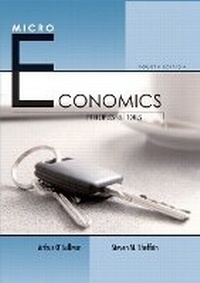
Microeconomics
Principles and Tools
4th Edition
Published on 9. December 2004
Book
Paperback/Softback
496 pages
978-0-13-153606-7 (ISBN)
Description
For 1-Semester Principles of Microeconomics courses.
This Principles of Microeconomics text uses 5 key principles, and an Active Approach to teach microeconomics.
O'Sullivan/Sheffrin makes use of Active Learning Tools which get students involved in role-playing, help them apply concepts, and offer reinforcement of the material (tools include: Economic Experiments, Application Questions, and Test Your Understanding Questions).
The text provides a clear, concise, and accessible presentation of key points. Its hallmark feature includes a focus on the 5 Key Principles of Economics-1) Opportunity Cost, 2) The Marginal Principle (comparing marginal benefits and marginal costs), 3) Diminishing Returns, 4) The Principle of Voluntary Exchange, 5) The Real-Nominal Principle (distinguishing real from nominal magnitudes).
It is available in a hardbound, Economics text, as well as, Micro and Macro splits.
This Principles of Microeconomics text uses 5 key principles, and an Active Approach to teach microeconomics.
O'Sullivan/Sheffrin makes use of Active Learning Tools which get students involved in role-playing, help them apply concepts, and offer reinforcement of the material (tools include: Economic Experiments, Application Questions, and Test Your Understanding Questions).
The text provides a clear, concise, and accessible presentation of key points. Its hallmark feature includes a focus on the 5 Key Principles of Economics-1) Opportunity Cost, 2) The Marginal Principle (comparing marginal benefits and marginal costs), 3) Diminishing Returns, 4) The Principle of Voluntary Exchange, 5) The Real-Nominal Principle (distinguishing real from nominal magnitudes).
It is available in a hardbound, Economics text, as well as, Micro and Macro splits.
More details
Edition
4th edition
Language
English
Place of publication
United States
Publishing group
Pearson Education (US)
Target group
Professional and scholarly
Dimensions
Height: 255 mm
Width: 203 mm
Thickness: 19 mm
Weight
900 gr
ISBN-13
978-0-13-153606-7 (9780131536067)
Copyright in bibliographic data and cover images is held by Nielsen Book Services Limited or by the publishers or by their respective licensors: all rights reserved.
Schweitzer Classification
Other editions
New editions

Arthur O'Sullivan | Steven Sheffrin | Steve Perez
Microeconomics
Principles, Applications, and Tools: United States Edition
Book
02/2007
5th Edition
Pearson
€81.83
Article exhausted; check for reprint
Previous edition

Book
02/2004
3rd Edition
Prentice-Hall
€79.35
Article exhausted; check for reprint
Content
PART 1: INTRODUCTION AND KEY PRINCIPLES
Chapter 1: Introduction: What is Economics?
Chapter 2: Key Principles of Economics
Chapter 3: Exchange and Markets
Chapter 4: Supply, Demand, and Market Equilibrium
PART 2: A CLOSER LOOK AT SUPPLY AND DEMAND
Chapter 5: Elasticity: A Measure of Responsiveness
Chapter 6: Consumer Choice
Chapter 7: Market Efficiency and Government Intervention
PART 3: INFORMATION AND EXTERNALITIES
Chapter 8: Imperfect Information: Adverse Selection and Moral Hazard
Chapter 9: Environmental Policy
Chapter 10: Public Goods and Public Choice
PART 4: MARKET STRUCTURES AND PRICING
Chapter 11: Production Technology and Cost
Chapter 12: Perfect Competition
Chapter 13: Monopoly and Price Discrimination
Chapter 14: Market Entry and Monopolistic Competition
Chapter 15: Oligopoly and Strategic Behavior
Chapter 16: Market Structure and Public Policy
PART 5: THE LABOR MARKET AND INCOME DISTRIBUTION
Chapter 17: The Labor Market and the Distribution of Income
Chapter 18: Beyond Perfect Competition: Unions, Monopsony, and Imperfect Information
PART 6: THE BASIC CONCEPTS IN MACROECONOMICS
Chapter 19: International Trade and Public Policy
Chapter 1: Introduction: What is Economics?
Chapter 2: Key Principles of Economics
Chapter 3: Exchange and Markets
Chapter 4: Supply, Demand, and Market Equilibrium
PART 2: A CLOSER LOOK AT SUPPLY AND DEMAND
Chapter 5: Elasticity: A Measure of Responsiveness
Chapter 6: Consumer Choice
Chapter 7: Market Efficiency and Government Intervention
PART 3: INFORMATION AND EXTERNALITIES
Chapter 8: Imperfect Information: Adverse Selection and Moral Hazard
Chapter 9: Environmental Policy
Chapter 10: Public Goods and Public Choice
PART 4: MARKET STRUCTURES AND PRICING
Chapter 11: Production Technology and Cost
Chapter 12: Perfect Competition
Chapter 13: Monopoly and Price Discrimination
Chapter 14: Market Entry and Monopolistic Competition
Chapter 15: Oligopoly and Strategic Behavior
Chapter 16: Market Structure and Public Policy
PART 5: THE LABOR MARKET AND INCOME DISTRIBUTION
Chapter 17: The Labor Market and the Distribution of Income
Chapter 18: Beyond Perfect Competition: Unions, Monopsony, and Imperfect Information
PART 6: THE BASIC CONCEPTS IN MACROECONOMICS
Chapter 19: International Trade and Public Policy