

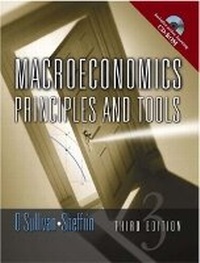
Macroeconomics
Principles and Tools
3rd Edition
Published on 8. July 2002
Book
Paperback/Softback
414 pages
978-0-13-035811-0 (ISBN)
Description
For 1-semester, freshman/sophomore level courses in Principles of Macroeconomics.
This modern principles text has a strong foundation in demand and supply, the most important topic in learning and teaching principles of economics. Its improved coverage of change in demand vs. change in quantity demanded (also in supply coverage) enables students to better visualize and truly understand the difference between these two fundamental concepts. In macroeconomics, the long run first organization offers a balanced presentation between long run and short run topics allow professors to cover the important issues of growth early, and gives them the flexibility to cover Keynesian material when they feel it is important. The AD/AS model is covered early in the presentation.
If you want to teach a modern principles course that brings out economic applications through active learning and experiments, and utilizes a streamlined framework emphasizing 5 key principles, examine O'Sullivan/Sheffrin's Economics: Principles and Tools 3/e.
If you prefer to introduce long run issues with subsequent, balanced coverage of AS/AD and the Keynesian Cross, examine Chapters 7-10.
When covering Comparative Advantage, if you prefer early coverage and emphasis continuing throughout related topics, start by looking at Chapter 3 and continue through O'Sullivan/Sheffrin's discussion of interdependence of economies.
This modern principles text has a strong foundation in demand and supply, the most important topic in learning and teaching principles of economics. Its improved coverage of change in demand vs. change in quantity demanded (also in supply coverage) enables students to better visualize and truly understand the difference between these two fundamental concepts. In macroeconomics, the long run first organization offers a balanced presentation between long run and short run topics allow professors to cover the important issues of growth early, and gives them the flexibility to cover Keynesian material when they feel it is important. The AD/AS model is covered early in the presentation.
If you want to teach a modern principles course that brings out economic applications through active learning and experiments, and utilizes a streamlined framework emphasizing 5 key principles, examine O'Sullivan/Sheffrin's Economics: Principles and Tools 3/e.
If you prefer to introduce long run issues with subsequent, balanced coverage of AS/AD and the Keynesian Cross, examine Chapters 7-10.
When covering Comparative Advantage, if you prefer early coverage and emphasis continuing throughout related topics, start by looking at Chapter 3 and continue through O'Sullivan/Sheffrin's discussion of interdependence of economies.
More details
Edition
3rd edition
Language
English
Place of publication
United States
Publishing group
Pearson Education (US)
Target group
Professional and scholarly
Dimensions
Height: 254 mm
Width: 200 mm
Thickness: 17 mm
Weight
800 gr
ISBN-13
978-0-13-035811-0 (9780130358110)
Copyright in bibliographic data and cover images is held by Nielsen Book Services Limited or by the publishers or by their respective licensors: all rights reserved.
Schweitzer Classification
Other editions
New editions

Book
05/2005
4th Edition
Pearson
€53.31
Article exhausted; check for reprint
Previous edition
Book
12/2003
2nd Edition
Pearson
€62.14
Article exhausted; check for reprint
Content
I. INTRODUCTION AND KEY PRINCIPLES.
1. Introduction: What Is Economics?
2. Key Principles of Economics.
3. Markets in the Global Economy.
4. Supply, Demand, and Market Equilibrium.
II. THE BASIC CONCEPTS IN MACROECONOMICS.
5. Measuring a Nation's Production and Income.
6. Unemployment and Inflation.
III. THE ECONOMY IN THE LONG RUN.
7. Classical Economics: The Economy at Full Employment.
8. Why Do Economies Grow?
IV. ECONOMIC FLUCTUATIONS.
9. Aggregate Demand and Aggregate Supply.
10. Keynesian Economics and Fiscal Policy.
11. Investment and Financial Intermediation.
V. MONEY, BANKING, AND MONETARY POLICY.
12. Money, the Banking System, and the Federal Reserve.
13. Monetary Policy in the Short Run.
VI. INFLATION, UNEMPLOYMENT, AND ECONOMIC POLICY.
14. From the Short Run to the Long Run.
15. The Dynamics of Inflation and Unemployment.
16. Current Issues in Macroeconomic Policy.
VII. THE INTERNATIONAL ECONOMY.
17. International Trade and Public Policy.
18. The World of International Finance.
1. Introduction: What Is Economics?
2. Key Principles of Economics.
3. Markets in the Global Economy.
4. Supply, Demand, and Market Equilibrium.
II. THE BASIC CONCEPTS IN MACROECONOMICS.
5. Measuring a Nation's Production and Income.
6. Unemployment and Inflation.
III. THE ECONOMY IN THE LONG RUN.
7. Classical Economics: The Economy at Full Employment.
8. Why Do Economies Grow?
IV. ECONOMIC FLUCTUATIONS.
9. Aggregate Demand and Aggregate Supply.
10. Keynesian Economics and Fiscal Policy.
11. Investment and Financial Intermediation.
V. MONEY, BANKING, AND MONETARY POLICY.
12. Money, the Banking System, and the Federal Reserve.
13. Monetary Policy in the Short Run.
VI. INFLATION, UNEMPLOYMENT, AND ECONOMIC POLICY.
14. From the Short Run to the Long Run.
15. The Dynamics of Inflation and Unemployment.
16. Current Issues in Macroeconomic Policy.
VII. THE INTERNATIONAL ECONOMY.
17. International Trade and Public Policy.
18. The World of International Finance.