

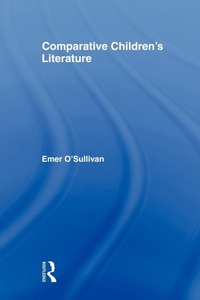
Comparative Children's Literature
1st Edition
Published on 31. July 2009
Book
Paperback/Softback
208 pages
978-0-415-56412-0 (ISBN)
Description
WINNER OF THE 2007 CHLA BOOK AWARD!
Children's literature has transcended linguistic and cultural borders since books and magazines for young readers were first produced, with popular books translated throughout the world.
Emer O'Sullivan traces the history of comparative children's literature studies, from the enthusiastic internationalism of the post-war period - which set out from the idea of a supra-national world republic of childhood - to modern comparative criticism. Drawing on the scholarship and children's literature of many cultures and languages, she outlines the constituent areas that structure the field, including contact and transfer studies, intertextuality studies, intermediality studies and image studies. In doing so, she provides the first comprehensive overview of this exciting new research area. Comparative Children's Literature also links the fields of narratology and translation studies, to develop an original and highly valuable communicative model of translation.
Taking in issues of children's 'classics', the canon and world literature for children, Comparative Children's Literature reveals that this branch of literature is not as genuinely international as it is often fondly assumed to be and is essential reading for those interested in the consequences of globalization on children's literature and culture.
Children's literature has transcended linguistic and cultural borders since books and magazines for young readers were first produced, with popular books translated throughout the world.
Emer O'Sullivan traces the history of comparative children's literature studies, from the enthusiastic internationalism of the post-war period - which set out from the idea of a supra-national world republic of childhood - to modern comparative criticism. Drawing on the scholarship and children's literature of many cultures and languages, she outlines the constituent areas that structure the field, including contact and transfer studies, intertextuality studies, intermediality studies and image studies. In doing so, she provides the first comprehensive overview of this exciting new research area. Comparative Children's Literature also links the fields of narratology and translation studies, to develop an original and highly valuable communicative model of translation.
Taking in issues of children's 'classics', the canon and world literature for children, Comparative Children's Literature reveals that this branch of literature is not as genuinely international as it is often fondly assumed to be and is essential reading for those interested in the consequences of globalization on children's literature and culture.
More details
Language
English
Place of publication
London
United Kingdom
Publishing group
Taylor & Francis Ltd
Target group
College/higher education
Dimensions
Height: 234 mm
Width: 156 mm
Thickness: 12 mm
Weight
342 gr
ISBN-13
978-0-415-56412-0 (9780415564120)
Copyright in bibliographic data and cover images is held by Nielsen Book Services Limited or by the publishers or by their respective licensors: all rights reserved.
Schweitzer Classification
Other editions
Additional editions
Emer O'Sullivan
Comparative Children's Literature
E-Book
03/2005
1st Edition
Routledge
€77.99
Available for download
Emer O'Sullivan
Comparative Children's Literature
E-Book
03/2005
1st Edition
Routledge
€77.99
Available for download
Emer O'Sullivan
Comparative Children's Literature
Book
03/2005
1st Edition
Routledge
€206.20
Shipment within 15-20 days
Persons
Emer O'Sullivan is Professor for Literature and Cultural Studies at the University of Lueneburg, Germany. Her book, Kinderliterarische Komparastik, on which this book is based, won the International Research Society for Children's Literature Award for Outstanding Research in August 2001.
Content
List of figures, Preface, Acknowledgements, Introduction, 1 Comparative literature and children's literature, 2 Constituent areas of comparative children's literature, 3 The development, culture-specific status and international exchange of children's literatures, 4 Children's literature in translation, 5 The implied translator and the implied reader in translated children's literature, 6 World literature and children's classics, Notes, Bibliography, Index