

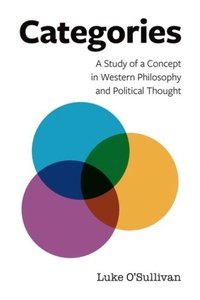
Categories
A Study of a Concept in Western Philosophy and Political Thought
Published on 31. July 2024
Book
Hardback
344 pages
978-1-3995-2415-5 (ISBN)
Description
In ancient and modern Western thought, the problem of the nature of categories has been inseparable from arguments about the nature of selfhood; about how knowledge is organised; about how power should be distributed; and about how history should be understood. For Plato, Forms belonging to a timeless order of being played the role of categories or fundamental concepts; for Aristotle categories were immanent in things; for Kant they were a priori logical structures of our consciousness; and for Hegel they were dynamic, dialectical inter-related ideas. In Categories, O'Sullivan shows how these answers have gone forward into the contemporary era, and identifies three key schools of thought that have developed since Hegel in particular. He explains modern thought as a tension between a desire for a single dominant perspective, whether scientific or phenomenological; a belief in irretrievable fragmentation; and an effort to find a middle ground.
Reviews / Votes
It is in our nature to use categories - to understand and navigate the world around us, Luke O'Sullivan tells us. His masterful study guides us through the efforts of western philosophers to grapple with the problem of how to interpret reality. The result is an illuminating history of thought, and an insightful contribution to our understanding of this central aspect of the human condition. -- Chandran Kukathas, Singapore Management University All human thought begins with categories or the making of distinctions. A knowledge of the history of the term remains indispensable for philosophy today. In this erudite, carefully argued, and elegantly written book, which includes chapters on Plato, Aristotle, Kant, and Hegel as well as some of the most important contemporary authors to have addressed the issue of categories, Luke O'Sullivan provides us with an excellent study of an absolutely crucial topic. -- Frank Ankersmit, author of Representation: The Birth of Historical Reality from the Death of the PastMore details
Language
English
Place of publication
Edinburgh
United Kingdom
Target group
Professional and scholarly
Product notice
sewn/stitched
Cloth over boards
Dimensions
Height: 234 mm
Width: 156 mm
Thickness: 21 mm
Weight
658 gr
ISBN-13
978-1-3995-2415-5 (9781399524155)
Copyright in bibliographic data and cover images is held by Nielsen Book Services Limited or by the publishers or by their respective licensors: all rights reserved.
Schweitzer Classification
Other editions
Additional editions
E-Book
07/2024
1st Edition
Edinburgh University Press
€92.49
Available for download
Person
Luke O'Sullivan is an Associate Professor in the Department of Political Science at the National University of Singapore. He maintains a repository of his published work at https://nus.academia.edu/LukeOSullivan.
Content
Preface
Introduction - Why Categories Matter
Part 1: Categories in Platonic and Aristotelian Thought
1. Plato - Forms as Categories of Ideal Being
2. Aristotle - Categories as not-Forms, or Substances
Part 2: Categories in Modernity - Kant and Hegel
3. Kant - The Categorial A Priori
4. Hegel - The Dialectic Dynamics of Categories
Part 3: Contemporary Theories of Categories
5. Fragmentarians - The Categorial Kaleidoscope
6. Subordinationists - The Quest for a Master Category
7. Pluralists - The Search for Categorial Limits
Conclusion - The Inescapability of Categoriality
Index
Introduction - Why Categories Matter
Part 1: Categories in Platonic and Aristotelian Thought
1. Plato - Forms as Categories of Ideal Being
2. Aristotle - Categories as not-Forms, or Substances
Part 2: Categories in Modernity - Kant and Hegel
3. Kant - The Categorial A Priori
4. Hegel - The Dialectic Dynamics of Categories
Part 3: Contemporary Theories of Categories
5. Fragmentarians - The Categorial Kaleidoscope
6. Subordinationists - The Quest for a Master Category
7. Pluralists - The Search for Categorial Limits
Conclusion - The Inescapability of Categoriality
Index