

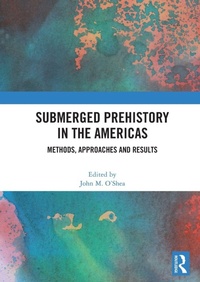
Submerged Prehistory in the Americas
Methods, Approaches and Results
1st Edition
Published on 28. November 2024
Book
Paperback/Softback
208 pages
978-1-032-44228-0 (ISBN)
Description
This book presents an overview of the exciting new developments in underwater research in North America, ranging from new approaches for discovering submerged sites to an assessment of how these findings challenge the understanding of the North American past.
Archaeological sites preserved on the world's continental shelves are relevant to a wide range of major research questions and their importance increases with the heightened awareness of climate change and rising modern sea levels. Once thought lost forever, these sites survive underwater, preserved from the ravages of modern farming and development. To investigate the submerged landscapes, archaeologists use many of the same technologies developed for discovery of shipwrecks but, couple them with anthropological and environmental models to identify and study the way of life of people residing in these ancient lands.
In this book, leading figures associated with submerged site exploration share an emphasis on the conduct and results of underwater research. It will be a fascinating read for advanced students of Archaeology, History and Environmental Studies. This volume was originally published as a special issue of The Journal of Island and Coastal Archaeology.
Archaeological sites preserved on the world's continental shelves are relevant to a wide range of major research questions and their importance increases with the heightened awareness of climate change and rising modern sea levels. Once thought lost forever, these sites survive underwater, preserved from the ravages of modern farming and development. To investigate the submerged landscapes, archaeologists use many of the same technologies developed for discovery of shipwrecks but, couple them with anthropological and environmental models to identify and study the way of life of people residing in these ancient lands.
In this book, leading figures associated with submerged site exploration share an emphasis on the conduct and results of underwater research. It will be a fascinating read for advanced students of Archaeology, History and Environmental Studies. This volume was originally published as a special issue of The Journal of Island and Coastal Archaeology.
More details
Language
English
Place of publication
London
United Kingdom
Publishing group
Taylor & Francis Ltd
Target group
College/higher education
Academic, Postgraduate, and Undergraduate
Dimensions
Height: 246 mm
Width: 174 mm
Thickness: 12 mm
Weight
384 gr
ISBN-13
978-1-032-44228-0 (9781032442280)
Copyright in bibliographic data and cover images is held by Nielsen Book Services Limited or by the publishers or by their respective licensors: all rights reserved.
Schweitzer Classification
Other editions
Additional editions
E-Book
05/2023
1st Edition
Routledge
€55.49
Available for download
Book
05/2023
1st Edition
Routledge
€196.00
Shipment within 10-20 days
E-Book
05/2023
1st Edition
Routledge
€55.49
Available for download
Person
John O'Shea is Curator of Great Lakes Archaeology in the Museum of Anthropological Archaeology at the University of Michigan, USA. He received his PhD in Prehistoric Archaeology from Cambridge University, UK. In addition to underwater research, he has directed major field projects in Hungary, Romania, and North America.
Content
Introduction-Submerged prehistory in the Americas: Methods, approaches and results 1. Submerged prehistory and anthropological archaeology: Do underwater studies contribute to theory? 2. "The early days" - underwater prehistoric archaeology in the USA and Canada 3. Crossing the waterline: Integrating terrestrial and submerged site investigations in the Aucilla River, Florida 4. Combining underwater and terrestrial research approaches in the Great Basin Desert, Walker Lake, Nevada 5. The magnificent seven: Marine submerged precontact sites found by systematic geoarchaeology in the Americas 6. Micro-regional approaches for submerged site archaeology 7. The archaeology of submerged prehistoric sites on the North Pacific Coast of North America 8. Coastally-adapted: A developing model for coastal Paleoindian sites on the North American eastern continental shelf 9. Global experience in locating submerged prehistoric sites and their relevance to research on the American continental shelves