

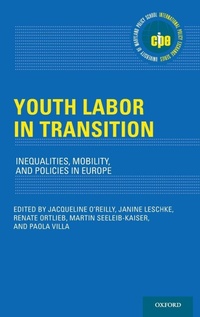
Youth Labor in Transition
Inequalities, Mobility, and Policies in Europe
Published on 10. January 2019
Book
Hardback
736 pages
978-0-19-086479-8 (ISBN)
Description
Exacerbated by the Great Recession, youth transitions to employment and adulthood have become increasingly protracted, precarious, and differentiated by gender, ethnicity, and socioeconomic status. Youth Labor in Transition examines young people's integration into employment, alongside the decisions and consequences of migrating to find work and later returning home. The authors identify key policy challenges for the future related to NEETS, overeducation, self-employment, and ethnic differences in outcomes. This illustrates the need to encompass a wider understanding of youth employment and job insecurity by including an analysis of economic production and how it relates to social reproduction of labor if policy intervention is to be effective.
The mapping and extensive analysis in this book are the result of a 31/2-year, European Union-funded research project (Strategic Transitions for Youth Labour in Europe, or STYLE; http://www.style-research.eu) coordinated by Jacqueline O'Reilly. With an overall budget of just under 5 million euros and involving 25 research partners; an international advisory network and local advisory boards of employers, unions, and policymakers; and non-governmental organizations from more than 20 European countries, STYLE is one of the largest European Commission-funded research projects to exist on this topic. Consequently, this book will appeal to an array of audiences, including academic and policy researchers in sociology, political science, economics, management studies, and more particular labor market and social policy; policy communities; and bachelor's- and master's-level students in courses on European studies or any of the aforementioned subject areas.
The mapping and extensive analysis in this book are the result of a 31/2-year, European Union-funded research project (Strategic Transitions for Youth Labour in Europe, or STYLE; http://www.style-research.eu) coordinated by Jacqueline O'Reilly. With an overall budget of just under 5 million euros and involving 25 research partners; an international advisory network and local advisory boards of employers, unions, and policymakers; and non-governmental organizations from more than 20 European countries, STYLE is one of the largest European Commission-funded research projects to exist on this topic. Consequently, this book will appeal to an array of audiences, including academic and policy researchers in sociology, political science, economics, management studies, and more particular labor market and social policy; policy communities; and bachelor's- and master's-level students in courses on European studies or any of the aforementioned subject areas.
Reviews / Votes
This is a timely volume taking seriously the wider perspectives of youth labor: it is not only the problem of unemployment, it is the life course perspective; it is not only the problem of education, it is the effective demand perspective; it is not only economic production, but also the social reproduction perspective that policymakers have to simultaneously consider in their endeavor to navigate all youth into good labor market transitions. If you share this view, dig deep into this highly professional volume and you will come out with richer insights. If you are skeptic, dig even deeper to sharpen your critical mind. * Guenther Schmid, Emeritus Director, Berlin Social Science Centre (WZB); former Professor of Political Economy, Freie Universitaet Berlin * Liberalization of labor markets and welfare protections, exacerbated by the economic crisis of 2008-9, has created difficulties especially for youth as they seek to transition to employment and adulthood. This impressive volume assembles a wealth of quantitative and qualitative information on the experiences of European countries in coping with these difficulties, and assesses how the dynamics of labor markets generate differences in youth transitions by gender, ethnicity, migration, and family structures. The valuable chapters in this volume make essential reading for social scientists as well as policymakers concerned with this central social and economic problem of our time. * Arne L. Kalleberg, Kenan Distinguished Professor of Sociology, University of North Carolina at Chapel Hill * This book presents and integrates a huge volume of new research analyzing the lives of young people entering labor markets in Europe. The role of families, employers, migration, economic crises, and regional differences in shaping transitions into and out of employment are examined with the highest quality of writing and scholarship. This tome is far more than a collection of excellent chapters; it provides the most comprehensive guide yet to the individual and societal effects of youth labor markets, and should be read by all researchers and policymakers who care about these things. * Brendan Burchell, Reader in the Social Sciences, Department of Sociology, University of Cambridge *More details
Series
Language
English
Place of publication
New York
United States
Target group
Professional and scholarly
Dimensions
Height: 240 mm
Width: 161 mm
Thickness: 44 mm
Weight
1256 gr
ISBN-13
978-0-19-086479-8 (9780190864798)
Copyright in bibliographic data and cover images is held by Nielsen Book Services Limited or by the publishers or by their respective licensors: all rights reserved.
Schweitzer Classification
Other editions
Additional editions
Jacqueline O'Reilly | Janine Leschke | Renate Ortlieb
Youth Labor in Transition
Inequalities, Mobility, and Policies in Europe
E-Book
11/2018
OUP eBook
€0.00
Available for download
Jacqueline O'Reilly | Janine Leschke | Renate Ortlieb
Youth Labor in Transition
Inequalities, Mobility, and Policies in Europe
E-Book
11/2018
1st Edition
OUP eBook
€45.99
Available for download
Persons
Jacqueline O'Reilly, DPhil, is Professor at the University of Sussex Business School, UK; Chair of the Editorial Board for Work, Employment and Society; and member of the Executive Council of the Society for the Advancement of Socio-Economics.
Janine Leschke, PhD, is Professor with special responsibilities at the Department of International Economics, Government and Business at Copenhagen Business School, Denmark.
Renate Ortlieb, PhD, is Professor of Human Resource Management and Head of the Department of Human Resource Management at the University of Graz, Austria. She is Editor-in-Chief of the German Journal of Human Resource Management.
Martin Seeleib-Kaiser, PhD, is Professor of Comparative Public Policy in the Institute of Political Science at Eberhard Karls Universitaet Tuebingen, Germany.
Paola Villa, PhD, is Professor of Applied Economics in the Department of Economics and Management at the University of Trento, Italy.
Janine Leschke, PhD, is Professor with special responsibilities at the Department of International Economics, Government and Business at Copenhagen Business School, Denmark.
Renate Ortlieb, PhD, is Professor of Human Resource Management and Head of the Department of Human Resource Management at the University of Graz, Austria. She is Editor-in-Chief of the German Journal of Human Resource Management.
Martin Seeleib-Kaiser, PhD, is Professor of Comparative Public Policy in the Institute of Political Science at Eberhard Karls Universitaet Tuebingen, Germany.
Paola Villa, PhD, is Professor of Applied Economics in the Department of Economics and Management at the University of Trento, Italy.
Editor
Full ProfessorFull Professor, University of Sussex Business School, UK
Associate ProfessorAssociate Professor, Copenhagen Business School
Professor of Human Resource ManagementProfessor of Human Resource Management, University of Graz, Austria
Professor of Comparative Social Policy and PoliticsProfessor of Comparative Social Policy and Politics, Eberhard Karls Universitaet Tuebingen, Germany
Full Professor of Applied EconomicsFull Professor of Applied Economics, University of Trento, Italy
Content
Chapter 1: Comparing Youth Transitions in Europe: Joblessness, Insecurity, Institutions, and Inequality
Jacqueline O'Reilly, Janine Leschke, Renate Ortlieb, Martin Seeleib-Kaiser, and Paola Villa
PART I: COMPARING PROBLEMATIC YOUTH TRANSITIONS TO WORK
Chapter 2: Where Do Young People Work?
Raffaele Grotti, Helen Russell, and Jacqueline O'Reilly
Chapter 3: How Does the Performance of School-To-Work Transition Regimes Vary in the European Union?
Kari P. Hadjivassiliou, Arianna Tassinari, Werner Eichhorst, and Florian Wozny
Chapter 4: Stressed Economies, Distressed Policies, and Distraught Young People: European Policies and Outcomes from a Youth Perspective
Mark Smith, Janine Leschke, Helen Russell, and Paola Villa
Chapter 5: Labor Market Flexibility and Income Security: Changes for European Youth During the Great Recession
Janine Leschke and Mairead Finn
Chapter 6: Policy Transfer and Innovation for Building Resilient Bridges to the Youth Labor Market
Maria Petmesidou and Maria Gonzalez Menendez
PART II: TRANSITIONS AROUND WORK AND THE FAMILY
Chapter 7: Youth Labor Flows Differ from Those of Older Workers?
Vladislav Flek, Martin Hala, and Martina Mysikova
Chapter 8: How Can Young People's Employment Quality Be Assessed Dynamically?
Gabriella Berloffa, Eleonora Matteazzi, Gabriele Mazzolini, Alina Sandor, and Paola Villa
Chapter 9: Youth Transitions and Job Quality: How Long Should They Wait and What Difference Does the Family Make?
Marianna Filandri, Tiziana Nazio, and Jacqueline O'Reilly
Chapter 10: The Worklessness Legacy: Do Working Mothers Make a Difference?
Gabriella Berloffa, Eleonora Matteazzi, and Paola Villa
Chapter 11: Stuck in the Parental Nest? The Effect of the Economic Crisis on Young Europeans' Living Arrangements
Fernanda Mazzotta and Lavinia Parisi
Chapter 12: Income Sharing and Spending Decisions of Young People Living with Their Parents
Marton Medgyesi and Ildiko Nagy
PART III: TRANSITIONS ACROSS EUROPE
Chapter 13: What Happens to Young People Who Move Country to Find Work?
Mehtap Akguec and Miroslav Beblavy
Chapter 14: Europe's Promise for Jobs? Labor Market Integration of Young EU Migrant Citizens in Germany and the United Kingdom
Thees Spreckelsen, Janine Leschke, and Martin Seeleib-Kaiser
Chapter 15: How Do Labor Market Intermediaries Help Young Eastern Europeans Find Work?
Renate Ortlieb and Silvana Weiss
Chapter 16: What Are the Employment Prospects for Young Estonian and Slovak Return Migrants?
Jaan Masso, Lucia Mytna Kurekova, Maryna Tverdostup, and Zuzana Zilincikova
PART IV: CHALLENGING FUTURES FOR YOUTH
Chapter 17: Origins and Future of the Concept of NEETs in the European Policy Agenda
Massimiliano Mascherini
Chapter 18: Overeducation in Europe: Is There Scope for a Common Policy Approach?
Seamus McGuinness, Adele Bergin, and Adele Whelan
Chapter 19: Do Scarring Effects Vary by Ethnicity and Gender?
Carolina V. Zuccotti and Jacqueline O'Reilly
Chapter 20: Do Business Start-Ups Create High-Quality Jobs for Young People?
Renate Ortlieb, Maura Sheehan, and Jaan Masso
Chapter 21: Are the Work Values of the Younger Generations Changing?
Gabor Hajdu and Endre Sik
Chapter 22: How Can Trade Unions in Europe Connect with Young Workers?
Kurt Vandaele
Chapter 23: Integrating Perspectives on Youth Labor in Transition: Economic Production, Social Reproduction, and Policy Learning
Jacqueline O'Reilly, Janine Leschke, Renate Ortlieb, Martin Seeleib-Kaiser, and Paola Villa
Jacqueline O'Reilly, Janine Leschke, Renate Ortlieb, Martin Seeleib-Kaiser, and Paola Villa
PART I: COMPARING PROBLEMATIC YOUTH TRANSITIONS TO WORK
Chapter 2: Where Do Young People Work?
Raffaele Grotti, Helen Russell, and Jacqueline O'Reilly
Chapter 3: How Does the Performance of School-To-Work Transition Regimes Vary in the European Union?
Kari P. Hadjivassiliou, Arianna Tassinari, Werner Eichhorst, and Florian Wozny
Chapter 4: Stressed Economies, Distressed Policies, and Distraught Young People: European Policies and Outcomes from a Youth Perspective
Mark Smith, Janine Leschke, Helen Russell, and Paola Villa
Chapter 5: Labor Market Flexibility and Income Security: Changes for European Youth During the Great Recession
Janine Leschke and Mairead Finn
Chapter 6: Policy Transfer and Innovation for Building Resilient Bridges to the Youth Labor Market
Maria Petmesidou and Maria Gonzalez Menendez
PART II: TRANSITIONS AROUND WORK AND THE FAMILY
Chapter 7: Youth Labor Flows Differ from Those of Older Workers?
Vladislav Flek, Martin Hala, and Martina Mysikova
Chapter 8: How Can Young People's Employment Quality Be Assessed Dynamically?
Gabriella Berloffa, Eleonora Matteazzi, Gabriele Mazzolini, Alina Sandor, and Paola Villa
Chapter 9: Youth Transitions and Job Quality: How Long Should They Wait and What Difference Does the Family Make?
Marianna Filandri, Tiziana Nazio, and Jacqueline O'Reilly
Chapter 10: The Worklessness Legacy: Do Working Mothers Make a Difference?
Gabriella Berloffa, Eleonora Matteazzi, and Paola Villa
Chapter 11: Stuck in the Parental Nest? The Effect of the Economic Crisis on Young Europeans' Living Arrangements
Fernanda Mazzotta and Lavinia Parisi
Chapter 12: Income Sharing and Spending Decisions of Young People Living with Their Parents
Marton Medgyesi and Ildiko Nagy
PART III: TRANSITIONS ACROSS EUROPE
Chapter 13: What Happens to Young People Who Move Country to Find Work?
Mehtap Akguec and Miroslav Beblavy
Chapter 14: Europe's Promise for Jobs? Labor Market Integration of Young EU Migrant Citizens in Germany and the United Kingdom
Thees Spreckelsen, Janine Leschke, and Martin Seeleib-Kaiser
Chapter 15: How Do Labor Market Intermediaries Help Young Eastern Europeans Find Work?
Renate Ortlieb and Silvana Weiss
Chapter 16: What Are the Employment Prospects for Young Estonian and Slovak Return Migrants?
Jaan Masso, Lucia Mytna Kurekova, Maryna Tverdostup, and Zuzana Zilincikova
PART IV: CHALLENGING FUTURES FOR YOUTH
Chapter 17: Origins and Future of the Concept of NEETs in the European Policy Agenda
Massimiliano Mascherini
Chapter 18: Overeducation in Europe: Is There Scope for a Common Policy Approach?
Seamus McGuinness, Adele Bergin, and Adele Whelan
Chapter 19: Do Scarring Effects Vary by Ethnicity and Gender?
Carolina V. Zuccotti and Jacqueline O'Reilly
Chapter 20: Do Business Start-Ups Create High-Quality Jobs for Young People?
Renate Ortlieb, Maura Sheehan, and Jaan Masso
Chapter 21: Are the Work Values of the Younger Generations Changing?
Gabor Hajdu and Endre Sik
Chapter 22: How Can Trade Unions in Europe Connect with Young Workers?
Kurt Vandaele
Chapter 23: Integrating Perspectives on Youth Labor in Transition: Economic Production, Social Reproduction, and Policy Learning
Jacqueline O'Reilly, Janine Leschke, Renate Ortlieb, Martin Seeleib-Kaiser, and Paola Villa