

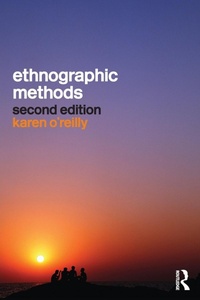
Ethnographic Methods
2nd Edition
Published on 18. November 2011
Book
Paperback/Softback
262 pages
978-0-415-56181-5 (ISBN)
Description
This new edition of Karen O'Reilly's popular Ethnographic Methods provides a comprehensive and accessible introduction to the technical, practical and philosophical issues that arise when employing traditional and innovative research methods in relation to human agents.
Using a wide range of case studies and source material to illustrate the dilemmas and resolutions that an ethnographic researcher may encounter, this textbook guides the reader from the initial design and planning stages through to the analysis and writing-up. It explores the historical and philosophical foundations of ethnographic research and goes on to cover a range of relevant topics such as participant observation, qualitative interviews, (focus) group interviews and visual data collection and analysis.
Having been substantially revised and updated, the second edition includes new discussions of emerging practices such as reflexive ethnography and autoethnographic accounts, as well as an entire chapter dedicated to new directions in the field - including virtual, mobile, multi-sited and global ethnography.
Using a wide range of case studies and source material to illustrate the dilemmas and resolutions that an ethnographic researcher may encounter, this textbook guides the reader from the initial design and planning stages through to the analysis and writing-up. It explores the historical and philosophical foundations of ethnographic research and goes on to cover a range of relevant topics such as participant observation, qualitative interviews, (focus) group interviews and visual data collection and analysis.
Having been substantially revised and updated, the second edition includes new discussions of emerging practices such as reflexive ethnography and autoethnographic accounts, as well as an entire chapter dedicated to new directions in the field - including virtual, mobile, multi-sited and global ethnography.
Reviews / Votes
'There are people who think there is no need to teach Ethnographic methods to students, because they think they are an innate tool of any ethnographers' research equipment. Karen O'Reilly, however, beautifully demonstrates in this book how much can be gained from teaching them. Had I read O'Reilly's book when I did some amateur research on a group of Spanish traditional dancers once, I would certainly have done a better job.''The book is a clear and plainly written introduction to...ethnographic methods and gives useful directions so readers can get a deeper understanding of the subject through further reading and suggested practical experience, one of the best improvements of this second edition. The book has also been expanded and updated in response to the important developments of recent years.'
'In fact, the most arresting feature of the book is O'Reilly's constant defence of the need of rigour, critical thought and an honest reflexion on the limitations and benefits of the research methods used, of being aware of the causes of bias....In the end, one of the strongest impressions the book leaves is that it is not the sophistication of the methods used that gives scientific status to ethnography, but reflexivity and being aware of what you are doing and why. Something, by the way, that is applicable to any scientific discipline and is not always properly stressed.'-Jordi Prats in Significance 'There are people who think there is no need to teach Ethnographic methods to students, because they think they are an innate tool of any ethnographers' research equipment. Karen O'Reilly, however, beautifully demonstrates in this book how much can be gained from teaching them. Had I read O'Reilly's book when I did some amateur research on a group of Spanish traditional dancers once, I would certainly have done a better job.'
'The book is a clear and plainly written introduction to...ethnographic methods and gives useful directions so readers can get a deeper understanding of the subject through further reading and suggested practical experience, one of the best improvements of this second edition. The book has also been expanded and updated in response to the important developments of recent years.'
'In fact, the most arresting feature of the book is O'Reilly's constant defence of the need of rigour, critical thought and an honest reflexion on the limitations and benefits of the research methods used, of being aware of the causes of bias....In the end, one of the strongest impressions the book leaves is that it is not the sophistication of the methods used that gives scientific status to ethnography, but reflexivity and being aware of what you are doing and why. Something, by the way, that is applicable to any scientific discipline and is not always properly stressed.'-Jordi Prats in Significance
More details
Edition
2nd edition
Language
English
Place of publication
London
United Kingdom
Publishing group
Taylor & Francis Ltd
Target group
College/higher education
Dimensions
Height: 234 mm
Width: 156 mm
Thickness: 15 mm
Weight
418 gr
ISBN-13
978-0-415-56181-5 (9780415561815)
Copyright in bibliographic data and cover images is held by Nielsen Book Services Limited or by the publishers or by their respective licensors: all rights reserved.
Schweitzer Classification
Other editions
New editions

Karen O'Reilly
Ethnographic Methods
Book
01/2026
3rd Edition
Routledge
€57.13
The article will not be published
Additional editions
Karen O'Reilly
Ethnographic Methods
Book
11/2011
2nd Edition
Routledge
€233.30
Shipment within 15-20 days
Previous edition
Karen O'Reilly
Ethnographic Methods
Book
09/2004
1st Edition
Routledge
€58.37
Article exhausted; check for reprint
Person
Karen O'Reilly is Professor of Sociology at Loughborough University, where she teaches tourism, migration and advanced ethnographic methods.
Content
1. Introduction: Ethnography as Practice 2. Where to Begin 3. Ethical Ethnography 4. Participating and Observing 5. Interviews: Asking Questions of Individuals and Groups 6. Practical Issues in Interviewing 7. New Directions in Ethnography 8. Ethnographic Analysis 9. Writing and Representation