

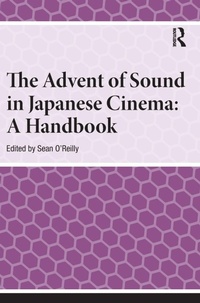
The Advent of Sound in Japanese Cinema
A Handbook
1st Edition
Will be published approx. on 22. January 2026
Book
Hardback
308 pages
978-90-485-7244-1 (ISBN)
Description
The advent of synchronous sound is the most fundamental rupture in the history of cinema. Building on the growing general interest in and the excellent recent scholarship on Japanese cinema's fraught transition to sound, this book paradoxically offers a narrow thematic and chronological focus yet also a broad and diverse range of topics and approaches. Limiting its scope entirely to the 1930s enables this volume to achieve a cohesiveness that is rare in anthologies, while its other strength is its breadth: fifteen very different angles from which to approach the 1930s and the advent of sound offer a clearer picture of the sheer variety of innovations in and reactions to the contested sound transition in Japanese cinema. Part 1 explores the industrial side of film production, with one chapter for each major studio. Part 2 explores the new storytelling possibilities the advent of sound enabled. Part 3 traces the careers of three key yet often overlooked directors, while Part 4 describes the important roles that individual or collective actors played in Japanese cinema during the sound transition. Finally, Part 5 traces the evolution of soundscapes in 1930s Japan, ultimately taking readers beyond the doors of the movie theater to a broader understanding of sound. Many take for granted the seeming superiority of sync sound to silent cinema, but the drawn-out, hotly contested transition to talkies in Japan shows that in the 1930s, neither spectators nor filmmakers necessarily shared this assumption-and perhaps we should not either.
More details
Series
Language
English
Place of publication
Amsterdam
Netherlands
Target group
Professional and scholarly
Academic
Illustrations
57 s/w Zeichnungen, 4 s/w Tabellen, 66 s/w Abbildungen, 9 s/w Photographien bzw. Rasterbilder
4 Tables, black and white; 57 Line drawings, black and white; 9 Halftones, black and white; 66 Illustrations, black and white
Dimensions
Height: 250 mm
Width: 175 mm
Thickness: 22 mm
Weight
750 gr
ISBN-13
978-90-485-7244-1 (9789048572441)
Copyright in bibliographic data and cover images is held by Nielsen Book Services Limited or by the publishers or by their respective licensors: all rights reserved.
Schweitzer Classification
Other editions
Additional editions
E-Book
01/2026
Routledge
€324.99
Available for download
E-Book
01/2026
Routledge
€324.99
Available for download
Person
Sean O'Reilly is Professor of Global Connectivity and Coordinator of the Japan Studies program at Akita International University. A graduate of Harvard University's History and East Asian Languages doctoral program, he completed a secondary field in Film and Visual Studies. His research, which began with a Fulbright Scholarship to Japan, concerns the ways Japanese history has been reinvented in film and popular culture. Publications include Re-viewing the Past: The Uses of History in the Cinema of Imperial Japan (Bloomsbury, 2018) and "The Resurgent Right: The Secret of Japan's Twenty-first Century Cinematic Success" (Journal of Japanese and Korean Cinema, 2023).
Content
Introduction: The Advent of Sound in Japanese Cinema: Soundscapes of the 1930s Part 1: Talkies vs. Tradition: Japanese Movie Studios' 1930s Experimentation 1. P.C.L. and the 1930s "Talkie" Films of Naruse Mikio 2. A Flexible Shochiku Realism: Shimazu Yasujiro and the Introduction of Sound 3. Reevaluating Nikkatsu Talkies: Dubbing During the Transition to Sound Cinema in Japan Part 2: Sounding Them Out: New Genres in 1930s Japan 4. Changing Lyrics, Changing Times: Kaeuta (Parody Song) Culture in Japanese Cinema of the 1930s 5. "Made in Japan": The Birth of Tokusatsu 6. Sounding out Synchrony: Early Experiments with Manga Eiga and Sound Part 3: Finding Their Voice: The Woes and Wows of Great Directors in 1930s Japan 7. Japan's "Best One" of 1939: Why Uchida Tomu's Earth Won the Top Critics' Prize in an Extraordinary Year 8. Restricting the Soundscape: Aural Minimalism in Tasaka Tomotaka's War Films 9. Image-Grammar: Shimazu Yasujiro and Film Language Part 4: Speaking Up: Actors' Struggles with the Silent-to-Sound Transition in 1930s Japan 10. Magnetic Nonchalance: Actor Saburi Shin's Performances and Performativity in 1930s Shochiku Films 11. The Narutaki-Zenshin Collaboration: Creative Vanguards and Networks Advancing Period Film Conventions 12. Rhythms in Migration: Whispering Sidewalks and Japan's Jazz Age Cinema Interlude. Acting out the Soundscape: Enoken Plays Kondo Isami Part 5: Movie Musicality: Soundscapes of the 1930s 13. From Silent to Talkie Soundscapes: Transforming Sounds and New Subjectivity 14. The Relationship between Ozu Yasujiro's Signature Style and the Soundscape in The Only Son 15. Dreamworlds: The Cinema and the Department Store Appendix: The Advent of Sound: Timeline