

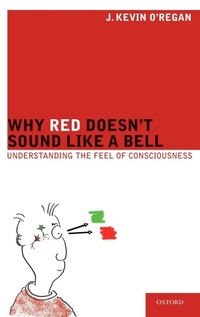
Why Red Doesn't Sound Like a Bell
Understanding the feel of consciousness
1st Edition
Published on 7. July 2011
Book
Hardback
224 pages
978-0-19-977522-4 (ISBN)
Description
This book proposes a novel view to explain how we as humans -- contrary to current robots -- can have the impression of consciously feeling things: for example the red of a sunset, the smell of a rose, the sound of a symphony, or a pain.
The book starts off by looking at visual perception. Our ability to see turns out to be much more mysterious than one might think. The eye contains many defects which should seriously interfere with vision. Yet we have the impression of seeing the world in glorious panavision and technicolor. Explaining how this can be the case leads to a new idea about what seeing really is. Seeing is not passively receiving information in the brain, but rather a way of interacting with the world. The role of the brain is not to create visual sensation, but to enable the necessary interactions with the world.
This new approach to seeing is extended in the second part of the book to encompass the other senses: hearing, touch, taste and smell. Taking sensory experiences to be modes of interacting with the world explains why these experiences are different in the way they are. It also explains why thoughts or automatic functions in the body, and indeed the vast majority brain functions, are not accompanied by any real feeling.
The "sensorimotor" approach is not simply a philosophical argument: It leads to scientifically verifiable predictions and new research directions. Among these are the phenomena of change blindness, sensory substitution, "looked but failed to see", as well as results on color naming and color perception and the localisation of touch on the body.
The approach is relevant to the question of what animals and babies can feel, and to understanding what will be necessary for robots to become conscious.
The book starts off by looking at visual perception. Our ability to see turns out to be much more mysterious than one might think. The eye contains many defects which should seriously interfere with vision. Yet we have the impression of seeing the world in glorious panavision and technicolor. Explaining how this can be the case leads to a new idea about what seeing really is. Seeing is not passively receiving information in the brain, but rather a way of interacting with the world. The role of the brain is not to create visual sensation, but to enable the necessary interactions with the world.
This new approach to seeing is extended in the second part of the book to encompass the other senses: hearing, touch, taste and smell. Taking sensory experiences to be modes of interacting with the world explains why these experiences are different in the way they are. It also explains why thoughts or automatic functions in the body, and indeed the vast majority brain functions, are not accompanied by any real feeling.
The "sensorimotor" approach is not simply a philosophical argument: It leads to scientifically verifiable predictions and new research directions. Among these are the phenomena of change blindness, sensory substitution, "looked but failed to see", as well as results on color naming and color perception and the localisation of touch on the body.
The approach is relevant to the question of what animals and babies can feel, and to understanding what will be necessary for robots to become conscious.
Reviews / Votes
For readers of Perception, O'Regan's Why Red Doesn't Sound Like a Bell provides for a well-argued criticism of and a strong alternative to deterministic perspectives on perception and its role in consciousness. * Perception *More details
Language
English
Place of publication
New York
United States
Target group
Cognitive psychologists, neuroscientists, graduate students
Illustrations
42 illustrations
Dimensions
Height: 240 mm
Width: 161 mm
Thickness: 17 mm
Weight
505 gr
ISBN-13
978-0-19-977522-4 (9780199775224)
Copyright in bibliographic data and cover images is held by Nielsen Book Services Limited or by the publishers or by their respective licensors: all rights reserved.
Schweitzer Classification
Other editions
Additional editions
E-Book
08/2011
OUP eBook
€39.49
Available for download
Person
Kevin O'Regan is director of one of France's most influential experimental psychology laboratories. He is most cited today as the originator of the sensorimotor approach to consciousness. He is also one of the discovers of the much discussed phenomenon of "change blindness", and well known for his work on eye movements in reading.
Content
PART 1: THE FEEL OF SEEING ; 1. The catastrophe of the eye ; 2. A new view of seeing ; 3. Applying the new view of seeing ; 4. The illusion of seeing everything ; 5. Some contentious points ; PART 2: THE FEEL OF CONSCIOUSNESS ; 6. Towards consciousness ; 7. Types of consciousness ; 8. Phenomenal consciousness, raw feel, and why they're hard ; 9. Squeeze a sponge, drive a Porsche: a sensorimotor account of feel ; 10. Consciously experiencing a feel ; 11. The sensorimotor approach to color ; 12. Sensory substitution ; 13. The localization of touch ; 14. The phenomenality plot ; 15. Consciousness