

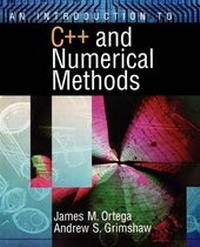
An Introduction to C++ and Numerical Methods
Published on 27. August 1998
Book
Paperback/Softback
288 pages
978-0-19-511767-7 (ISBN)
Description
In addition to being an introduction to C++, this text also provides clear explanations of the basics of numerical methods, and is unique for its coverage of numerical methods used in scientific and engineering computation. In addition there is a general discussion of some of the basic paradigms for writing good programs and detecting errors. The result is a brief yet comprehensive treatment of the subject.
Reviews / Votes
"An excellent introduction to both C++ and numerical methods. The writing is clear, concise, and very readable. A great book!"--Anton Kruger, The University of Iowa"Ortega and Grimshaw direct their book toward undergraduate students taking a course of study in numerical methods. Unlike many earlier books written for use with the BASIC or FORTRAN programming languages, this one gives the reader an introduction to implementing numerical methods using C++. Since C++ is likely one of the more widely used languages of the current day in engineering and science, this treatment is very appropriate. No previous programming
experience is required to use this book. The authors take a very gentle and gradual approach to introducing programming concepts. Nevertheless, a significant number of numerical methods are covered . . . The
quality of the presentation is high, and the book includes a generous number of figures and tables. Undergraduates."--Choice
"This is an excellent text and the Instructor's Manual is very helpful. The numerous examples from engineering make this the best text for engineering courses in C++."--Rolph W. Pike, Louisian State University
More details
Language
English
Place of publication
New York
United States
Target group
College/higher education
Illustrations
line figures
Dimensions
Height: 233 mm
Width: 189 mm
Thickness: 14 mm
Weight
504 gr
ISBN-13
978-0-19-511767-7 (9780195117677)
Copyright in bibliographic data and cover images is held by Nielsen Book Services Limited or by the publishers or by their respective licensors: all rights reserved.
Schweitzer Classification
Content
Part 1 Basic Constructs ; Chapter 1: Introduction ; 1.1 Computers and Software ; 1.2 Binary Number and Memory ; 1.3 Rounding Errors ; 1.4 Programs ; Chapter 2: A First C++ Program ; 2.1 Computation and Assignment ; 2.2 Variable Types ; 2.3 Input and Output ; 2.4 A complete Program ; 2.5 Errors and Debugging ; Chapter 3 Decisions ; 3.1 The if Statement ; 3.2 Logical Operators ; 3.3 Nested If and Switch Statements ; 3.4 Good Programming Practice ; Chapter 4 Around and Around: iteration ; 4.1 The for statement ; 4.2 The while Statement ; 4.3 An Approximation to ex ; 4.4 Advanced Loop Control ; Chapter 5 Functions ; 5.1 Library Functions ; 5.2 User-Defined Functions ; 5.3 More General Functions ; 5.4 Local vs. Global Variables ; Chapter 6 Numerical Integration ; 6.1 Approximate Integration Formulas ; 6.2 Flow Charts ; 6.3 An Integration Program ; 6.4 Discretization Error ; Chapter 7 Reading and Writing: Input/Output ; 7.1 Precision ; 7.2 Spacing ; 7.3 File Input/Output ; 7.4 The print () Function ; Chapter 8 Solution of Nonlinear Equations ; 8.1 The Bisection Method ; 8.2 Newton's Method ; 8.3 Errors and Combined Method ; Chapter 9 Lots of Values: Arrays ; 9.1 Array Declarations ; 9.2 Arrays and Functions ; Chapter 10 Differential Equations ; 10.1 The Initial Value Problem ; m 10.2 Euler's Method ; 10.3 Systems of Equations ; Part II Extensions of the Basic Constructs ; Chapter 11 More on Data Types and Operations ; 11.1 Other Fundamental Data Types ; 11.2 Operations ; 11.3 Characters and Strings ; 11.4 User-Defined Data Types ; Chapter 12 Lots More Values: Two-Dimensional Arrays ; 12.1 Two-Dimensional Arrays ; 12.2 Arrays and Functions ; 12.3 Arrays of Strings ; Chapter 13 Linear Equations ; 13.1 Least Squares Approximation ; 13.2 Gaussian Elimination ; 13.3 Errors ; 13.4 Efficiency ; Chapter 14 More on Functions ; 14.1 Reference versus Value ; 14.2 Recursive and Inline Functions ; 14.3 Function Miscellanea ; 14.4 Libraries of Functions ; Chapter 15 Pointers ; 15.1 Pointer Variables ; 15.2 Pointers and Arrays ; 15.3 Pointers and Functions ; 15.4 Pointers and Strings ; Chapter 16 Dynamic Memory ; 16.1 Dynamic Memory Allocation ; 16.2 Matrices and Strings ; 16.3 Linked Lists ; Part III Object-Oriented Programming ; Chapter 17 Classes and Objects ; 17.1 A Simple Class ; 17.2 Classes and Functions ; Chapter 18 Array Classes and Dynamic Memory ; 18.1 A Vector Class ; 18.2 Dynamic Memory Allocation ; 18.3 A Matrix Class ; Chapter 19 Inheritance ; 19.1 Derived Classes ; 19.2 Polymorphism and Virual Functions ; 19.3 Linear Equations ; Further Reading ; Appendix 1 ASCII Character Codes ; Appendix 2 Library Functions ; Index