

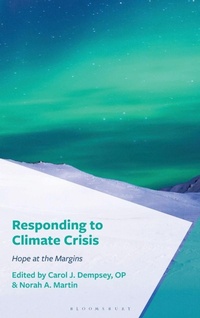
Responding to Climate Crisis
Hope at the Margins
Published on 30. April 2026
Book
Hardback
248 pages
978-1-9787-1557-8 (ISBN)
Description
Earth and all its communities of life are experiencing a climate crisis, a phrase broadly understood here as the disruption of the Earth's systems. This disruption, caused by social, political, economic, cultural, and ecological turmoil, upheaval, and violence, negatively affects the atmosphere in which life exists.
In the midst of such disruption, how can we have hope? And, if we can, where can we find it and keep it alive? This edited collection brings together the work of thirteen theologians, philosophers, and scientists from disparate parts of our shared Earth to continue the efforts of Thomas Berry in arguing that hope can be found even in the midst of global crises. Though each essay offers a different vision of hope, they agree with Berry's vision of shifting to an Earth-centered world from a human-centered one. Through this radical shift, we see ourselves as not alone but rather woven within a network of living communities equally affected by devastating changes. By collaborating with other-than-human communities on this planet, the scholars herein reconceptualize hope, thereby challenging traditional ways of thinking about and solutions for today's multi-layered issues. When those on the margins of life are seen, heard, respected, cherished, and listened to, then hope flourishes and all life recovers its vibrancy.
In the midst of such disruption, how can we have hope? And, if we can, where can we find it and keep it alive? This edited collection brings together the work of thirteen theologians, philosophers, and scientists from disparate parts of our shared Earth to continue the efforts of Thomas Berry in arguing that hope can be found even in the midst of global crises. Though each essay offers a different vision of hope, they agree with Berry's vision of shifting to an Earth-centered world from a human-centered one. Through this radical shift, we see ourselves as not alone but rather woven within a network of living communities equally affected by devastating changes. By collaborating with other-than-human communities on this planet, the scholars herein reconceptualize hope, thereby challenging traditional ways of thinking about and solutions for today's multi-layered issues. When those on the margins of life are seen, heard, respected, cherished, and listened to, then hope flourishes and all life recovers its vibrancy.
Reviews / Votes
This book is path breaking with its skillful weaving of urgency and action in response to our growing environmental challenges. In drawing on Thomas Berry's insights, it invites us to embrace the living Earth community in which we dwell. Its clarion call to shifting of worldviews and transformative engagement is keenly needed at present around the planet. * Mary Evelyn Tucker, co-author of Thomas Berry: A Biography, Ecology and Religion, and Journey of the Universe *More details
Series
Language
English
Place of publication
United States
Publishing group
Bloomsbury Publishing Plc
Target group
Professional and scholarly
Dimensions
Height: 235 mm
Width: 157 mm
Thickness: 18 mm
Weight
515 gr
ISBN-13
978-1-9787-1557-8 (9781978715578)
Copyright in bibliographic data and cover images is held by Nielsen Book Services Limited or by the publishers or by their respective licensors: all rights reserved.
Schweitzer Classification
Other editions
Additional editions
E-Book
02/2026
1st Edition
Lexington Books/Fortress Academic
€94.99
Available for download
E-Book
02/2026
1st Edition
Lexington Books/Fortress Academic
€94.99
Available for download
Persons
Carol J. Dempsey, OP, is Professor of Theology and Religious Studies (Biblical Studies) at the University of Portland.
Norah A. Martin is Professor of Philosophy and Environmental Studies at the University of Portland.
Norah A. Martin is Professor of Philosophy and Environmental Studies at the University of Portland.
Content
Introduction: Carol J. Dempsey, OP and Norah Martin
Chapter One: Exile and Return: Empathy, Hope, and the Awakening of a New Diaspora: Michael Andrews
Chapter Two: Radical Hope: Civil Society Confronts Climate Justice in Small Island Developing States: Neil Oculi, Kieran Maynard, and Mark A. Boyer
Chapter Three: Destructive Hope? Apocalypse as Queer Eco-Spiritual Practice: Brandy Daniels
Chapter Four: Neo-liberal Mining in the Philippines: Destruction, Resistance, Re-Envisioning: Christina A. Astorga
Chapter Five: Climate Hope through the Land: An Indigenous Decolonial Framework for Post-Apocalyptic Climate Hope: Brian Burkhart
Chapter Six: Rays of Hope: The Bible between Environmental and Indigenous Concerns in the Church of Norway: Tina Dykesteen Nilsen
Chapter Seven: Dalit Earth: Listening to the Ecological Wisdom of the Broken People: Joshua Samuel
Chapter Eight: Ground of Being: Reading Psalm 37 with the Maasai: Beth E. Elness-Hanson
Chapter Nine: African Traditional Notion of Vitality as a Pathway to Eco-intimacy: Mark Omorovie Ikeke
Chapter Ten: A Community of Subjects is a Community of Conscious Beings: Non-Human Consciousness and a New Environmental Vision: Norah Martin
Chapter Eleven: Voices of the Wilderness: Ecospiritual and Ecotherapeutic Practices for Cultivating Intimacy with the More-Than-Human World: Rachel Wheeler
Chapter Twelve: Shifting Paradigms to Embrace a Cosmic Consciousness: Carol J. Dempsey, OP
Epilogue: Earth Democracy: The Democracy of All Being: Vandana Shiva
Chapter One: Exile and Return: Empathy, Hope, and the Awakening of a New Diaspora: Michael Andrews
Chapter Two: Radical Hope: Civil Society Confronts Climate Justice in Small Island Developing States: Neil Oculi, Kieran Maynard, and Mark A. Boyer
Chapter Three: Destructive Hope? Apocalypse as Queer Eco-Spiritual Practice: Brandy Daniels
Chapter Four: Neo-liberal Mining in the Philippines: Destruction, Resistance, Re-Envisioning: Christina A. Astorga
Chapter Five: Climate Hope through the Land: An Indigenous Decolonial Framework for Post-Apocalyptic Climate Hope: Brian Burkhart
Chapter Six: Rays of Hope: The Bible between Environmental and Indigenous Concerns in the Church of Norway: Tina Dykesteen Nilsen
Chapter Seven: Dalit Earth: Listening to the Ecological Wisdom of the Broken People: Joshua Samuel
Chapter Eight: Ground of Being: Reading Psalm 37 with the Maasai: Beth E. Elness-Hanson
Chapter Nine: African Traditional Notion of Vitality as a Pathway to Eco-intimacy: Mark Omorovie Ikeke
Chapter Ten: A Community of Subjects is a Community of Conscious Beings: Non-Human Consciousness and a New Environmental Vision: Norah Martin
Chapter Eleven: Voices of the Wilderness: Ecospiritual and Ecotherapeutic Practices for Cultivating Intimacy with the More-Than-Human World: Rachel Wheeler
Chapter Twelve: Shifting Paradigms to Embrace a Cosmic Consciousness: Carol J. Dempsey, OP
Epilogue: Earth Democracy: The Democracy of All Being: Vandana Shiva