

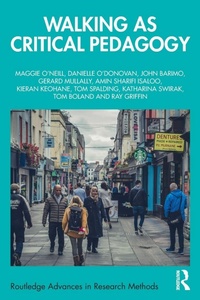
Walking as Critical Pedagogy
1st Edition
Published on 16. September 2025
Book
Paperback/Softback
166 pages
978-1-032-94248-3 (ISBN)
Description
Defining the principles and practices of walking as critical pedagogy, this book engages with social questions and challenges related to understandings of the Anthropocene.
Through a series of chapters that operationalize walking as a form of participatory pedagogy, it explores issues including migration and borders, sustainability and climate change, gender and feminist thought, the labour market, crime and rehabilitation, and urban life and regeneration. Showing how walking enables us to learn creatively, convivially and critically on the move in city spaces, while thinking relationally, the authors demonstrate the importance of space, time and place: the layers of history embedded in the present, and the importance of active, embodied, participatory, collaborative, creative and place based learning.
A pioneering approach to walking as a form of engagement and learning, Walking as Critical Pedagogy will appeal to researchers and students across the social sciences interested in new methods and research methodologies, and creative ways of teaching and learning about - and engaging with - major global issues in society.
Through a series of chapters that operationalize walking as a form of participatory pedagogy, it explores issues including migration and borders, sustainability and climate change, gender and feminist thought, the labour market, crime and rehabilitation, and urban life and regeneration. Showing how walking enables us to learn creatively, convivially and critically on the move in city spaces, while thinking relationally, the authors demonstrate the importance of space, time and place: the layers of history embedded in the present, and the importance of active, embodied, participatory, collaborative, creative and place based learning.
A pioneering approach to walking as a form of engagement and learning, Walking as Critical Pedagogy will appeal to researchers and students across the social sciences interested in new methods and research methodologies, and creative ways of teaching and learning about - and engaging with - major global issues in society.
Reviews / Votes
'This sparkling, accessible collection makes a significant and unique contribution to academic discussions about walking as critical pedagogy. In their different approaches to roaming through the layered historical palimpsest of the city and its vital, myriad spaces, the authors, students and other participants experience, conceive and imagine the city otherwise, disclosing a wealth of sensory, theoretical and historical insights. In attuning to the pedestrian experiences of forgotten and overlooked urban inhabitants - women, migrants, the unemployed and recently incarcerated - this book offers an interdisciplinary and inclusive approach that foregrounds lived experiences and avoids theoretical and methodological purism.'- Tim Edensor, Emeritus Professor of Social and Cultural Geography at the Institute of Place Management, Manchester Metropolitan University, UK
'Walking as Critical Pedagogy brings a fascinating set of experiences and perspectives from applying walking methods to understand the City from collaborative processes. In critical dialogue with the legacy of Paulo Freire, this book creatively shows the possibilities of walking for research and teaching- definitely, a joy to read and learn.'
- Ligia Ferro, Professor of Sociology at the University of Porto, Portugal
'I have indelible memories of walk-and-talks with classmates in graduate school. Walking has been an integral part of my thinking and reflecting-with others or alone. The editors have had the brilliant idea of devoting a fascinating volume to the time-honored peripatetic approach. Reading it will refresh and inspire.'
- Professor Alfonso Montouri, California Institute of Integral Studies, San Franscisco
More details
Series
Language
English
Place of publication
London
United Kingdom
Publishing group
Taylor & Francis Ltd
Target group
College/higher education
Postgraduate and Undergraduate
Illustrations
20 s/w Abbildungen, 15 s/w Photographien bzw. Rasterbilder, 5 s/w Zeichnungen
5 Line drawings, black and white; 19 Halftones, black and white; 24 Illustrations, black and white
Dimensions
Height: 234 mm
Width: 156 mm
Thickness: 10 mm
Weight
289 gr
ISBN-13
978-1-032-94248-3 (9781032942483)
Copyright in bibliographic data and cover images is held by Nielsen Book Services Limited or by the publishers or by their respective licensors: all rights reserved.
Schweitzer Classification
Other editions
Additional editions
Maggie O'Neill | Danielle O'Donovan | John Barimo
Walking as Critical Pedagogy
E-Book
09/2025
1st Edition
Routledge
€55.49
Available for download
Maggie O'Neill | Danielle O'Donovan | John Barimo
Walking as Critical Pedagogy
Book
09/2025
1st Edition
Routledge
€207.20
Shipment within 10-20 days
Maggie O'Neill | Danielle O'Donovan | John Barimo
Walking as Critical Pedagogy
E-Book
09/2025
1st Edition
Routledge
€55.49
Available for download
Persons
Maggie O'Neill is Professor in Sociology & Criminology and Director of the Institute for Social Sciences in the 21st Century and UCC Futures: Collective Social Futures at University College Cork, Ireland. She is the co-author of Walking Methods: Research on the Move.
Danielle O'Donovan is an architectural historian, heritage consultant and Director of The Butter Museum, Cork.
John Barimo is Manager of the Sustainable Development Solutions Network Ireland, Office of Sustainability and Climate Action, University College Cork, Ireland.
Gerard Mullally is Senior Lecturer in the Department in Sociology and Criminology at University College Cork, Ireland.
Amin Sharifi Isaloo is Lecturer in the Department in Sociology and Criminology at University College Cork, Ireland.
Kieran Keohane is Professor in the Department of Sociology and Criminology at University College Cork, Ireland. He is the co-editor of Late Modern Subjectivity and Its Discontents and The Social Pathologies of Contemporary Civilization.
Tom Spalding is Lecturer in the Department of Media Communications at Munster Technological University, Cork, Ireland.
Katharina Swirak is Senior Lecturer in Criminology and Sociology at University College Cork, Ireland.
Tom Boland is Senior Lecturer in Sociology and Head of Department of Sociology and Criminology at University College Cork, Ireland. He is the author of The Spectacle of Critique.
Ray Griffin is Senior Lecturer in Organisation Studies at the South East Technological University, Waterford, Ireland.
Danielle O'Donovan is an architectural historian, heritage consultant and Director of The Butter Museum, Cork.
John Barimo is Manager of the Sustainable Development Solutions Network Ireland, Office of Sustainability and Climate Action, University College Cork, Ireland.
Gerard Mullally is Senior Lecturer in the Department in Sociology and Criminology at University College Cork, Ireland.
Amin Sharifi Isaloo is Lecturer in the Department in Sociology and Criminology at University College Cork, Ireland.
Kieran Keohane is Professor in the Department of Sociology and Criminology at University College Cork, Ireland. He is the co-editor of Late Modern Subjectivity and Its Discontents and The Social Pathologies of Contemporary Civilization.
Tom Spalding is Lecturer in the Department of Media Communications at Munster Technological University, Cork, Ireland.
Katharina Swirak is Senior Lecturer in Criminology and Sociology at University College Cork, Ireland.
Tom Boland is Senior Lecturer in Sociology and Head of Department of Sociology and Criminology at University College Cork, Ireland. He is the author of The Spectacle of Critique.
Ray Griffin is Senior Lecturer in Organisation Studies at the South East Technological University, Waterford, Ireland.
Author
University College Cork, Ireland
University College Cork, Ireland
University College Cork, Ireland
University College Cork, Ireland
University College Cork, Ireland
University College Cork, Ireland
Waterford Institute of Technology, Ireland
Southeast Technological University Waterford, Ireland
Content
Introduction: Walking as Critical Pedagogy - Principles and Practice, 1 Walking as Critical pedagogy: A feminist walk in Cork, 2 Walking through the Anthropocene: Pathways to sustainability?, 3. Migration, Liminality and Place:walking as critical pedagogy, 4.Cork's 'Wandering Rocks': walking as urban sociology, 5. Layers - Walking Through Time on the Streets of Cork: Walking as Reformative and Transgressive, 6. Walking, Crime, Justice and Reintegration , 7. Seeing the labour market unfold: Encounters on the street-level