

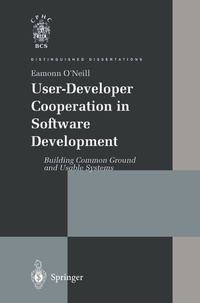
User-Developer Cooperation in Software Development
Building Common Ground and Usable Systems
Published on 2. October 2012
Book
Paperback/Softback
XIII, 317 pages
978-1-4471-1072-9 (ISBN)
Description
The topic of the research reported here is direct user participation in the task-based development of interactive software systems. Building usable software demands understanding and supporting users and their tasks. Users are a primary source of usability requirements and knowledge, since users can be expected to have intimate and extensive knowledge of themselves, their tasks and their working environment. Task analysis approaches to software development encourage a focus on supporting users and their tasks while participatory design approaches encourage users' direct, active contributions to software development work. However, participatory design approaches often concentrate their efforts on design activities rather than on wider system development activities, while task analysis approaches generally lack active user participation beyond initial data gathering. This research attempts an integration of the strengths of task analysis and user participation within an overall software development process. This work also presents detailed empirical and theoretical analyses of what it is for users and developers to cooperate, of the nature of user-developer interaction in participatory settings. Furthermore, it makes operational and assesses the effectiveness of user participation in development and the impact of user-developer cooperation on the resulting software product. The research addressed these issues through the development and application of an approach to task based participatory development in two real world development projects. In this integrated approach, the respective strengths of task analysis and participatory design methods complemented each other's weaker aspects.
More details
Series
Edition
Softcover reprint of the original 1st ed. 2001
Language
English
Place of publication
London
United Kingdom
Target group
Professional and scholarly
Research
Illustrations
XIII, 317 p.
Dimensions
Height: 235 mm
Width: 155 mm
Thickness: 19 mm
Weight
511 gr
ISBN-13
978-1-4471-1072-9 (9781447110729)
DOI
10.1007/978-1-4471-0355-4
Schweitzer Classification
Other editions
Additional editions
Eamonn O'Neill
User-Developer Cooperation in Software Development
Building Common Ground and Usable Systems
E-Book
12/2012
Springer
€96.29
Available for download
Eamonn O'Neill
User-Developer Cooperation in Software Development
Building Common Ground and Usable Systems
Book
02/2001
Springer
€106.99
Shipment within 15-20 days
Content
1: Introduction.- 1.1 Background.- 1.2 Problem Statement.- 1.3 Research Approach.- 1.4 Results and Contributions Made.- 1.5 Outline of Chapters.- 2: A Longitudinal View on Software Development and Participation.- 2.1 Computer Systems Development: Changing Constraints.- 2.2 Participatory Design.- 2.3 Giving the Users What They Want: Effective HCI.- 2.4 Where Are We Now?.- 2.5 Research Questions Raised.- 3: The Projects and Their Analysis.- 3.1 The Development Method.- 3.2 The Development Projects Studied.- 3.3 Data Available from the Projects.- 3.4 Research Method.- 4: Towards a Theory of User-Developer Cooperation.- 4.1 Developing Interaction Analysis.- 4.2 The Construction of Shared Understandings.- 4.3 Cooperative Development and Common Ground.- 4.4 Conclusion.- 5: Effective Participation: Contributing to Discourse and Artefacts.- 5.1 The Nature of Participation: Contributing to Discourse.- 5.2 Were the Studied Projects Participatory.- 5.3 Effective Participation: Contributing to Artefacts.- 5.4 Conclusion.- 6: User Participation and Software Usability.- 6.1 Evaluating the Software.- 6.2 Summary of the Usability Evaluation Results.- 6.3 Tracing Relationships Between Contributions, Software Features and Usability.- 6.4 Results of Tracing Analysis.- 6.5 Discussion.- 6.6 Conclusion.- 7: Task-Based Cooperative Development: Conclusions.- 7.1 Summary.- 7.2 Lessons and Limitations.- 7.3 Future Work.